
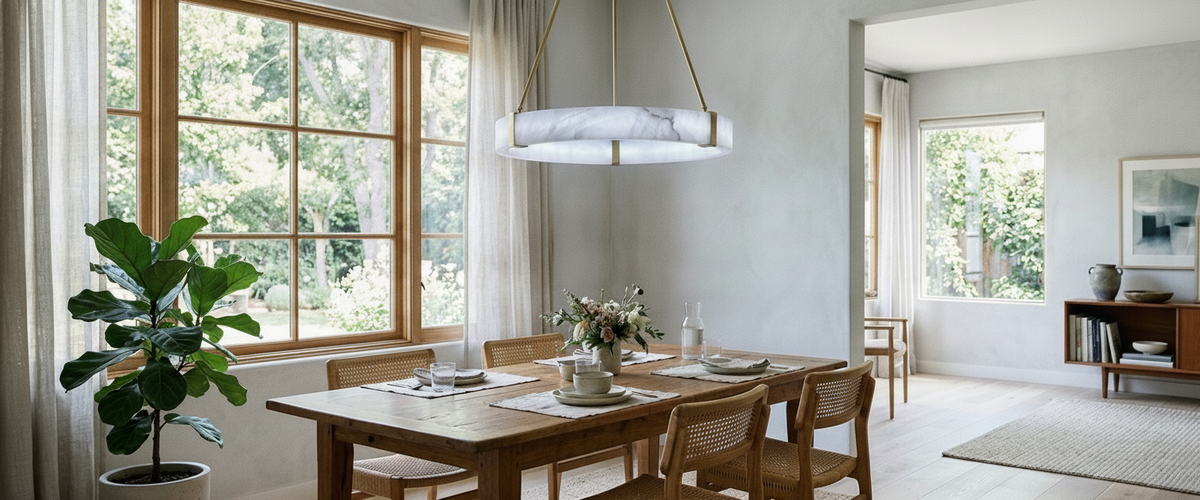

Quick answer: modern chandeliers dining room sizing comes down to three numbers. Hang the lowest point of the fitting 76 to 86cm (30 to 34in) above the tabletop on a standard 2.4m (8ft) ceiling, size it at roughly half to two-thirds of the table width and never closer than 30cm (12in) to either long edge, then light it at 2700K with a CRI of 90 or above on a trailing-edge dimmer. Shape follows the table: linear bars for rectangles, rings for rounds and squares, clusters for rooms that need softness rather than symmetry. Diffused stone such as alabaster flatters faces at seated eye level; an exposed filament only flatters the fitting. Get those decisions right and the piece still looks correct in five years.
A dining chandelier gets judged twice: on the day it goes up, and five years later, when the trend that sold it has quietly dated and you are still eating dinner underneath it. This guide is built around that second verdict. Modern chandeliers dining room decisions live or die on two things: the silhouette above the table, and the quality of the light landing on the people around it. Everything below is the method we use with clients, from the shapes that suit real tables to the finishes that age well, the heights and diameters worth measuring twice, and the trend traps we still watch people fall into. You can see the range we work from in the dining room chandeliers collection.

At a Glance
Match the shape to the table. Linear bars for rectangles over 1.8m (6ft), rings for rounds and squares, clusters for tables that need softness rather than symmetry.
Hang the base 76 to 86cm (30 to 34in) above the tabletop on a standard 2.4m (8ft) ceiling, adding roughly 7.5cm (3in) per extra foot of ceiling height.
Size it at roughly half to two-thirds of the table width, never wider than the table minus 30cm (12in) of clearance each side.
Diffused stone flatters people; bare filament flatters the fitting. Alabaster and marble soften glare at eye level.
Airy frames age better than dense ones. Negative space is doing real design work.
Dim it. 2700K, CRI 90 or above, on a trailing-edge dimmer installed by a qualified electrician.

Three Modern Chandeliers Dining Room Silhouettes and the Tables They Suit
Most modern chandeliers dining room shortlists fall into three families, and the table underneath decides which one is right long before taste does.
The linear bar is the workhorse for rectangular tables. It tracks the length of the table, spreads light evenly down the centre line, and keeps sightlines clear across the width. Aim for a bar that runs roughly half to two-thirds of the table length, leaving visual breathing room at both ends. A carved alabaster bar reads calmer than a metal one because the stone itself glows; the fitting becomes a soft band of light rather than a row of hardware.
The ring suits round and square tables, where a linear form would look stranded. Rings work because they give you a strong outline with an empty middle, so the eye keeps travelling through to the wall behind. On a 1.4m (55in) round table, a ring of around 80 to 90cm reads generous without crowding.
The cluster is the least literal of the three: a group of stone or glass shades hung at staggered drops from a single canopy. It suits rooms where the architecture is already busy, or where you want light to feel gathered rather than engineered. Clusters are also the most forgiving over a table that is slightly off-centre in the room, because there is no strict axis to betray you.
Fixture Size by Table Size
1.2m (48in) round table: a ring or cluster of roughly 60 to 80cm across.
1.4m (55in) round table: a ring of roughly 80 to 90cm.
1.8m (6ft) rectangular table: a linear bar of roughly 90 to 120cm.
2.1m (7ft) rectangular table: a linear bar of roughly 105 to 140cm.
2.4m (8ft) or longer: two matched pendants, or a multi-light bar of at least 150cm.
Why Matt Black Reads Graphic and Polished Chrome Still Reads 2008
Finish dates modern chandeliers dining room fittings faster than form does. Matt black frames have held up because they behave like a drawn line: they define the shape and then get out of the way, especially against pale plaster or a soft grey wall. Where a six-seat table needs structure without visual weight, a slim black frame such as Brianna 6 Light Chandelier, Black holds the outline while leaving most of the ceiling visible through it. Blackened brass and bronze do something similar with more warmth in the reflection.
Polished chrome struggles for a different reason. It mirrors everything around it, including the ceiling spots, and those reflections carry a cold cast. In a dining room lit for the evening, that coldness fights the candlelight and the wine glasses. Antique or brushed brass is the safer warm metal, particularly alongside stone, because the two age in the same direction. If the room is already warm in tone, a softened gold finish like the one on Kristy 3 Light Chandelier, Distressed Gold picks up candlelight rather than bouncing it back cold.
One practical note from the studio: if you already have brassware on a sideboard or ironmongery on the doors, do not chase an exact match. Fittings in the same finish family but a different sheen look intentional. Identical finishes look like a showroom set.
Exposed Filament or Diffused Stone: The Real Dividing Line
This is the decision that changes the room, and it is not really about style. It is about where the brightest point in the room sits relative to a seated person's eyes.
An exposed filament bulb puts a small, intense source directly in your guests' field of view. It photographs beautifully and it is uncomfortable to sit under for two hours. Diffused stone does the opposite. Alabaster is translucent enough to carry light through its thickness, so the whole shade becomes the source: broad, low in luminance, warm in tone. Faces look better because the light wraps rather than spikes.
Alabaster is a gypsum stone, soft enough to be carved into thin translucent panels, which is exactly why it has been used for light-transmitting windows and lamps for centuries. It is also water-soluble, which shapes how you clean it (more on that below). The British Geological Survey is the place to start if you want the geology behind the material rather than the marketing copy.
The three stones behave differently once they are lit:
Alabaster: the most even glow across the whole panel, warm and predictable, and the most flattering at seated eye level.
Marble: denser, so it tends to glow at the edges and thinner sections rather than across the full face. Quieter, more architectural.
Onyx: dramatic banding and a warm amber cast. Quiet by day, theatrical at night, and the least consistent piece to piece.
Bulbs and Dimming
Colour temperature: 2700K for most dining rooms; 2400K if the scheme is very warm and layered with candles.
Colour rendering: CRI 90 or higher, or food and skin tones go flat.
Dimming: specify dimmable lamps and a trailing-edge dimmer suited to LED loads. Dim-to-warm lamps drop towards 2200K as you lower them, which mimics candlelight.
Output: a stone chandelier absorbs some light, so plan slightly more lumens than a bare-bulb fitting of the same size.
Wiring: ceiling fixtures should be installed by a qualified electrician working to the current wiring regulations. Guidance from bodies such as NICEIC is worth reading before you book anyone.
Negative Space Is the Material
Look at the modern chandeliers dining room fittings that still hold up after a decade and they share one quality: you can see through them. An open ring, a slim bar, a cluster with air between the shades. The empty space is doing as much work as the metal and stone, because it lets the room breathe and keeps the fitting from turning into a solid object hanging over your dinner.
Dense fittings, by contrast, become a lid. Anything with tiered crystal, heavy stacked drums or a closed body will visually lower a ceiling, and in a room where people sit for hours, that is felt rather than noticed. If your ceiling is under 2.4m (8ft), open frames are close to compulsory. Niori's alabaster pieces work well here because the stone panels are thin and translucent, so even a substantial silhouette stays visually light once it is switched on. It is worth browsing the alabaster lighting collection with that filter in mind: how much of the ceiling can you still see?
Trend Traps We Still See Over Dining Tables
These are the modern chandeliers dining room trends we still talk clients out of, and the reason each one fails over a table rather than in a photograph.
The Sputnik. Radiating arms with bare bulbs on the ends. It was a genuine mid-century form; it became a rental-flat cliche across the mid-2010s. Over a dining table it also scatters glare in every direction, including straight at your guests.
Caged Edison bulbs. Industrial cages made sense in a warehouse. Above a walnut table with upholstered chairs, they look like a costume.
The oversized statement piece. Scale is powerful, but a fitting that dominates a modest room stops being architecture and starts being an obstacle. Test the width against the table, not against the ceiling.
Cool white LED. The fastest way to make an expensive fitting look cheap. Anything above 3000K in a dining room reads clinical.
Matching everything. A chandelier, wall lights and table lamps all drawn from the same series feels catalogue-bought. Vary the scale and keep one material thread running through instead.
How Your Table Finish and Chair Backs Decide the Right Chandelier
A high-gloss lacquered or glass table reflects the fitting back at you, so whatever you hang becomes two objects. Diffused stone survives this test; a mass of exposed bulbs does not, because you get a second constellation of glare in the tabletop. Matt oak, limed timber and honed stone tables absorb reflection and give you more freedom.
Chair backs matter more than people expect. Tall, solid upholstered backs create a strong horizontal band around the table, and a low-hanging dense chandelier sitting just above them makes the whole arrangement feel compressed. With high-backed chairs, favour a slim linear bar or a ring hung towards the upper end of the recommended range. With low, open-backed chairs you have room for a cluster with staggered drops.
Long tables over 2.4m (8ft) often want two matched pendants rather than one chandelier, or a single fitting with enough lamps to cover the length. Where one piece is the cleaner answer, a wider multi-light frame such as Brianna 9 Light Chandelier, Black spreads light along the table instead of pooling it in the middle. Two smaller alabaster pendants spaced evenly along the table do the same job with more rhythm in a long room. Browse the wider lighting range if you want to compare pendant pairs against a single bar before committing.
Modern Chandeliers Dining Room Sizing and Hanging: The Numbers That Matter
Getting the maths right is what separates modern chandeliers dining room fittings that look designed into a room from ones that look dropped into it.
Diameter rule: add the room's length and width in metres and multiply by roughly 10 for a chandelier diameter in centimetres. A 4m by 5m room lands around 90cm.
Table rule: the fitting should be about half to two-thirds of the table width, and never closer than 30cm (12in) to either long edge.
Height rule: 76 to 86cm (30 to 34in) from tabletop to the lowest point of the fitting on a 2.4m (8ft) ceiling. Add roughly 7.5cm (3in) for every additional foot of ceiling.
Sightline check: sit at the table before signing off the drop. If two people opposite each other cannot make eye contact, it is too low.
Weight and fixing: stone fittings are heavier than metal equivalents. Confirm the ceiling structure and fixing method with your electrician, and never rely on a plasterboard-only fixing.
Centring: centre the fixture on the table, not the room, if the two do not align. The table always wins.
The Squint Test Before You Commit
The best modern chandeliers dining room choices survive the squint test, which is the trick we use in the studio when a client is torn between two shortlisted fittings. Pull up both images, step back, and squint until the detail dissolves. What survives is the silhouette. If the shape still reads clearly and pleasantly as a soft mass of light, it will still look good in five years. If it collapses into a scribble of arms and dots, the appeal was detail-driven, and detail-driven appeal fades.
We shipped a nine-light alabaster ring to a converted barn in Suffolk two years ago, where the client had originally specified a filament cluster. The squint test settled it in seconds: the cluster read as visual noise against the exposed timber, the ring read as one clean line of glow. Since then they have changed the chairs and the rug and left the chandelier exactly where it is. That is the outcome to design for.
Keeping Stone Fittings Looking Right
Alabaster is soft and reacts badly to water, so cleaning is dry work: a soft brush or a lint-free cloth, no sprays, no ammonia, no proprietary glass cleaner drifting onto the stone. Marble tolerates a barely damp cloth followed by immediate drying. Check fixings and any suspension cables annually, and switch the circuit off at the consumer unit before touching anything. Over a dining table, the real enemy is kitchen grease carried on warm air, so make cleaning part of the same routine as the extractor filters rather than an afterthought.
Budget for a stone chandelier depends on scale, the grade and translucency of the stone, how much hand-carving is involved, the metalwork engineering and the installation itself. Send through your room dimensions, table size and ceiling height and we will quote modern chandeliers dining room options against the actual brief rather than a guess. It is a faster route to the right fitting than comparing headline prices.