
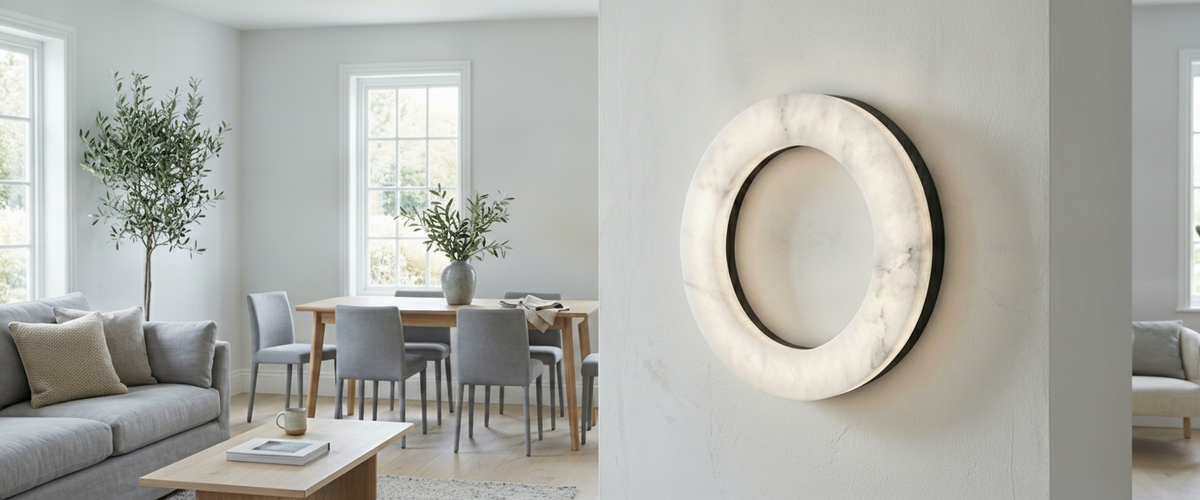

Designer light fixtures in the UK earn their price in the room, not the photograph. The honest difference between a high-street pendant and a genuine fixture is light quality and longevity: one throws a flat, slightly clinical light, the other glows from within and reads as part of the architecture. The best designer light fixtures in the UK can look near-identical to a cheap copy in a thumbnail, then behave like different objects entirely once they are hung and switched on. The gap you are paying for shows up in the material, the casting, the way light moves through the piece, and how it ages over a decade.
A solid alabaster pendant glows from within, with the veining visible through the stone.
At Niori we work in alabaster and natural stone, so we see this difference daily. Stone is unforgiving. A cheap shortcut shows up the moment a lamp warms up. That makes it a useful lens for judging the wider category of designer light fixtures, not just our own range.

Key Takeaways for Buying Designer Lighting in the UK
Material first: solid alabaster, marble or onyx diffuses light from inside the stone. Resin and printed glass only mimic the look.
The cost sits in the unseen work: castings, hand-finishing, wiring quality and metalwork, not the marketing.
Provenance matters: ask where a piece is made and finished, and whether the stone is natural or reconstituted.
Read the spec sheet before you trust the price: dimming, IP rating, weight, fixings and bulb type tell you more than the styling.
Lead times are normal for bespoke or hand-finished work. A long wait is often a sign of real making, not poor service.

What Separates a Designer Fixture From a High-Street Lookalike
The honest answer is light quality and longevity. The best designer light fixtures are engineered around how they will sit in a real room, at a real dimming level, for years. A lookalike is engineered around hitting a price and photographing well. That is the line that separates true designer lighting in the UK from a styled imitation.
With alabaster the difference is stark. Genuine stone is translucent in depth, so the light source disappears and the whole shade becomes the lamp. You get a warm, slightly amber glow with the natural veining showing through, never a single hot spot. A resin imitation tends to glow evenly and lifelessly, because there is no mineral structure for the light to travel through. Once you have seen the two side by side, you stop trusting the photograph.
The same logic applies to designer wall lights in the UK. A solid stone wall light grazes the surface beside it and picks up texture in the plaster or panelling. A thin pressed-glass version just sits there as a bright shape.
Where the Money Goes: Castings, Finishes and Hand-Finishing
Pick up one of these designer light fixtures and the weight tells the first part of the story. Solid brass castings feel dense; plated zinc or aluminium feels hollow and slightly tinny. Brass that has been hand-finished and lacquered will hold its tone for years, while a cheap plated finish can flake or discolour within a season or two of cleaning.
Hand-finished solid brass holds its tone for years, unlike thin plated finishes.
Stone work is where the hours quietly stack up. Alabaster and onyx are cut, hollowed and then hand-sanded through finer and finer grits until the surface is smooth enough to pass light cleanly. Every block is different, so a maker has to match veining across a chandelier or a run of wall lights by eye. That selection and matching is skilled, slow work, and it is most of what you are paying for in a hand-finished piece.
Wiring is the part buyers forget. In good designer light fixtures the internal cabling, terminals and earthing are specified to current standards and the assembly is built to be serviced, not glued shut. The Chartered Institution of Building Services Engineers (CIBSE) publishes guidance on lighting quality and installation that sits behind how reputable makers approach this. Always have mains fixtures fitted by a qualified electrician.
British Makers Versus Imported Names, and Why Provenance Matters
Provenance is not snobbery; it changes what you actually receive. Designer light fixtures designed and hand-finished in a UK or European workshop usually come with traceable materials, repairable assembly, and someone who can answer a technical question. A drop-shipped fixture badged as designer may have been mass-produced with reconstituted stone, then marked up several times before it reaches you.
Ask two direct questions. Is the stone natural or reconstituted? And where is the piece finished, not just assembled? Natural alabaster has been used in lighting and sacred architecture for centuries precisely because of how it carries light; the Victoria and Albert Museum's collection notes on alabaster (vam.ac.uk) trace that long history. Reconstituted or resin-bonded stone is a manufactured substitute, and it neither glows nor ages the same way.
You can browse the difference in person across our alabaster lighting range, where each pendant and wall light is cut from solid stone rather than a moulded copy.
How to Read a Spec Sheet Before You Trust the Price Tag
A confident maker publishes detail. A reseller hides behind styling shots. Before you commit to any designer lighting in the UK, work through the spec sheet methodically. The genuine designer light fixtures will give you every line you ask for.
Material: solid natural stone, or reconstituted/resin? This is the single most important line.
Weight and fixings: a real stone pendant is heavy. A medium alabaster pendant can run 6 to 10 kg (13 to 22 lb), so check the supplied bracket or canopy is rated for it and that your ceiling can take the load.
Bulb type and cap: designer light bulbs in the UK still need a stated fitting (E27, E14, G9) and a recommended wattage. Match warm-white LEDs around 2700K to keep alabaster reading honey rather than blue.
Dimming: confirm the fixture is dimmable and which dimmer type it needs. Designer light switches in the UK now include trailing-edge dimmers that suit LED loads; the wrong dimmer causes flicker.
IP rating: bathrooms usually want at least IP44 in the zones near water, but its absence on a sheet that should list it is a small warning sign.
Shade and diffuser: for designer light shades in the UK, ask whether the shade is solid stone, stone veneer over glass, or fabric. Each gives a different light.
If a listing cannot answer these, the price is paying for marketing, not engineering.
Lead Times, Bespoke Options and What UK Delivery Really Involves
Hand-finished stone is not held in deep stock the way flat-pack lighting is. Expect a lead time on the better designer light fixtures, especially for chandeliers or matched sets where veining has to be selected across several pieces. We had a client fitting out a Cotswolds farmhouse who wanted six matched alabaster wall lights down a single corridor; getting the veining to flow naturally along the run took longer than wiring the whole floor, and it was worth every day.
Bespoke work, custom drops, a wider pendant, a non-standard finish, adds time and usually a deposit. That is normal. Delivery of heavy stone needs proper packaging and often a two-person handover, so factor that into a project timeline rather than assuming next-day arrival.
For larger schemes, a lighting designer in the UK often plans layouts using lighting design software so loads, beam angles and circuits are mapped before anything is ordered. As a rough starting point, hang a dining pendant so its base sits about 30 to 36 inches (75 to 90 cm) above the table. Good lighting design in the UK starts on paper, not on site. If you are working with a designer, share the spec sheets early; it saves expensive surprises later.
Spotting the Markup That Buys You Nothing
Some premiums are real. Others are pure positioning. With designer light fixtures, the markup worth paying buys solid material, hand-finishing, serviceable wiring and a maker who stands behind the piece. The markup worth refusing pays for a designer-sounding name stuck on a generic import, a glossy catalogue, or exclusivity that adds nothing to the light in your room.
A simple test: ask what happens if a component fails in five years. A genuine maker can supply a replacement part or repair the fixture. A reseller often cannot, because they never made it. That single answer tells you whether you are buying lighting or buying a logo.
When you are comparing across categories, pendants, chandeliers, wall lights and table lamps, it helps to see a full range of designer light fixtures in one place. Our wider lighting collection sets stone fixtures alongside brass detailing so you can judge proportion and finish before committing.
A Quick Buyer's Checklist
Confirm the stone is natural, not reconstituted or resin.
Check weight against your ceiling or wall and the supplied fixings.
Match warm-white LED bulbs around 2700K and confirm the cap fitting.
Verify the fixture is dimmable and note the dimmer type required.
Read the spec sheet in full; treat missing detail as a red flag.
Ask about lead time, bespoke options and how the piece is delivered.
Confirm replacement parts and servicing are available.
Use a qualified electrician for any mains installation.
Designer light fixtures in the UK earn their price in the room, not the listing. Judge these designer light fixtures on material, light quality and how they will hold up over years, and the difference between a real fixture and a clever lookalike stops being a mystery.