
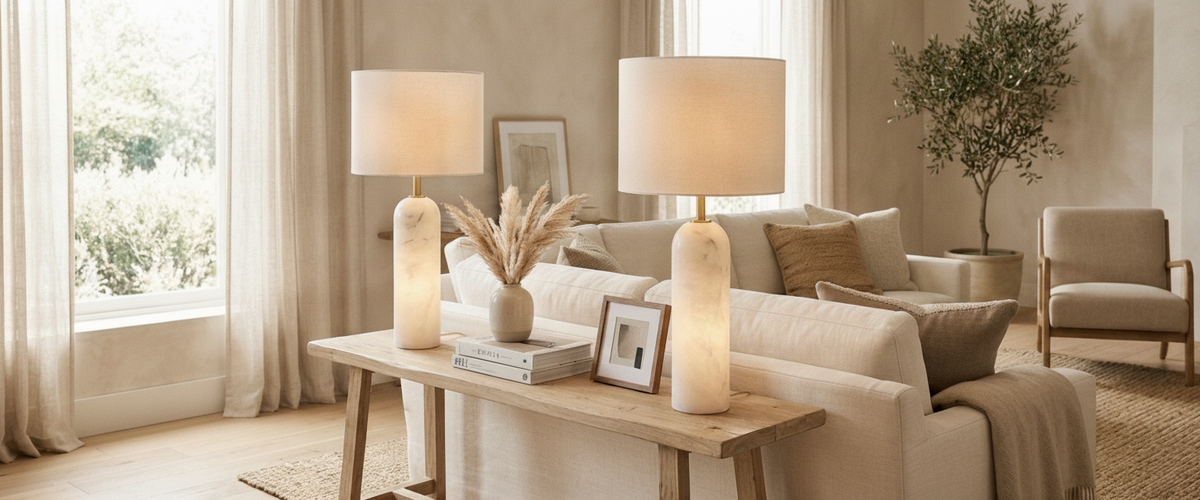

Good table lamps living room lighting comes down to four calls: height, so the bulb stays out of your eye line when you sit; scale, so the lamp belongs to the table under it; bulb, because a warm dimmable one sets the whole evening; and material, because the base spends most of its life switched off, being looked at. Beside a sofa that usually means an overall lamp height of 24 to 30 inches (61 to 76 cm), a shade narrower than the tabletop, and a 2200K to 2700K bulb on a dimmer.
Switch on the ceiling light at 8pm and watch a living room lose its nerve. The light drops straight down, hardens every shadow and leaves the corners dead. Lamps at seated height are the fix, and the rest of this guide works through those four calls in order, with the measurements to check before you buy.
Most of what follows leans on the alabaster and natural-stone bases we work with at Niori. With living room table lamps, light output is only half the job; the stone itself carries and softens the glow instead of leaving everything to the shade. Get the four calls right and the lamps stop being decoration and start doing real work.

Table Lamps Living Room: The Short Answer
Height beside a sofa: 24 to 30 inches (61 to 76 cm) overall, so the bottom of the shade meets seated eye level.
Height on a console: 28 to 34 inches (71 to 86 cm), because the lamp is read from across the room.
Scale rule: one to one and a half times the height of the surface, with the shade inside the tabletop edge.
Bulb: 2200K to 2700K, CRI 90 or above, on a dimmer.
Pair or single: a matched pair for symmetry, one sculptural lamp for a looser, collected scheme.

Key Takeaways
Height first: the bottom of the shade should sit roughly at seated eye level, so you never see the bare bulb from the sofa.
Scale to the surface: the table lamps living room side tables can carry should be no taller than about one and a half times the height of the table they stand on, and no wider than the tabletop.
Warm and dimmable: use 2200K to 2700K bulbs on a dimmer to kill glare and set an evening mood.
Pairs vs singles: matched pairs of living room table lamps frame a symmetrical layout; a single lamp suits an asymmetric or layered scheme.
Material matters: alabaster and stone bases diffuse light through the body of the lamp, not just the shade.
What a Low Pool of Light Does That a Ceiling Fitting Never Will
A ceiling fitting lights the room from one direction, and it lights the whole thing at once. That is useful for cleaning and hopeless for living. The eye reads a space as comfortable when light comes from several low sources at roughly the height of a seated person. Living room table lamps do exactly that. They create separate zones of brightness, a reading corner here, a warm spot on a console there, and let the ceiling recede into shadow where it belongs.
Alabaster changes the equation again. Because the stone is genuinely translucent, a base of this material does not just throw light down through the shade; the body itself glows, spreading a second, softer layer of light at the level of the tabletop. That double action is why table lamps living room schemes built around alabaster feel warmer at the same wattage. You can browse the range across our alabaster lighting collection to see how different bases handle the same warm bulb.
Sofa-Side, Console, Shelf: The Right Height for Each Perch
Living room lighting fails most often on height, not looks. The rule that holds across nearly every setting: when you sit down, the bottom edge of the shade should land close to your eye line so the bulb stays hidden. That single measurement settles most table lamps living room questions before style enters the conversation.
Beside the sofa. On an end table or side table next to seating, aim for a total lamp height of roughly 24 to 30 inches (61 to 76 cm). The tabletop usually sits a little below the sofa arm, so a taller lamp brings the shade up to where it needs to be for reading without blinding the person opposite. A ceramic gourd base with a lined shade, such as the Isla Ceramic Table Lamp, sits comfortably in this range and keeps the bulb hidden at seated eye level.
On a console behind the sofa. A console sits higher and is seen from across the room, so lamps can be taller and more sculptural here, in the region of 28 to 34 inches (71 to 86 cm). This is the spot where a carved stone base earns its keep, because you read the material as much as the light. A larger glazed piece like the Victor Large Table Lamp holds its own at this height and doubles as a focal point when unlit.
On a shelf or low cabinet. Lower surfaces call for shorter, wider lamps so the shade does not tower awkwardly. A squat gourd or dome base sits happily here and pushes light sideways into the room. Even at this height, living room table lamps hold their job of layering the glow.
How a Stone or Alabaster Base Reads Against Linen, Leather and Oak
In a table lamps living room scheme, the base is a daytime object first and a light source second. It spends most of its hours switched off, sitting against your upholstery and joinery, so how the lamp reads unlit matters as much as how it reads at 9pm.
Pale alabaster with its soft veining picks up the tones around it. Against a natural linen sofa it almost dissolves, adding texture without contrast. Set the same lamp against dark leather or a walnut console and the stone reads bright and quietly sculptural. Onyx and darker marbles do the opposite: they hold their own against pale oak and off-white walls, giving a scheme an anchor point.
Where the room leans metallic rather than pale, a polished glass and nickel base like the Orb Glass Table Lamp reads cleaner against dark leather and off-white walls than a soft stone would. The one combination worth planning carefully is stone against stone. A marble-based lamp on a marble-topped table can blur into a single mass. Break it with a metal detail, a slim brass neck or a nickel collar, or lift the lamp on a stack of books. If you are building a whole scheme of natural materials, spread the lamps around so no two heavy stone pieces sit side by side. The wider lighting collection is a useful place to see how bases in different materials pair up.
Warm Bulbs and Shades: Killing Glare at Seated Eye Level
The most expensive lamp in the world looks cheap with the wrong bulb in it. For a sitting room, warmth beats brightness every time. Most table lamps living room buyers spend hard on the base and underrate the bulb, and this is where a few pounds pay back fastest.
Color temperature: stay in the 2200K to 2700K range. This is the warm, slightly amber light that reads as relaxing after dark. Anything above 3000K starts to feel clinical in a living space.
Color rendering: choose a bulb with a CRI of 90 or above so skin tones and fabric colors look true rather than washed out.
Dimming: put the lamp on a dimmer, whether an inline switch or a smart plug. The Chartered Institution of Building Services Engineers argues for layered, adjustable lighting rather than a single blanket level, and a dimmable lamp is the easiest way to do it. See the CIBSE guidance on lighting for daily life for the principle.
Shades: an opaque or lined shade directs light up and down and shields the bulb; a translucent linen or paper shade glows all over and spreads a wider, softer wash. Line them up with the base material: a fabric shade warms an alabaster body, while a metal or glass shade suits a more architectural stone.
One studio lesson worth passing on: a clear filament bulb behind a pale, thin shade will show as a hard bright line at seated height. If you love the look of a visible filament, drop the wattage and dim it hard, or move it to a lamp you view from standing. It is a small detail, but it separates good living room table lamps from ones that make people squint.
A Matched Pair or a Lone Lamp: When Symmetry Warms, When It Stiffens
Two identical lamps flanking a sofa or a fireplace read as calm and deliberate. Symmetry is restful, and a matched pair of alabaster lamps is one of the most reliable moves in a formal scheme. It works because the eye stops hunting for balance.
A single lamp does a different job. In a layered, collected room, one sculptural lamp on a console, off to one side, keeps things loose and personal. Pairs can stiffen a relaxed scheme; a lone piece can look lonely in a formal one. Match the approach to the room you actually have, not the room in the catalogue. This is one of the choices that decides whether table lamps living room arrangements feel considered or accidental.
If you go for a pair but want to avoid a showroom look, keep the lamps matched and vary what sits around them: books stacked on one table, a small sculpture on the other. The lamps hold the symmetry while the details keep it human.
Scaling the Lamp to the Furniture It Actually Stands On
Scale is where good instincts and quick rules earn their place. Two checks cover most table lamps living room decisions.
Height against the table. A lamp should sit at roughly one to one and a half times the height of the surface it stands on. A 24-inch (61 cm) side table takes a lamp of around 24 to 30 inches (61 to 76 cm) overall.
Width against the tabletop. The widest point of the shade should not overhang the edge of the table. Leave a little breathing room on each side so the lamp looks settled rather than perched.
Weight is the quiet third factor with stone. Alabaster and marble bases are heavy for their size, which is a virtue on a stable side table and a hazard on a flimsy shelf. For heavier stone pieces, solid side tables and consoles are usually fine; a thin floating shelf is not. Check that the surface and, where relevant, the wall fixing can carry a solid stone base before you commit. If a lamp feels top-heavy, the base is too light for the shade, not the other way round.
A Quick Buyer's Checklist
Measure the table height and depth before you shop, not after.
Confirm the shade hides the bulb from your seated eye line.
Choose a 2200K to 2700K, CRI 90+ bulb and a way to dim it.
Decide pair or single based on the room's symmetry, not habit.
Match base material to your upholstery and joinery tones.
Check the surface can take the weight of a stone base.
Have a qualified electrician handle any hard-wiring or unfamiliar fittings.
The best living room table lamps do the slow, everyday work of making a space feel lived in. Choose the height and scale with care, put a warm bulb behind a shade that hides it, and let a material like alabaster carry the glow. Done well, table lamps living room choices are the difference between a fitting that lights a corner and one that changes how the whole space feels after dark. Buy them as a considered pair or a single sculptural piece, and they pay you back every evening. When you are ready to compare bases, start from the Niori homepage to see how the collections fit together.