
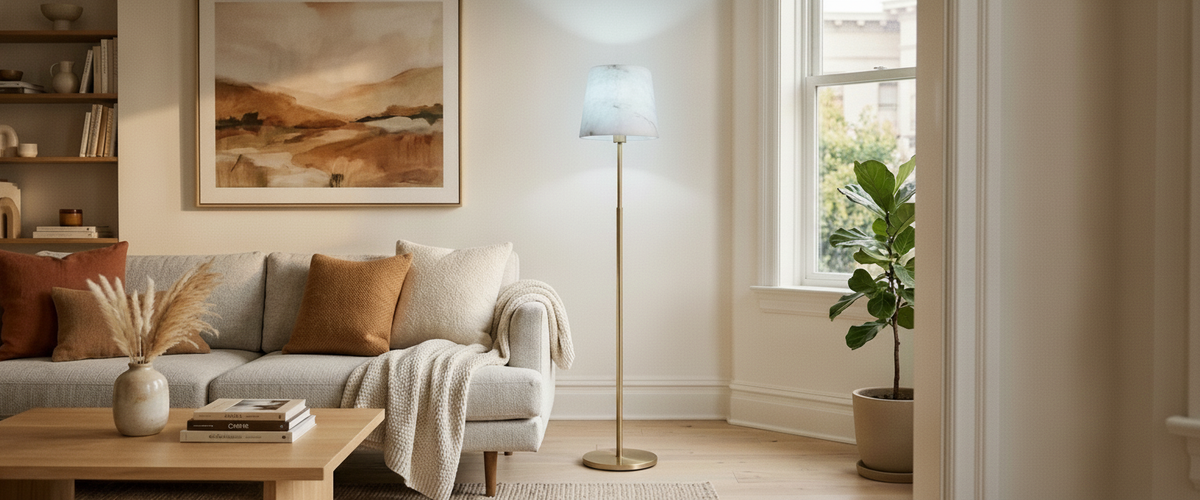

Floor lights living room schemes work best when you start at ankle height: put one lamp in the darkest corner, turn the ceiling light off, and the room settles. That is the short answer. The rest of this guide covers where to stand them (roughly 250 to 350mm out from the wall), how high the bright zone should sit against a seated eyeline (keep it out of the 1.05m to 1.30m band), which stone shades suit low-level light, what to run inside them (2700K, CRI 90 or better, around 400 to 800 lumens for corner work), and what floor lights honestly cannot do. Light arriving below waist height flatters faces and softens corners, so the space stops reading like a waiting area. Niori builds its floor pieces around alabaster and natural stone because those materials behave well at low level, where a bare bulb or a hard glass shade would only announce itself.

At a Glance
The floor lights living room short version, before the detail:
Low light reads calmer. Anything below roughly 900mm (about 3 ft) sits under the eyeline of a seated guest, so living room floor lights make a space feel restful rather than lit.
Corners first. The dark patch behind or beside the sofa is the single best position for a floor uplighter.
Texture rewards grazing. Lime plaster, brick, board-marked concrete and heavy curtain folds all gain depth when light climbs them from the skirting.
Check the sightline from the seat, not the doorway. Most glare complaints come from a shade edge sitting level with a sitting person's eyes.
Alabaster diffuses rather than blocks. Stone with genuine translucency spreads a warm, even glow at low output, which is exactly what late evenings need.
Floor lights living room fittings are ambience, not task light. You will still want a reading lamp beside the chair.

Why Light from Ankle Height Reads Calmer Than Anything at Eye Level
Comfort in a room tracks the position of bright surfaces more than the total amount of light. A bare pendant hanging in your sightline across the room keeps your pupils adjusting every time you look up. Light released near the floor washes upward and reflects off the ceiling and walls, so most of what your eye sees is a lit surface rather than a lamp. That single fact is the whole case for floor lights living room planning.
It is also why floor lights in a living room feel like evening light. There is a reason candlelight and firelight both sit low. Anything close to the ground gives long shadows across a rug, a slow gradient up the wall and a face that is lit from beneath the cheekbone rather than flattened from above.
Material decides whether that low position looks intentional or accidental. A translucent alabaster shade glows as an object in its own right, so even at ankle level it looks composed, which is why the stone suits living room floor lights better than most alternatives. Alabaster has been carved for centuries for the way it works under a chisel and softens the light passing through it, which is why medieval English workshops produced carved alabaster panels by the thousand, as the V&A sculpture collection records. The stone has not changed. Only the light source inside it has.
The Dark Corner Behind the Sofa, and the Uplighter That Pushes the Wall Back
Almost every sitting room has one corner that swallows light. Sofa on the diagonal, a tall plant, maybe a bookcase, and the whole zone reads as a hole. Ceiling downlights make it worse because they land on the floor in front of the sofa and leave the vertical surfaces dark.
Corners come first in any floor lights living room plan. Stand one fitting in that dark corner, roughly 250 to 350mm (10 to 14 in) out from the wall, and the corner opens. The light climbs both walls, the ceiling picks up a soft pool of reflected brightness and the room reads larger than it did five minutes earlier. Designers use this trick in small London flats and in wide open-plan barn conversions for the same reason: lit vertical surfaces set the perceived size of a room.
Where the corner is blocked by the back of a sofa and the base has nowhere sensible to stand, an arc form solves the geometry instead. As living room floor lights go, something like the Ginger LED Large Arc Floor Lamp keeps its weight against the wall while the head reaches out over the seating, so the light lands where you sit rather than behind you.
The pattern repeats in garden-level flats where three ceiling spots have been doing all the work and the room still reads as a basement. Put stone-shaded living room floor lights in each of the two darkest corners, drop the spots to about a quarter output, and the ceiling appears to lift. Nothing structural changes. The light simply stops pointing at the floor.
Grazing Textured Plaster, Brick and Curtain Folds from the Floor Up
Grazing is the deliberate version of the corner trick, and it is where floor lights living room schemes earn their keep. Set a narrow-beam or partly shielded floor light very close to a textured surface, within roughly 100 to 200mm (4 to 8 in), and every bump throws a shadow. Lime plaster gains a chalky relief. Reclaimed brick shows its mortar lines. Board-marked concrete stops looking flat.
Curtains are the underrated version. A floor light tucked behind the leading edge of a full-length linen curtain lifts the fold pattern from the hem to the pole and gives the window wall a soft glow after dark, which is far kinder than a wall light bouncing off the glass. Keep a sensible air gap, use an LED source that runs cool, and never let fabric drape over the fitting.
Marble and onyx behave differently to alabaster here. Denser, more figured stone tends to hold its veining as a visible pattern when lit from within, so it works well as a feature at the end of a sightline. Alabaster is more forgiving and reads as light itself. Both appear across the Niori lighting range, and when you are comparing floor lights living room options the decision is usually about how much pattern you want competing with the wall behind.
Sightlines from the Seat: Where a Floor Light Glares into a Guest's Face
Here is the test almost nobody performs before buying. Sit down in the chair you actually use. Now look across the room at the position where the floor light will stand. If the bright part of the fitting lands between about 1.05m and 1.30m (roughly 42 to 51 in) above the floor, you are looking straight into it.
Three fixes, in order of preference. Move the fitting behind the seating line so it is out of view. Choose a shade with a genuinely opaque or heavily diffusing upper rim so the source is shielded. Or drop the output and let the light do less work. Where the lamp has to stand in open view beside a sofa, a deep, downward-facing shade such as the one on the Balance 1 Light Floor Lamp keeps the source hidden from a seated eyeline, which a wide open drum at the same height would not. Slender stone-shaded living room floor lights sit slightly higher and are designed to be looked at, so those want a position that is either beside a seat or well off to one side, never dead ahead of the main sofa.
Reflections count as glare too. Living room floor lights facing a large TV screen, a glazed cabinet or a dark window will bounce a bright rectangle back at you. Check the room with the lights on and the daylight gone; the answer is obvious in ten seconds and invisible at 3pm.
Cables, Rugs and Doorways: The Limits of Floor Lights in a Living Room
Plug-in floor lights living room setups live or die by cable routing. The good positions are often the ones furthest from a socket, which is where trailing leads and creeping trip hazards begin. Trailing cables are one of the more common causes of trips at home, and a lead crossing a doorway or the main walking route is a genuine risk, not a styling problem.
Practical rules we give clients:
Run the cable along the skirting, not across open floor. Clip it if the route is permanent.
Never run a lead under a rug. Heat build-up and hidden wear are both real.
Keep leads clear of door swings and the path between sofa and kitchen.
If the only good corner has no socket, ask a qualified electrician about a new floor or wall outlet rather than living with an extension lead.
Weight matters on soft flooring. A heavy stone base needs a firm footing; on thick wool pile, check it sits level before you trust it near a walkway.
Wall-switched or five-amp circuits are worth requesting during any refurbishment. Being able to switch living room floor lights from the door changes how often you use them.
Any hard-wired work, added sockets or new switched circuits should go to a registered electrician, and Electrical Safety First is the sensible place to check credentials and home wiring advice before you book anyone. Living room floor lights are the easiest layer to add without building work, which is part of the appeal, but the socket that feeds them is not a DIY job.
How to Choose Floor Lights for a Living Room
A floor lights living room checklist, roughly in the order the criteria matter:
Job first. Corner wash, wall graze, sculptural glow beside a chair, or reading. Those are four different fittings.
Height against your seating. Measure the eye height of a seated adult in your own chairs and place the bright zone above or below it.
Shade behaviour. Translucent alabaster glows all over. Solid stone with a top opening throws light up only. Decide which reading you want before you fall for a shape.
Footprint and base weight. Slim bases suit tight corners; broad stone bases are stable but eat floor space next to a sofa arm.
Dimming route. In-line dimmer, wall dimmer or smart bulb. Confirm compatibility before you commit.
Finish coherence. Brushed brass, bronze and blackened metal all sit differently with warm stone. Match the metal to your handles and taps and the scheme holds together.
That last point decides more schemes than people expect. In a pale room where the hardware is already warm metal, a stem and shade in the same family, as on the Crosby 1 Light Floor Lamp, will disappear into the scheme rather than sit against it, while a blackened or dark timber fitting is better read as a deliberate contrast.
On budget, be wary of comparing headline numbers. Cost in stone lighting tracks the block the shade is cut from, the wall thickness achieved, the scale, the metalwork and the finishing time, so two floor lights living room pieces that look similar in a photograph can be very different objects in the room. If you are weighing options across a whole scheme, browse the alabaster lighting collection for shade behaviour first and ask us for a tailored quote on the pieces that fit the plan.
Bulbs, Dimming and Late Evening at Five Percent
Stone rewards restraint. For floor lights living room ambient work, aim for a warm source around 2700K, with CRI 90 or better so timber, wool and skin tones stay honest. Forget wattage as a measure of brightness; lumens are the number that matters, a point the Energy Saving Trust makes in its guidance on LED lighting. A corner uplighter usually earns its place somewhere in the 400 to 800 lumen band, while a reading position wants closer to 800 to 1,100 lumens landed on the page.
Dim-to-warm LEDs are the upgrade that changes how a room feels at 11pm. They drop towards 2200K as they dim, which is why an alabaster shade at very low output looks like embers rather than a dying torch. On a good dimmer, a stone floor light at around five percent becomes the only light you need; the ceiling stays off, the walls hold a faint glow and the room reads as somewhere you would happily stay another hour.
Two practical notes before you buy bulbs. Not every LED dims to a genuinely low level without flicker, so buy the bulb and the dimmer as a pair. And check the fitting's maximum lamp rating; enclosed stone shades trap heat, and overspecifying the source shortens the life of the driver long before it damages the stone.
What Floor Lights Cannot Do
Floor lights living room fittings will not light a page properly. Ambient floor light spreads wide and lands soft, which is the opposite of what reading, needlework or a crossword needs. Keep a table lamp with a directional shade beside the chair, and be honest that it is a task fitting rather than mood lighting.
They also cannot fix a room lit only from the centre of the ceiling. Floor lights in a living room work as one layer among several: a pendant or chandelier for occasion, wall lights for the vertical mid-height, table lamps for task, floor pieces for corners and texture. Get three of those four working on separate switches and the room becomes adjustable rather than binary. That layered approach runs through the whole Niori collection, and it is the reason we push clients to buy fewer, better-placed fittings rather than a matching set.
One more limit worth naming. A floor light cannot hide in a busy corner. If the space is already full of a plant, a side table and a stack of books, adding a fitting there will read as clutter no matter how good the stone is. Clear the corner first, then light it.