
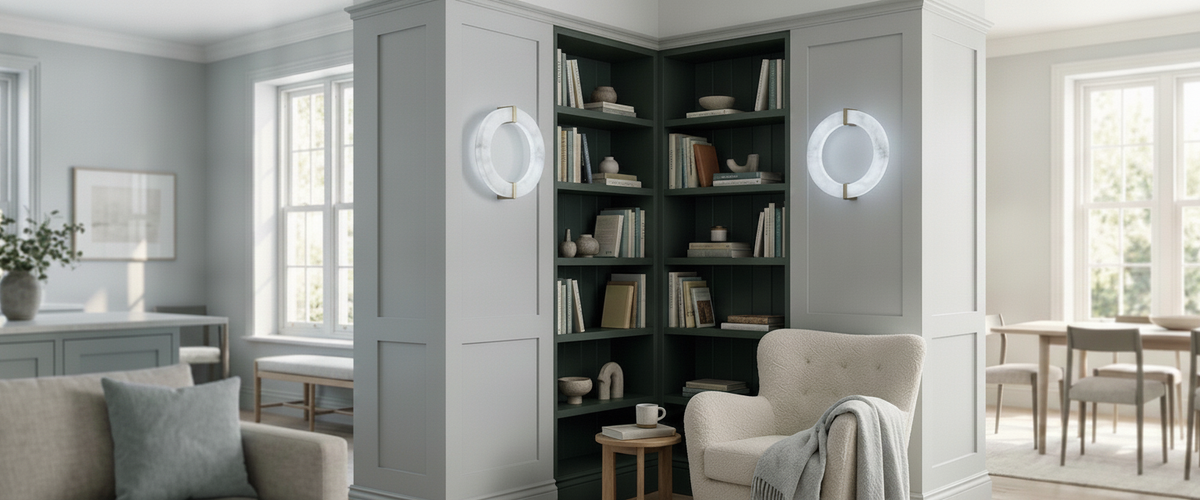

Get the height wrong on a pair of brass wall lights and you spend the next five years living with a bright disc burned into the plaster above the shade. Get it right and the wall glows, the metal warms up as the sun drops, and the room feels older and calmer than it did before. Brass is forgiving in color but unforgiving in placement, which is why so many brass wall lights end up either too high, too far apart, or aimed straight at the person sitting under them.
Brass wall lights sit at the warm end of the fixture spectrum. Where a pale stone or glass shade stays cool and quiet, brass pushes amber back into the room, and that difference decides where each type belongs.
A balanced pair of sconces reads as part of the joinery.

Key Takeaways
Finish changes the mood: antique brass reads soft and settled, polished brass reads crisp and reflective, aged or natural brass keeps shifting as it lives.
Shade shape controls the beam: a brass cone throws a tighter, more directional pool than an open or upward shade.
Height matters more than symmetry: most brass wall lights sit best with the light source around eye level or just above, roughly 60 to 66 inches (152 to 168 cm) to center.
Brass and alabaster work together: the metal adds warmth and structure while stone diffuses the glow.
Leave honest patina alone: clean tarnish only where it looks wrong, and stop touching the rest.

Antique, Polished and Aged Brass Against Paint and Plaster
The same brass wall light will look like three different fixtures depending on the finish and the wall behind it. Antique brass, with its darkened, slightly matte surface, sinks into deep colors; put it on a charcoal or forest-green wall and it reads as a warm outline rather than a bright object. For a paneled hallway or library where you want the metal to feel like it has always been there, a settled heritage finish such as the Saylor Medium Wall Light in Heritage Brass reads as part of the joinery rather than an addition to it. An antique brass wall light of this kind hides its age in the best way.
Polished brass wall lights do the opposite. They catch every bit of light in the room and throw it back, so against pale plaster or off-white paint they stay sharp and almost jewelry-like. A lacquered piece like the Bray 1 Light Wall Light in Lacquered Brass keeps that crisp reflective quality fixed, which rewards good wall finishes and punishes patchy ones, because the reflection draws the eye straight to the surface behind it.
Natural or living brass, sold unlacquered, starts bright and dulls over months into something between the two. If you like the idea of a fixture that changes with the room, that is the one to choose. If you want it to stay exactly as it arrived, look for a lacquered finish, which seals the surface against the air. Surrounding materials and light exposure both shift how a finish is read over time, and brass wall lights are no exception.
Why a Brass Cone Throws a Tighter Beam
Shade geometry does most of the work in how a sconce lights a wall. A brass cone wall light, narrow at the top and wider at the mouth, funnels the output into a defined pool. Point it down and you get a clean cone of light on the wall below, with a crisp edge; point it up and you wash the ceiling. Either way the beam is contained, which makes cones the right pick for task moments: beside a reading chair, over a worktop return, or flanking a piece of art you want lit rather than flooded.
A cone shade funnels the output into a defined pool.
Open shades and lantern-style fixtures spread the light in a wider, softer field. They fill a landing or a hallway with ambient glow but rarely light a single object well. So the first question before you buy has nothing to do with which brass you like: decide whether you want the fixture to light the wall, the room, or one particular thing. Match the shade to the answer and the finish becomes the easy decision.
Placing Sconces Beside Art, Mirrors and Beds
The hotspot problem, that harsh bright ring on the wall, comes from mounting a downward or open shade too close to the plaster. The fix is distance and aim. Beside a mirror, mount the pair so the light source sits near the height of your own reflection, which fills the face with even light instead of casting shadows up from below. Two slim brass wall lights framing a mirror beat one fixture above it almost every time. Where the space is tight, a compact piece such as the Mercer 1 Light Small Wall Light in Heritage Brass sits close to the glass without crowding it.
Beside artwork, keep the beam off the frame's center and let it graze rather than blast. A cone angled slightly toward the wall lights the piece without the glare that flattens texture. Over a bed, treat brass wall lights as replacements for bedside lamps: mount them high enough to clear the pillows, around 30 to 36 inches (76 to 91 cm) above the mattress, and choose a design that lets you point the light down onto a book without spilling into your partner's eyes. A switch or dimmer within arm's reach is worth insisting on at the planning stage.
Where Brass Adds Warmth and Stone Holds Back
This is where the metal earns its place next to our core material. Alabaster and marble fixtures give a soft, diffused, slightly cool light; the stone glows evenly and keeps the mood restrained. Brass wall lights bring the opposite temperament, a warm metallic reflection that lifts a room that risks feeling flat. In practice the two belong together.
We shipped a pair of brass wall lights to a client in a converted barn who had already fitted alabaster pendants in the same hallway. The pendants gave the ceiling a low, even glow; the wall fittings, mounted lower down the run, added the warm anchor points that made the space feel lived in rather than lit. That combination, cool diffused stone above and warm directional metal at eye level, is one of the most reliable moves in the range. You can see how the finishes read together across our alabaster lighting and browse the wider lighting collection to plan a room that balances both.
Mounting Height and Spacing for a Balanced Pair
A pair of brass wall lights only reads as a pair if the math behind it is quiet. Work from the center of the light source, not the top of the fixture, and aim for roughly 60 to 66 inches (152 to 168 cm) off the finished floor in living spaces. Drop that in a bedroom, raise it slightly in a tall hallway. What you are protecting is the sightline: you do not want to look up into a bare lamp or down onto a glaring shade.
For spacing, let the objects between the sconces set the gap. Framing a mirror or a bed, sit each fixture 6 to 10 inches (15 to 25 cm) off the edge so the light reaches the middle. Running brass wall lights along a corridor, space them evenly and resist the urge to crowd; three well-spaced points of light read better than five that fight each other. Measure twice, mark the center of each backplate on the wall, and check the line with a level before anyone drills.
Any hard-wired sconce should be installed by a qualified electrician. Brass wall lights sit at head height and get touched, so the connection and the fixing both need to be right; UK guidance on domestic electrical work makes clear this is not a job to improvise (electricalsafetyfirst.org.uk).
Living With Brass: Patina to Keep, Tarnish to Leave
Unlacquered brass wall lights will change, and most of that change is worth keeping. The gentle darkening across the body, the slightly warmer tone that settles in after a year, that is patina and it is part of why people choose the metal. Resist the urge to polish it back to a showroom shine every few weeks; you will only reset a finish that was heading somewhere good.
What to address is the uneven stuff: fingerprints near a switch, a greenish bloom where a hand rests, a splash near a basin. A soft dry cloth handles most of it. For anything stubborn, a mild brass cleaner used sparingly on the marked area, then buffed dry, keeps the rest of the patina intact. Lacquered brass asks for even less; a damp cloth and no abrasives, because scratching the lacquer lets the air in and creates patches. Keep cleaning products off any adjacent alabaster or marble entirely, since acidic residues mark natural stone.
Quick Buyer Checklist
Decide the job first: wall wash, room ambience, or lighting one object.
Choose the shade shape to match that job; cone for control, open for spread.
Pick the finish to suit your wall color and how much change you want over time.
Confirm dimming, and specify a switch within reach for bedside pairs.
Set mounting height from the light source, not the fixture top.
Book a qualified electrician for the install.
Brass is one of the few materials that gets better the longer you leave it alone, which is rare in a house full of things that need replacing. Choose the finish for the wall and the shade for the task, then set the height from the sightline, and a pair of brass wall lights will do quiet, warm work for decades. As a specialist in alabaster and natural-stone lighting, Niori pairs that warmth with the soft diffusion of stone so a room reads balanced rather than busy.