
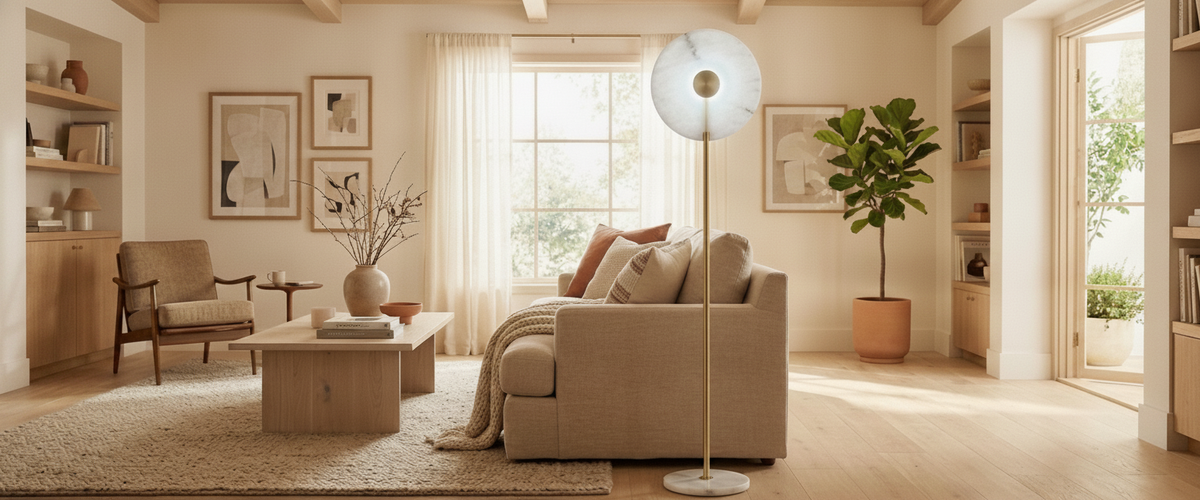

Most floor lamps come back for reasons you can measure. The shade sits too low, so the bulb glares straight into your eye from the sofa. The base is light, so one passing dog puts it on the rug. The cord is short, so the lamp lands three feet from the spot it was bought for. This guide covers the floor lamps living room buyers actually keep, in figures rather than adjectives: the height band that lifts the shade above seated eye level (58 to 64 inches, or 147 to 163 cm), the base weight that holds on a rug, the shade material that softens output instead of firing a hotspot across the wall, and the placement that earns a lamp its floor space.
We ship the floor lamps living room clients order every week, and the same four questions come back. How tall? How heavy? How far from the sofa? Can I run two? Here are the answers in numbers, so the lamp works the night it arrives instead of sitting in the box while you rethink the corner.
Placement and height decide whether floor lamps living room layouts feel soft or harsh.

Key Takeaways Before You Buy
Shade height: aim for the bottom of the shade to land around eye level when you're seated, roughly 58 to 64 inches (147 to 163 cm) from the floor for the whole lamp.
Base weight: a wide, heavy base beats a slim, light one every time. Stability is the thing nobody checks in the showroom.
Light quality: match the lamp's color temperature to what your room already uses, ideally 2700K warm white for living spaces.
Placement: beside a sofa arm, behind a reading chair, or in the dead corner most floor lamps living room plans ignore.
Two lamps: yes, you can run a pair in one space, and often should, to balance a wide or open-plan layout.

The Height and Shade Width Most People Get Wrong
Seated, your eye sits roughly 40 to 42 inches (100 to 107 cm) off the floor on a normal sofa. If a lamp's shade bottom drops below that line, you get raw bulb glare instead of soft, downward wash. That's why so many floor lamps living room owners bought in a hurry feel harsh: the shade is simply too low.
Overall lamp height in the 58 to 64 inch (147 to 163 cm) band works for most sofas. Taller reading lamps and torchieres can run higher because they throw light up or over your shoulder rather than into your face. Shade width matters too. A narrow shade concentrates a bright pool; a wider one spreads a gentler glow across a larger patch of the room. For a lamp meant to light a reading corner, go narrower. For ambient fill next to a sofa, go wider.
This is where alabaster and natural stone change the math. A carved alabaster shade doesn't just block glare, it diffuses light through the stone itself, so the whole shade glows at an even, warm level. You get usable light without the hotspot. That softer output is why we lean toward stone diffusers over hard reflective materials when we spec the floor lamps living room shoppers will actually read by.
Arc, Tripod or Column: Which Shape Suits Which Sofa
Shape follows layout more than taste. Three broad families cover most rooms.
Arc floor lamps reach out and over, so the light source lands above a coffee table or the center of a seating group without a lamp base in the walkway. They suit a sofa floating in a room, or a sectional where you can't tuck a lamp against a wall. Among floor lamps living room layouts with a floating sofa, this is the shape to reach for. The trade-off is footprint: the base sits well behind where the light falls, so you need clearance.
Tripod floor lamps spread three legs for a wide, stable stance and read as relaxed and mid-century. They work in corners and beside chairs, though the splayed feet eat floor space, so keep them clear of traffic routes. As floor lamps living room options go, they suit a relaxed layout that isn't fighting for space.
Column and torchiere lamps take the smallest footprint. A slim column sits neatly beside a sofa arm; a torchiere bounces light off the ceiling for soft, indirect fill that lifts a whole room. Where you want that upward, indirect wash rather than a downward reading pool, a piece like the Opera Torchiere Floor Lamp throws light off the ceiling to lift the whole space evenly. Of all the floor lamps living room shoppers see, column shapes are our quiet favorite, because the lit stone becomes a vertical accent even at low brightness. You'll find both slim columns and sculptural stone forms across our lighting collection if you want to compare silhouettes side by side.
Arc, tripod and column: each shape suits a different sofa layout, so measure before you fall for a silhouette.
Base Weight and Footprint: The Stability Nobody Checks
A floor lamp lives in the open, near feet, pets, vacuum cleaners, and the occasional stumble. The base has to hold its ground. Slim bases on tall lamps are the ones that wobble, tip, and eventually get moved to a spare room. It's the failure mode we see most in the floor lamps living room buyers send back.
Natural stone helps here in a way metal alone can't. A marble or solid alabaster base carries real mass low to the floor, which is exactly where you want the weight for a stable lamp. If a base feels light when you lift the box, that's a warning. Ask about base diameter and material before you buy, and picture the lamp in a room with children or a dog before you commit to something top-heavy. On the floor lamps living room traffic walks past daily, mass down at the base is the difference between a keeper and a returns label.
Footprint is the other half. An arc lamp needs a wide, weighted base to counter the reach of the arm, so it takes more floor than its slim column cousin. Measure the spot you have in mind, then leave a few inches of breathing room so the lamp doesn't crowd the sofa. Even the best-looking floor lamps living room corners can hold will fail if the base can't keep them steady.
Matching the Lamp's Light to What the Room Already Has
A single mismatched lamp can make a whole room look off. Color temperature is where floor lamps living room schemes clash most often with everything around them. If your ceiling lights and table lamps run at 2700K warm white and you drop in a cooler 4000K floor lamp, the corner it lights will read blue and clinical against everything else.
For living rooms, we recommend sticking to 2700K across the room, with a high color rendering index (CRI 90 or above) so skin tones, timber, and textiles look true. The Chartered Institution of Building Services Engineers publishes guidance on lighting quality that's worth a look if you want to understand how color temperature and rendering shape a space. Alabaster does some of this work for you: the stone warms and evens the light passing through it, so a well-chosen bulb reads soft rather than stark. Where the corner needs a soft, contained glow rather than a hard downlight, a shaded column such as the Ascent Floor Lamp in Polished Nickel keeps the output gentle while holding a crisp silhouette against the wall. It's a good template for the floor lamps living room corners really need.
Dimming matters just as much on the floor lamps living room evenings lean on. The lamp should drop to a low evening glow, not just full brightness. Choose dimmable LED bulbs and, if you're wiring in a wall dimmer, confirm it's LED-compatible; mismatched dimmers cause flicker and buzz. For anything hard-wired, use a qualified electrician rather than improvising.
Switch Position, Cable Length and the Reach to the Nearest Socket
Here's a practical detail that ruins otherwise good lamps: the switch. An inline foot switch is easy to nudge with a toe. A switch on the cord halfway down is fiddly in the dark. A switch high on the stem, near the shade, is the most comfortable to reach from a standing position. On floor lamps living room buyers use nightly, check where it sits before you commit.
Cable length decides where the lamp can actually live. A short cord chains you to the nearest socket, and trailing an extension lead across a walkway is both ugly and a trip hazard. Plan the run before delivery: which socket, which side of the sofa, and whether the cable can hide behind furniture. In older homes with sparse sockets, that reach often beats style as the deciding factor when you shortlist floor lamps living room wiring can actually reach.
Where to Place a Floor Lamp in the Living Room
The best spots for the floor lamps living room layouts allow share a logic: they light a task or fill a dark zone without blocking the room.
Beside a sofa arm: the classic position. Sits at reading height, frees the side table, and anchors the seating group.
Behind or beside a reading chair: position the shade so light falls over your shoulder onto the page, not into your eyes. For this job an adjustable head matters more than a fixed shade, which is why a swing-arm design like the Gibson Traditional Swing Arm Floor Lamp lets you aim the light onto the page rather than into your face.
In a dark corner: most living rooms have one corner the ceiling light never reaches. A floor lamp there balances the room after dark and adds depth.
Over a coffee table with an arc lamp: when you can't put a lamp against a wall, arc the light in from the side.
Flanking a fireplace or media wall: a matched pair frames the focal point and lifts the whole end of the room.
Can you run two lamps in one space at once? Absolutely, and in a wide or open-plan room you often should. A single lamp leaves one side brighter than the other. A pair of floor lamps living room proportions can carry, or a floor lamp paired with a table lamp on the opposite side, evens the balance and stops the space feeling lopsided. The pair doesn't have to be identical, but keeping the color temperature and rough scale consistent keeps them reading as a set.
Signs of a Lamp Worth Keeping Versus One You'll Replace
We had a client in a coastal home who'd been through three lamps in two years before coming to us. Each one failed the same way: a light plastic base, a wobble, then a switch that stopped clicking. The lamp that finally stayed had a solid stone base and a metal frame that didn't flex. That's the pattern to look for in floor lamps living room use will test hardest.
A lamp worth keeping has real weight low down, a shade that holds its shape and color, a switch that feels solid, and a frame with no give when you nudge it. Alabaster and marble components add longevity because natural stone doesn't yellow, warp, or scuff the way cheaper materials do; carved alabaster pieces have survived intact for centuries, which tells you something about how the material ages. Our alabaster lighting range leans on exactly this durability, with stone shades and bases built to stay in the room rather than the loft. It's why so many of the floor lamps living room clients buy from us stay put once they land.
Budget varies with material, scale, and the engineering behind the base, so ask for a tailored quote rather than assuming a single price bracket. A solid-stone piece costs more up front and less over a decade, because you buy it once. Start from the Niori homepage to see how the pieces sit together across a room, then narrow your shortlist by shape and height using the checklist above.