
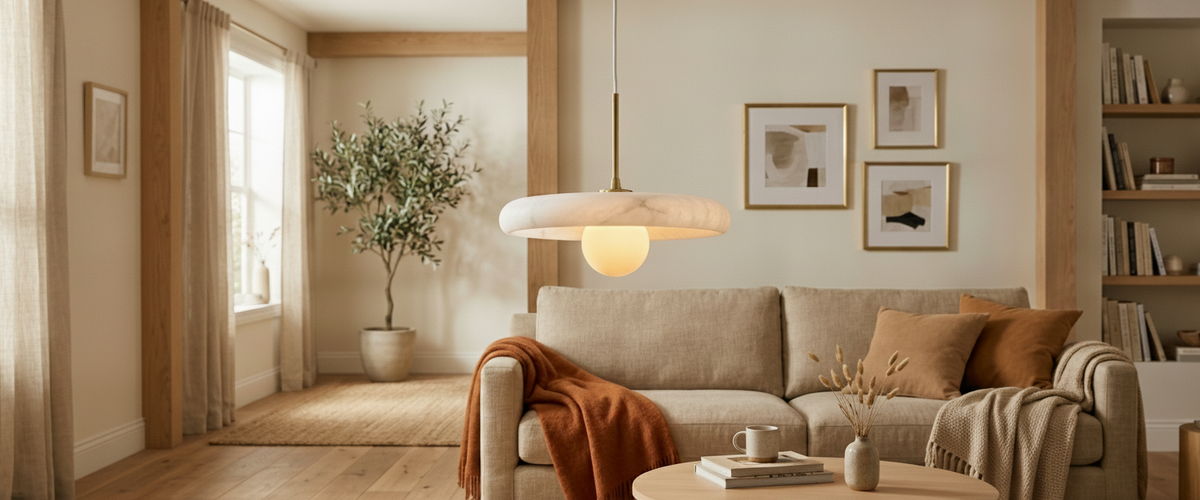

The fastest way to ruin a beautiful alabaster pendant is to screw in the wrong bulb. We have shipped fixtures to clients who later complained the stone looked grey and lifeless, only to find a 5000K daylight LED sitting inside a shade carved to glow honey-warm. The fixture was fine. The light source was fighting it. Choosing the right light LED light bulbs matters as much as choosing the fixture, because alabaster does not just hold a bulb; it transmits and colours whatever passes through it.
A warm bulb brings out the honey veining in an alabaster shade.
Niori designs alabaster and natural-stone lighting, so we spend a lot of time thinking about how light LED light bulbs change the mood of a hand-carved piece. Get the bulb right and the veining lights up like backlit honeycomb. Get it wrong and you have an expensive nightlight.

Quick Answer: What to Look For
Colour temperature: 2700K to 3000K for warm white. Alabaster reads best in this range, so pick your light LED light bulbs accordingly.
Dimmable: choose dimmable LED light bulbs if your circuit has a dimmer, and pair them with a compatible LED dimmer.
Output: aim for the lumens you need, not the wattage. An 8W LED can match an old 60W incandescent.
Fitting: match the cap (E27, E14, B22) to your fixture before you buy.
Heat: LEDs run cooler than halogen, which is kinder to stone over years of use.
Lifespan: typically 15,000 to 50,000 hours, so you rarely open the fixture.

What Lighting Makers Think About Before the Bulb Goes In
When we carve an alabaster shade, we are designing for a light source we do not control once the piece leaves the studio. So the design accounts for it early. Wall thickness, the density of the stone, and the depth of the veining all decide how much light escapes and what colour your light LED light bulbs take on the way out.
A thin, pale alabaster shade transmits a lot of light and shows fine detail, so warm light LED light bulbs keep it golden rather than washed out. A thicker, more heavily veined piece holds light back and benefits from a slightly brighter source so the carving still reads across the room. Before we recommend a bulb, we test how the stone behaves on the bench with a lamp. That is the difference between a specialist and a parts catalogue.
Why Colour Temperature Decides Everything
Alabaster is naturally warm. It carries cream, amber, and soft brown tones, and those tones come alive under a warm light source. Push a cool 4000K or 5000K LED through the same stone and the veining turns flat and slightly clinical, because the blue-leaning light cancels the warmth the material is known for.
For almost every alabaster and natural-stone fixture we make, we recommend warm white light LED light bulbs at 2700K to 3000K. A 2700K candle or globe bulb behaves like a gentle flame inside the shade. If you want a fraction more clarity in a larger room, 3000K holds the warmth while lifting the brightness slightly. Colour rendering matters too; look for a high CRI (90 or above) so the stone's true colour shows rather than a muddy approximation. The lighting industry guidance on quality of light backs this up: rendering and temperature shape how a material reads far more than raw output does. If you want to go deeper on the warm end of the scale, our guide to choosing the right colour temperature for alabaster lighting walks through how each range behaves through stone.
The same stone, two colour temperatures: warm white keeps the amber alive.
Matching the Bulb to the Fixture
Different Niori pieces want different light LED light bulbs, and the fitting is the first thing to confirm.
Pendants and ceiling lights: often E27 globe or A60 shapes. A frosted or opal LED globe spreads light evenly through a domed alabaster shade and avoids a hotspot. Where you want that even spread rather than a hard point of light, an opal globe such as the 8W LED Globe Bulb E27 Opal 3000K sits closer to the right design language for a domed shade.
Chandeliers and wall lights: usually smaller E14 or B22 candle bulbs. A 4 to 4.5W LED candle in warm white suits the scale and keeps each arm consistent. For a multi-arm fixture where the cap is E27, a compact warm-white candle such as the Energizer 4.2W LED Candle Bulb E27 2700K keeps the proportions delicate without overpowering the shade.
Table and floor lamps: commonly E27. Choose your light LED light bulbs by the look you want; a clear filament bulb shows a deliberate sparkle through translucent stone, while an opal bulb gives a smoother, more even glow.
Linear and cove effects: dimmable LED strip behind a stone panel or shelf creates a backlit wash without a visible point source. For that hidden, continuous glow, a run like the Ecliptus 24V Dimmable LED Strip 15W 3000K washes light across stone without ever showing the source.
If you are still choosing the fixture itself, browse the alabaster lighting collection to see how shade thickness and form vary across pendants, wall lights, and lamps, then match the bulb to that piece.
Dimmable LED Light Bulbs and How to Use Them
Alabaster rewards dimming more than almost any other material. At full brightness it reads clean and architectural; dimmed to a third, it becomes the warm pool of light you actually want at dinner or last thing at night. For that flexibility you need two things to agree: a dimmable LED light bulb and a dimmer rated for LED loads.
Old rotary dimmers built for incandescent bulbs often misbehave with LEDs, causing flicker, buzz, or a narrow dimming range. A trailing-edge LED dimmer usually fixes this. We always tell clients to confirm the bulb says "dimmable" on the box, because a non-dimmable LED on a dimmer circuit can flicker badly or fail early. If your wiring or dimmer needs changing, use a qualified electrician rather than guessing.
Do LED Light Bulbs Get Hot? And Why It Matters for Stone
LED light bulbs do get warm, but far less than the halogen and incandescent bulbs they replaced, where most of the energy left as heat. Light LED light bulbs run cool enough to touch the body after a few minutes, though the driver area can be warmer. For natural stone this is good news. Years of high heat can dry out or stress certain materials and discolour internal components, so a cooler source is gentler on a fixture you intend to keep. Still, give the bulb a little air; if a shade encloses it tightly, choose a lower-wattage LED that comfortably hits your target lumens.
How Long LED Light Bulbs Last
Quality light LED light bulbs are rated for roughly 15,000 to 50,000 hours depending on the model. In a normal home running a few hours a night, that can mean many years before a swap. For a chandelier with several lamps, that lifespan saves you opening a delicate fixture repeatedly. Two practical notes: heat shortens LED life, so good ventilation helps, and cheaper bulbs sometimes dim or shift colour before they fail outright. Buying a slightly better bulb is worth it inside a fixture you spent real money on.
Workshop to Wall: Where the Bulb Fits in the Process
A finished Niori piece passes through stone selection, carving, finishing, wiring, and install. The conversation about light LED light bulbs belongs at both ends. At selection, we read the veining and density to predict how much light the stone will pass. At wiring, we fit the right holder for the cap you need. At install, the bulb is the last decision, and it is the cheapest one to change if you ever want a different mood. That is the quiet advantage of LED: you can re-tune a room's atmosphere by swapping a single component.
Red Flags to Ask About Before You Commit
Vague colour temperature: if a seller cannot tell you the Kelvin rating, you cannot predict how the stone will look.
No CRI figure: low-CRI bulbs flatten natural veining. Ask for 90+.
"Dimmable" with no dimmer guidance: dimmable bulbs still need a compatible dimmer to behave.
Wrong cap supplied: confirm E27, E14, or B22 before delivery, not after.
Overbright recommendations: too-powerful light LED light bulbs create a hotspot and wash out the carving. Match lumens to room and shade thickness.
To compare fixture types and the bulbs they typically take, the full lighting collection is a useful starting point before you settle on a specification for your light LED light bulbs.
Disposal and Recycling, Done Properly
Spent light LED light bulbs should not go in your general waste bin. They are classed as electrical waste because of the components inside, and many can be recycled at household waste recycling centres or retailer take-back points. In the UK, the WEEE regulations cover lamps and luminaires; the official recycling guidance explains where to take old bulbs. Keep a small box for dead LEDs and drop them off in one trip rather than binning them one at a time.