
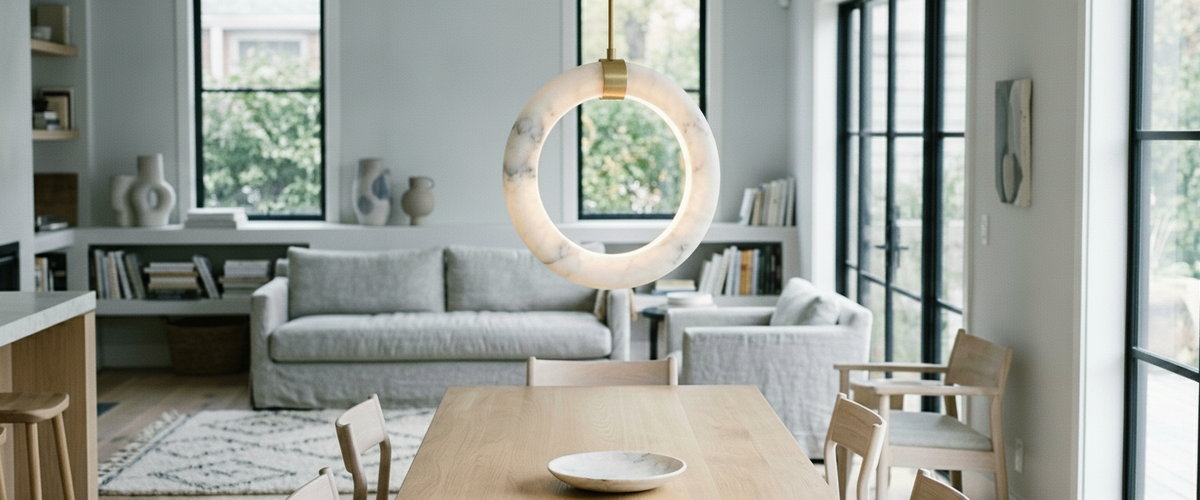

Put the wrong LED lighting LED bulb inside an alabaster pendant and the whole piece falls apart. The stone reads grey, the veining flattens, and the warm glow you paid for turns into something closer to a hospital corridor. The fixture has not failed; the bulb behind it has. Stone is a translucent material that depends entirely on what passes through it, which means the LED light LED bulb is not an afterthought. It is half the design.
We see this constantly in client projects. A beautiful onyx wall light arrives, gets fitted with whatever cool-white LED was already in the drawer, and the customer wonders why it looks nothing like the showroom. Match the light led light bulbs to the stone and the difference is immediate.
A 2700K bulb lets alabaster veining glow rather than flatten.

Key Takeaways
For alabaster and onyx, choose a warm LED light bulb led around 2700K. It flatters cream and honey tones; cool white drains them.
Lumens matter more than wattage. Aim for enough output to light the stone without scorching through thin veining.
If the fixture sits on a dimmer, you need dimmable LED light bulbs, not standard ones.
Opal and frosted bulbs hide the glare line inside translucent shades; clear filament suits open or vented fittings.
An LED light LED bulb runs far cooler than halogen, which protects the stone over years of use.

What an LED Light Bulb Actually Does Inside Stone
An incandescent or halogen bulb pushed heat and a continuous warm glow through alabaster, and it did the job, badly, by wasting most of its energy. A modern led light led bulb gives you the same warmth, when you pick the right colour temperature, with a fraction of the heat and a far longer life. For a material that you do not want to bake from the inside, that matters.
The variable that decides everything is colour temperature, measured in Kelvin. Alabaster sits in a narrow band of cream, ivory and pale honey. A 2700K LED light LED bulb sits right in that band and makes the veining glow. Push to 4000K or above and the stone goes clinical; the warm minerals that give alabaster its character simply disappear. The Natural Stone Institute notes that alabaster is a soft, translucent gypsum stone, which is exactly why it transmits light so well and why the source you choose has nowhere to hide. If you want the wider material picture first, our guide to choosing alabaster lighting covers stone types and care alongside bulb choice.
Lumens are the second number to read. Wattage tells you energy draw; lumens tell you actual brightness. A table lamp shade carved from thin alabaster needs a gentler output than a large pendant hung over a dining table, or the thin sections wash out and the thick sections stay dark. Reading both numbers stops you guessing.
Scale, Mounting Height and Sightlines
How a fixture reads in a room depends as much on where it sits as on the LED light LED bulb inside it. A pendant hung too high over an island becomes a glowing dot near the ceiling; drop it to roughly 30 to 36 inches (75 to 90 cm) above the worktop and the alabaster fills your eyeline at the right scale. Get the height wrong and no bulb will rescue it.
Drop a dining pendant to eye level so the stone reads at full scale.
Sightlines decide bulb choice too. If guests will sit below an open-bottomed pendant and look straight up into it, a bare clear filament bulb creates a hard glare spot. Where the stone needs an even, diffused spread rather than a hot point of light, an opal globe such as the 8W LED Globe Bulb E27 Opal lets the light wash across the veining instead of stabbing down. In a tall stairwell where nobody ever looks directly up into the fitting, the 8W E27 LED Filament Bulb in clear glass can show off its detail without anyone wincing.
Room by Room: Where the Light Earns Its Keep
Different rooms ask different things of an LED light LED bulb. Here is how we steer clients across our alabaster lighting range.
Living Rooms
This is where 2700K does its best work. An alabaster table lamp on a console or a pair of wall lights flanking a fireplace want soft, low-glare warmth. Use opal bulbs and put them on a dimmer so the room can shift from bright reading light to a low evening wash. A floor lamp with a stone diffuser in a corner does the same job vertically, lifting the gloom that ceiling downlights leave behind.
Dining Rooms
A stone pendant or small chandelier over the table is the centrepiece, so dimming is non-negotiable. You want enough output to see the food at the start of the evening and the ability to take it right down for the rest. Dimmable LED light bulbs paired with a compatible trailing-edge dimmer give a smooth fade with no flicker or buzz.
Bedrooms
Bedside alabaster lamps reward a lower lumen output and the warmest LED light LED bulb you can find. Cool light here is a mistake; it suppresses the wind-down the room is meant to encourage. For a slim stone form that needs warmth without bulk, a candle-style bulb like the Energizer 4.2W LED Candle Bulb E27 in 2700K keeps the scale right and the tone soft inside a tapered shade.
Hallways and Stairwells
Wall lights in narrow spaces need to throw light without dazzling anyone passing. Frosted bulbs keep the glow gentle. For a tall void, a long alabaster pendant with a higher-lumen LED light LED bulb fills the vertical space and gives the stone room to perform. Browse the full lighting collection if you are matching several fittings across a hallway, landing and stair run so the colour temperature stays consistent throughout.
Bulb Choice, Dimming and Contrast
A few practical decisions separate a fixture that sings from one that merely works.
Fitting type: Most of our fixtures take E27, E14 or B22 caps. Check the cap before you buy bulbs, not after.
Shape: Globe and golf-ball bulbs spread light evenly in rounded shades; candle bulbs suit slim, tapered forms; filament bulbs reward open or vented fittings where the bulb is part of the look.
Opal versus clear: Opal and frosted glass diffuse the glow and hide the hot spot. Clear filament gives sparkle but only where the bulb is meant to be seen.
Dimming: A standard LED light LED bulb will flicker or hum on a dimmer. Buy bulbs marked dimmable and pair them with a dimmer rated for LED loads.
Contrast: Alabaster glows hardest against a darker backdrop. A pale stone lamp on a white wall has less drama than the same lamp against a deep plaster or charcoal tone.
Heat is worth a line of its own. People ask whether an LED light LED bulb gets hot. They warm at the base where the driver sits, but they run far cooler than the halogen lamps they replaced, which is good news for soft stone that you do not want to cook from within. Any wiring or dimmer work should go to a qualified electrician rather than a weekend DIY session.
Placement Mistakes We See Most Often
The same errors come up again and again in client photos.
Mixing colour temperatures. Three 2700K wall lights and one stray 4000K bulb in the same room is glaring once you spot it. Buy your bulbs as a matched set.
Over-bright bedside lamps. A 1,000-lumen bulb in a small stone bedside lamp blows out the veining and ruins the mood. Go lower.
Clear filament in a closed shade. The hot spot shows straight through thin alabaster as an ugly bright line. Use opal.
Ignoring the dimmer. A fixture sold to be dimmed, fitted with non-dimmable bulbs, locks you into one harsh setting all evening.
Hanging too high. The most common fault. Lower the pendant until the stone meets your eyeline, then judge the bulb.
Fix those five and most rooms come right. A premium fixture is forgiving of almost everything except the wrong LED light LED bulb behind it, and that is the one thing fully in your control.