
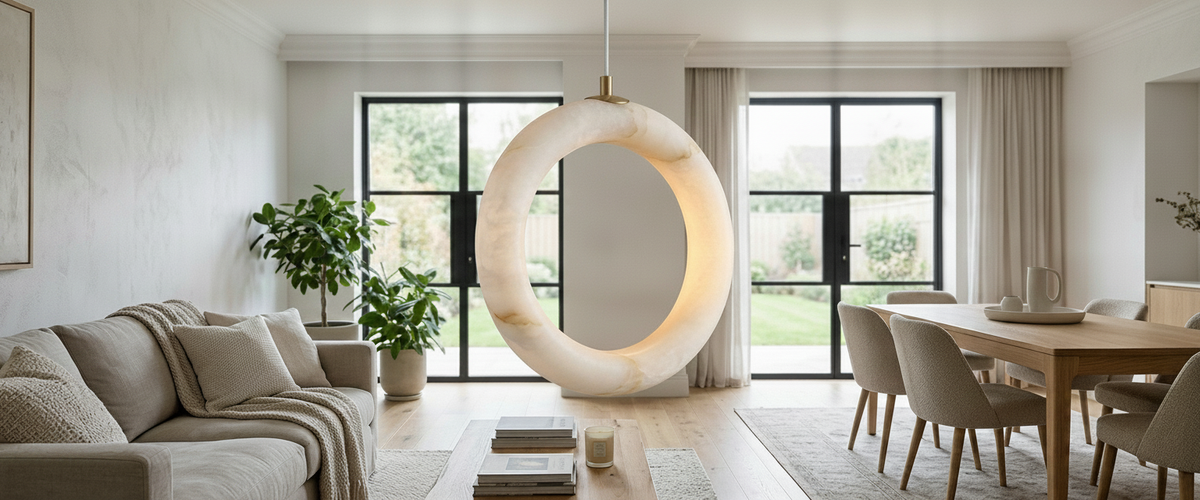

A dimmable lighting switch LED setup is the quiet engine behind every piece of natural-stone lighting that looks calm and expensive: choose a trailing-edge dimmer rated for low LED loads, a bulb or strip labelled dimmable, and a warm 2700K tone, and a slab of translucent stone reads like a lit ember. Fit the wrong dimmer behind a beautiful alabaster pendant and you hear about it before you see it: a faint buzz, a flicker at the low end, a glow that drops out two-thirds of the way down the dial. Get the dimmable light switch LED pairing right and the same stone looks alive rather than grey and lifeless.
At Niori we make alabaster and natural-stone lighting (pendants, chandeliers, wall lights, table lamps and floor lamps), so we spend as much time thinking about what sits behind the stone as the stone itself. A good dimmable light switch LED choice is a big part of that. Here is what actually matters.

Quick Answer: Key Takeaways
Not every LED is dimmable. Check the bulb and the driver, not just the fitting.
The dimmer must match the load. A trailing-edge dimmable light switch LED setup is the usual choice for low-wattage stone fixtures.
Warm light flatters stone. Around 2700K shows veining best; cooler temperatures wash it out.
Low-end behaviour is the test. Good kit dims smoothly to a candle glow without flicker or buzz.
Ask before you buy. A reputable maker tells you the bulb cap, wattage and dimmer compatibility up front.

What Lighting Makers Think About Before the Dimmable Light Switch LED Goes In
Before a single wire is run, the question is how the piece will be used. A dining pendant that needs to drop from bright prep light to a soft after-dinner glow has very different demands from a hallway wall light that mostly sits at one comfortable level. The fixture, the bulb cap, the driver and the wall control all need to agree with each other.
Alabaster changes the brief further. Because the stone is translucent, you are not just lighting a room; you are lighting the material. A dimmable lighting switch for LED has to ride down smoothly so the stone glows like a coal rather than snapping off. The thicker and more figured the stone, the more the light source matters, because every flaw in the dimming curve shows through the surface. If you want a wider primer on how the material behaves under light, our guide to choosing alabaster lighting covers the basics before you get to the wiring.
We tend to specify LED bulbs and drivers that are tested as a system rather than mixed at random. A bulb labelled dimmable is only half the story. The dimmable light switch LED at the wall has to be designed for the kind of low electrical load that small LED bulbs draw, which is where a lot of self-installed setups come unstuck.
Are All LED Lights Dimmable? The Honest Version
No. Plenty of LED light bulbs are non-dimmable, and putting them on a dimmer at best does nothing and at worst shortens their life or makes them flicker. Always look for dimmable LED light bulbs specifically; the packaging or product page will say so. Niori lists this clearly, and we also stock straightforward non-dimmable LED candle bulbs for fixtures where dimming is not wanted, where something like the Energizer 4.2W LED Candle Bulb E27 2700K covers warm fixed-output needs without the cost of a dimmable light switch LED circuit.
The same logic applies to dimmable LED strip lights, which we use to wash a wall or graze a stone surface from within a recess. A strip needs a compatible driver and a dimmer rated for its wattage. Where the goal is a soft diffused wash rather than a hard downlight, a warm 24V run such as the Ecliptus 24V Dimmable LED Strip Light 15W 2700K is closer to the right design language for grazing stone. Pair a low-voltage dimmable LED strip light with the wrong controller and you get the same flicker and drop-out you would on a bulb, just spread along a metre of light. You can see the spread of bulbs and drivers we work with across our lighting collection.
Craft Decisions That Change the Result and the Price
Several choices made early on shape how the finished piece behaves on a dimmer, and they also shape what it costs to build. The dimmable light switch LED you pair it with sits at the end of that chain.
Bulb Cap and Wattage
The cap (E27, E14, B22, GU10 and so on) decides which dimmable LED light bulbs or dimmable LED light globes will fit. Lower-wattage LED light bulbs that are dimmable give a softer base level, which suits alabaster, but very low loads can be fussy with cheaper dimmers. We size the bulb to the stone, then choose the dimmer to suit the bulb, not the other way round.
Driver Quality
For integrated LED fixtures and strips, the driver is the part that decides whether dimming feels smooth or stepped. A better driver costs more and is rarely visible, which is exactly why it gets cut from budget pieces. It is one of the clearest differences between lighting that ages well and lighting that starts to misbehave in its second year.
Colour Temperature
Warm light, roughly 2700K, brings out the honey and amber tones in alabaster and the grey-gold veining in many marbles. Push towards 4000K and the same stone looks clinical. Some downlights are switchable across colour temperatures, which is useful in a kitchen or bathroom where you want crisp task light by day and warmth at night; a fire-rated, CCT-switchable fitting such as the Renu 6W Fire-Rated Dimmable LED Downlight handles that shift without forcing a single fixed tone on the room.
Why Stone Selection and Veining Decide How the Glow Reads
Two alabaster shades cut from different blocks will light differently even with identical bulbs behind them. Denser stone holds the light tighter and glows more evenly; more open, heavily veined stone throws pockets of brightness and shadow that can be lovely or distracting depending on where the piece sits.
This is the part no dimmer can fix. A dimmable light switch LED controls intensity, but the character of the glow comes from the stone. Alabaster is a soft mineral, historically prized for letting light through; conservation notes from the Metropolitan Museum of Art describe how thin alabaster has been used since antiquity precisely because it transmits a warm, diffused light. We select and orient each piece so the best of that translucency faces the room.
One lesson from the studio: a client in a Cotswolds farmhouse wanted a large dining pendant dimmed very low for evenings. The first stone we trial-lit looked patchy at the bottom of the dimming range because a vein sat right across the lit zone. We re-cut from a calmer block, kept the same bulb and dimmable light switch LED, and the glow at 10 per cent suddenly read as one warm sheet rather than two bright patches. The fix was stone, not electronics.
Workshop Process, Start to Finish
Stone selection. Blocks are chosen for translucency and veining, then trial-lit before anything is carved.
Carving and shaping. Walls are worked to a thickness that glows evenly without becoming fragile.
Finishing. Surfaces are honed or polished; the finish changes how soft or sharp the lit surface looks.
Wiring and driver fit. Dimmable LED bulbs or integrated LEDs and their drivers are matched to the fixture.
Dimmer pairing and test. The piece is run across its full range against the dimmable light switch LED to check for flicker, buzz and drop-out.
Install guidance. We supply the bulb and dimmer specification so your electrician fits the right kit.
That last step matters. Mains wiring and dimmer fitting should always be carried out by a qualified electrician. We will tell you the cap, wattage and the dimmable light switch LED type; a professional makes the connection safe and compliant.
How Do Dimmable LED Lights Work, in Plain Terms
A dimmable LED does not simply receive less power the way an old incandescent bulb did. Modern dimmers usually chop the mains waveform many times a second, and the LED driver reads that and adjusts output. A trailing-edge dimmable light switch LED tends to suit the low loads of dimmable LED lights and gives the quiet, smooth fade that flatters stone. Leading-edge dimmers, designed for older heavier loads, can buzz or flicker with LEDs. This is why LED lighting that is dimmable should be specified as a matched set: bulb or strip, driver and dimmer, all agreeing on the same method.
Honest Red Flags to Ask About Before You Commit
"Yes it dims" with no detail. Ask which dimmer model and whether it is leading or trailing edge.
No minimum load stated. Very low-wattage fixtures need a dimmer rated for small loads or they flicker.
Mixed bulb and driver. If the seller cannot tell you the cap and wattage, fitting compatible dimmable LED light bulbs later becomes guesswork.
Cool-white only. For alabaster, a lack of warm or switchable colour temperature is a missed opportunity.
No low-end test. A good supplier has run the piece down to its lowest setting against the dimmable light switch LED and knows how it behaves.
Ask those questions and you will quickly tell a considered maker from a reseller. To see how a warm, dimmable light switch LED reads through different stones, browse our alabaster lighting range, or start from the Niori homepage to compare pendants, wall lights and lamps side by side.
The stone gives you the glow. The dimmable light switch LED behind it decides whether that glow is steady, warm and yours to control, or a constant low-level irritation. Spend your attention there and the rest of the piece looks after itself.