
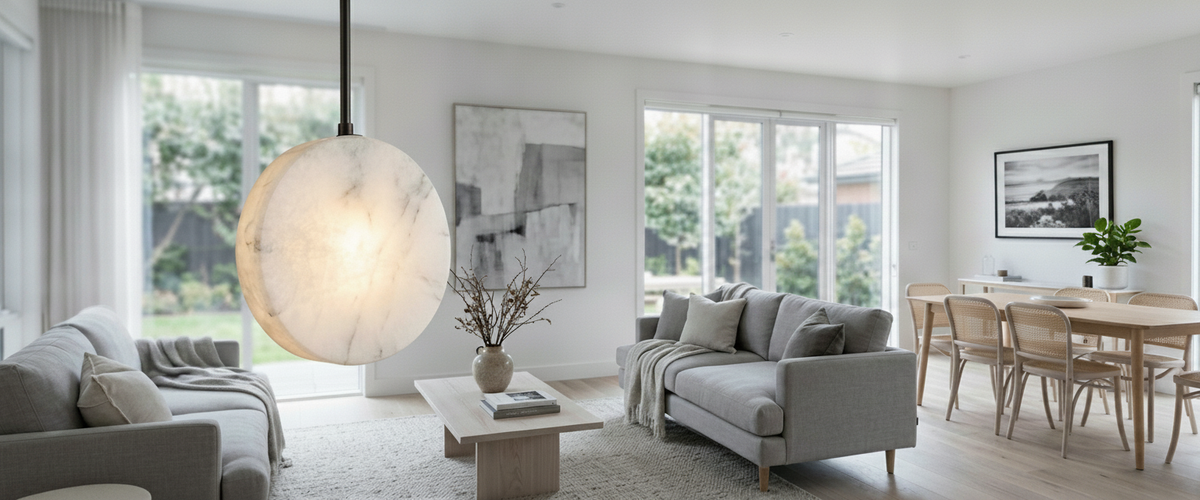

Switch on the wrong bulb behind a translucent alabaster shade and you will see exactly what went wrong: a cold, blue-white glare that flattens the stone and erases the veining you paid for. The fix is rarely the fixture. It is the bulb, and specifically whether your dimmable LED light bulbs are matched to the dimmer and the material in front of them. Alabaster rewards a slow, warm dim more than almost any other material, because the stone keeps glowing softly even when the source is turned right down.
We sell alabaster and natural-stone lighting at Niori, and the question we field most often is not about the marble or the brass detailing. It is about dimmable LED light bulbs that dim smoothly without flicker, buzz, or that ugly cut-off near the bottom of the range. So let us settle it properly.
Warm-dimmed bulbs let the alabaster veining read clearly even at low output.

Key Takeaways
Not all LEDs dim. A bulb has to be marked dimmable, and it has to be paired with an LED-rated dimmer.
Warm white wins for stone. Aim for 2700K, sometimes 2200K, to flatter alabaster veining.
Dimmer pairing matters more than wattage. Flicker and buzz almost always come from a mismatch, not the bulb itself.
Strip lights need a compatible driver. Dimmable LED strip lights run on low-voltage drivers, not a wall dimmer alone.
Place for glow, not glare. The bulb should light the stone, not stare out of the fixture at eye level.

What Dimmable LED Light Bulbs Actually Look Like Through Stone
The same bulb behaves differently depending on what sits in front of it. Behind clear glass, one of these dimmable LED light bulbs reads as a bright point. Behind alabaster, the stone diffuses and warms the output, so you see a lit panel of cream and amber with the natural mineral lines drawn through it. That diffusion is the whole point of alabaster lighting, and it is why bulb choice is so unforgiving here: the stone amplifies anything cold or harsh.
At full output, dimmable LED light bulbs give you task-grade brightness for a kitchen island pendant or a hallway. Dim them to roughly a third and the same fixture turns into evening ambience, the stone holding a low ember of light long after the room has gone quiet. That range, bright to barely-there, is what people are really buying when they ask about led lighting dimmable enough for a living room. You can see how this plays out across different fixture types in our alabaster lighting range, where the shade material is doing half the work.
Are LED Lights Dimmable? The Honest Answer
No, not all of them. A standard LED bulb often has no dimming circuitry inside, and forcing it onto a dimmer causes flicker, buzz, or premature failure. Dimmable led lighting carry the dimming electronics built in, and the packaging will say so plainly. If it does not say dimmable, treat it as fixed output. Proper dimmable LED light bulbs label this clearly.
Here is the part people miss. A dimmable bulb still needs a compatible dimmer. Old rotary dimmers were designed for the high load of incandescent bulbs, and a low-wattage LED often falls below their minimum threshold, which is what causes the bulb to flicker at the low end or refuse to switch off cleanly. You want a trailing-edge dimmer rated for LED loads. The Chartered Institution of Building Services Engineers publishes guidance on dimming compatibility that is worth a glance before you buy a houseful of switches.
So the short version: can LED lights be dimmable? Yes, when the bulb is built for it and the dimmer agrees. Match both and the result is smooth from full to a candle-low glow.
How Do Dimmable LED Lights Work
An LED itself does not dim the way an old filament did. Filaments cooled and reddened as you turned them down, which is part of why incandescent light felt so warm at low levels. LEDs use one of two methods instead. Trailing-edge dimmers reduce the voltage smoothly, which suits modern drivers and runs quiet. Pulse-width modulation switches the LED on and off faster than the eye can see, varying the ratio to set brightness.
For alabaster, trailing-edge dimming usually gives the gentler result. Some premium dimmable LED light bulbs add a warm-dim feature that shifts colour temperature downward as you lower the level, mimicking that old filament glow. Behind stone, the effect is genuinely lovely: the amber deepens into the veining as you dim, rather than the light just getting smaller. If you want the full background on warm tones and stone, our guide to choosing alabaster lighting covers how the material reads at different brightness levels.
From 2200K to 3000K: warmer tones keep alabaster looking rich rather than clinical.
Bulb Choice, Colour Temperature, and Contrast
Colour temperature is the single biggest lever you have. For alabaster and onyx, we steer almost everyone to 2700K warm white, occasionally 2200K for a candlelit feel in a bedroom or snug. Push to 3000K and the stone starts to look clinical; anything above that and you lose the warmth that makes the material worth having.
A few practical pointers when choosing led light bulbs dimmable enough for stone, since not every box of dimmable LED light bulbs suits a translucent shade:
CRI of 90 or higher. Colour rendering above 90 keeps the cream and honey tones of alabaster looking natural rather than washed out.
Match the cap. E27, E14, B22 and so on. Our candle fixtures often take E14 or E27; check before ordering.
Mind the shape. In a clear-throated fixture a candle or golf-ball bulb hides better than a fat globe. Behind solid alabaster, shape matters less because you never see the bulb.
Wattage equivalence. A 4 to 5W LED typically replaces a 40W incandescent. For diffused stone, you often need a touch more output than you expect, since the material absorbs some light.
Where the bulb sits inside carved alabaster wall lights and never shows, the cap fitting matters far more than the silhouette, so a compact 2700K candle in the right base such as the Energizer 4.2W LED Candle Bulb E27 2700K sets the warm tone you want, with the bayonet-cap B22 version covering older fittings; on a dimmer circuit, choose dimmable LED light bulbs in the same colour and shape. Contrast also plays a role: a glowing stone fixture reads strongest against a darker wall, so a soft-dimmed pendant lands better above a walnut table than against a bright white ceiling.
Dimmable LED Strip Lights for Stone and Cove Detailing
Strips are a different animal. Dimmable LED strip lights run on low voltage through a driver, so you cannot just wire one to a wall dimmer and expect smooth control. You need a dimmable driver or a controller designed for the strip, ideally matched in wattage and colour temperature.
We use warm strips, usually 2700K or 3000K, to wash light up behind a slab of backlit onyx or alabaster, or tucked into a cove to lift a ceiling. Get the wattage right and the glow is even; underpower a long run and you see hot spots near the feed. For backlighting natural stone, a continuous 2700K to 3000K run such as the Ecliptus 24V Dimmable LED Strip Light 2700K gives the closest match to the warm tone of a good filament-style bulb, while a higher-output option like the 75W 3000K strip suits longer backlit slabs where you need even coverage without hot spots. Browse the wider lighting collection if you are planning a scheme that mixes pendants, wall lights and linear detail.
Room by Room: Where the Glow Earns Its Keep
Kitchen. Over an island, a row of alabaster pendants on dimmable LED light bulbs gives you bright prep light by day and a low amber band in the evening. Keep them high enough to clear sightlines across the counter.
Living room. This is where dimming pays off most. A floor lamp or table lamp running dimmable LED light bulbs with a warm-dim feature lets you drop the room to a soft pool of light without buying new fixtures for the season.
Bedroom. Bedside alabaster lamps at 2200K to 2700K, dimmed low, are restful in a way cold light never is. Pair with a strip behind a headboard niche for a gentle wash.
Bathroom. Warm wall lights flanking a mirror, on a dimmer, soften the early-morning glare. Use fittings rated for the zone and let a qualified electrician confirm the install.
Hallway and stairs. Full output for safety, dimmed late at night. A stone wall light keeps the route lit without flooding the space.
Common Placement Mistakes We See
Buying a non-dimmable bulb for a dimmer circuit. The most frequent return reason. Check that you have actual dimmable LED light bulbs in the box.
Ignoring the dimmer. A perfect bulb on an old incandescent dimmer still flickers. Replace the switch, not the bulb.
Going too cool. 4000K behind alabaster looks grey and lifeless. Stay warm.
Hanging too low. A pendant at eye level turns a soft glow into glare across the dinner table. Lift it until you see the stone, not the source.
Mixing colour temperatures. One 2700K and one 3000K bulb in the same room read as a fault, not a feature. Keep them consistent.
We once shipped a pair of alabaster pendants to a client who swore the fixtures buzzed. They did not. The new dimmable LED light bulbs were fine, but the dimmer was an old rotary unit sitting well below the LED minimum load. One trailing-edge dimmer later, silence and a clean fade. Almost every dimming complaint we hear traces back to that pairing.
A Quick Buyer's Checklist
Confirm the bulb is labelled dimmable.
Choose 2700K (or 2200K for very soft rooms), CRI 90+.
Match the cap fitting to your fixture.
Fit an LED-rated trailing-edge dimmer.
For strips, buy a matching dimmable driver, not just a wall dimmer.
Test one of your dimmable LED light bulbs on the dimmer before committing to a full set.
Have any hard-wiring done by a qualified electrician.
Get the dimmable LED light bulbs and dimmer right and alabaster does what no other shade material quite manages: it holds light. Even dimmed to an ember, the stone keeps a warm presence in the room. That is the payoff for fussing over a small thing like the bulb behind it.