
Introduction
A single porch lantern may be charming, but it rarely delivers the security, visual impact, or property value that a fully planned exterior scheme can achieve. Properly specified outdoor ceiling lights safeguard walkways, highlight architectural details, and project the warm welcome that says “home” long after sunset.
This Ultimate Guide steers DIYers and first-time buyers through every choice - from fixture styles and IP ratings to lighting performance, weather-proof materials, and long-term maintenance, so you can illuminate porches, patios, and pergolas with confidence and style.

1. Outdoor Ceiling Lights Fixture Types: Flush-Mount, Semi-Flush & Pendants
Low-profile flush-mount luminaires sit almost level with the soffit, making them the go-to choice for verandas under 2.4 m of headroom where every millimetre counts. Choose sealed housings in powder-coated aluminium for wind-driven rain.
Semi-flush options suspend roughly 100–200 mm below the ceiling, giving space for more decorative shades and improved airflow, useful when a ceiling fan shares the joist. They excel above outdoor kitchens where a full pendant might sway in cross-breezes.
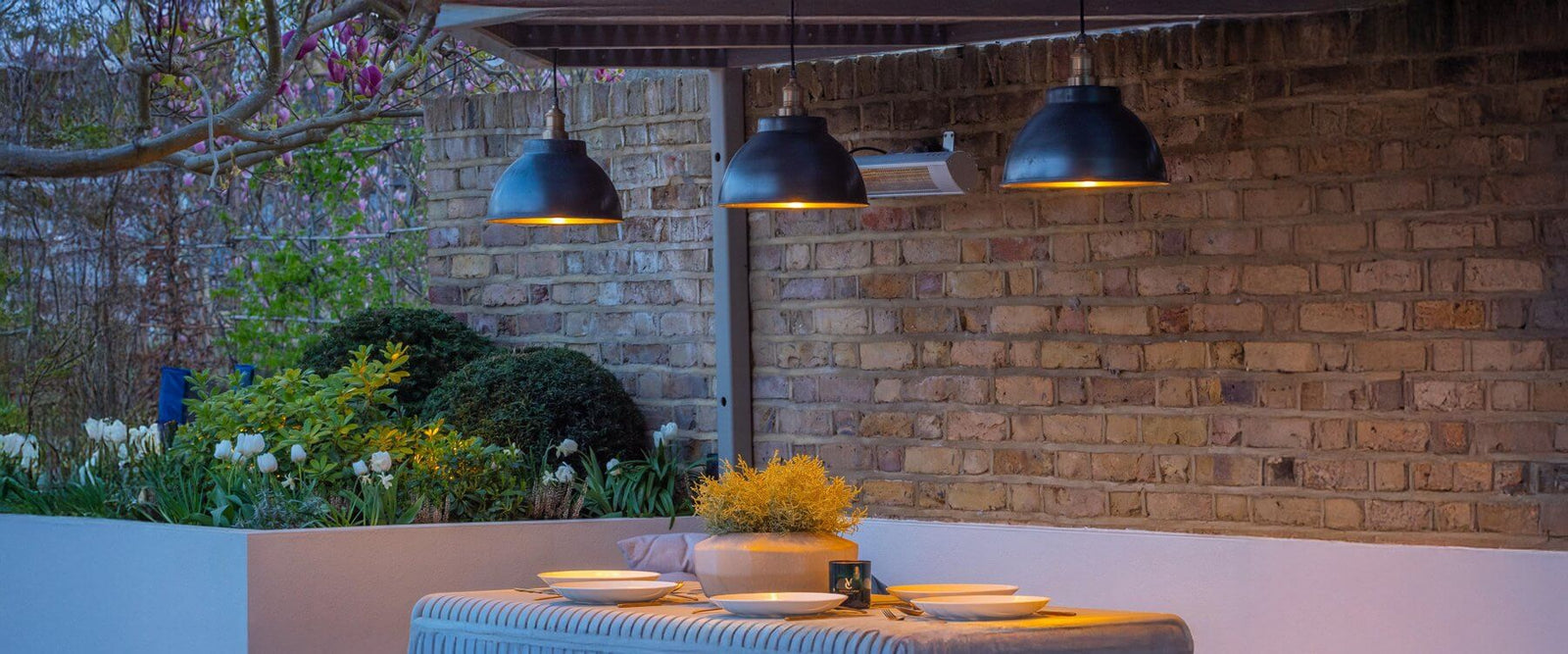
Pendant fittings become sculptural focal points under rafters that soar beyond 3 m. Industrial cage pendants deliver farmhouse character, while minimalist glass cylinders suit contemporary decks. Suspend pendants at least 2.05 m above the finished floor and 750 mm above any bar counter to maintain clear sight-lines and comply with Building Regulations Part K (headroom).

2. Understanding IP Ratings for Outdoor Ceiling Lights
Ingress Protection (IP) codes are a two-digit shorthand for a luminaire’s defence against solids and liquids. The first digit (0–6) handles dust; the second (0–9K) tackles moisture:
IP44 — Suitable for deep porches or soffits that are protected by generous eaves in calm climates.
IP54 — Ideal for wind-swept coastal gardens where salt spray and fine grit can enter housings.
IP65 — Best for unsheltered pergolas, carports, or balconies that face driving rain.
IP66–IP67 — Recommended for exposed sea-front decks, jetty-side pubs, or fixtures mounted beneath balconies where snow-melt cascades.

3. Lighting Performance Essentials
-
Brightness Targets
Aim for ≈ 100 lux along pathways to avoid shadows and trip hazards.
Plan ≈ 200 lux above alfresco dining tables so food colours read naturally.
Check the lamp’s lumens-per-watt rating (higher is more efficient).
-
Colour Temperature (Kelvin)
2 700 K – 3 000 K gives a warm, golden glow, ideal for brick or timber façades.
3 000 K – 4 000 K offers a neutral, crisper light that flatters render and contemporary decking.
Keep one temperature per zone to avoid patchy colour shifts.
-
CRI (Colour Rendering Index)
Choose CRI ≥ 80 for everyday use; upgrade to CRI 90+ if you want stone textures and planting to look vivid after dark.
-
Beam Angle & Spread
60–90° narrow beams spotlight tables or feature planters.
120–140° broad beams bathe large patios in an even wash, perfect for flush-mount soffit runs.
-
Dimming & Smart Controls
Select fittings labelled trailing-edge dimmable or DALI-ready if you intend to fine-tune ambience.
Pair with PIR or dusk-to-dawn sensors to meet Part L energy-efficiency goals and reduce electricity bills.
-
Lifetime & Reliability
Favour LEDs with an L70 ≥ 50 000 h rating, around 14 years at 10 h per night.
Ensure drivers are replaceable and confirm spare availability before purchase.

4. Weatherproof Materials & Finishes for Outdoor Ceiling Lights
From drizzle-soaked Devon mornings to salt-laden North Sea gusts and the occasional Mediterranean-grade heatwave in the South-East, UK weather batters exterior metals year-round. Choose materials that stand up to each element:
Powder-coated cast aluminium – Lightweight, won’t rust, and available in virtually any RAL colour; perfect for most suburban patios.
Galvanised steel – Offers industrial strength for pub gardens and barn conversions, but apply a clear lacquer every few years to keep the zinc layer bright.
Stainless steel 304 vs 316 – Grade 304 is fine for inland terraces, while molybdenum-rich 316 is essential for coastal decks from Cornwall to Aberdeenshire.
Glass-reinforced plastic (GRP) & resin composites – Mimic timber or rattan without warping, making them a solid pick for humid riverfront homes.
Nano-ceramic sealants – Premium fixtures now add this invisible barrier, extending salt-spray warranties up to 10 years, a wise investment if your balcony faces the Channel or braves Atlantic storms.
5. Regional Code Compliance for Outdoor Ceiling Lights
UK wiring must satisfy BS 7671 (IET Wiring Regulations). Outdoor ceiling lights require RCD protection ≤ 30 mA, with IP65 fittings within 3 m of hot tubs, pools, or garden ponds (Special Location Zone 1). Scotland incorporates these rules into the Technical Handbook Section 4, while Ireland references ET 101. Always check: fines for non-compliance can exceed the cost of the entire decking project.

6. Maintenance & Troubleshooting for Outdoor Ceiling Lights
Quarterly clean: Wash shades with pH-neutral soap and a microfibre cloth; avoid ammonia cleaners that streak powder-coat.
Lamp choice: Fit LED A60 or filament bulbs marked “wet location,” 80 + CRI and 2700 K to deter insects while preserving warm ambience.
Gasket audit: Inspect rubber seals each spring. Replace hard or cracked gaskets, condensation shorts drivers faster than rain ever will.
Flicker fix: If a fitting blinks, check torque on screw terminals, dryness inside the canopy, and driver temperature. Prompt maintenance keeps luminaires bright and safe for years.

7. Smart Controls & Energy Efficiency in Outdoor Ceiling Lights
Pair intelligent switches with PIR sensors on secondary circuits so paths illuminate only when needed. Integrated LEDs use a tenth the energy of halogen GU10s and often carry L70 ratings of 50 000 h, around 14 years at 10 h per night. Many UK energy suppliers offer ECO4 grants or Green Deal loans toward efficient retrofits, shortening payback to a single season of electricity bills.
8. Design Trends & Cost Planning for Outdoor Ceiling Lights
Mixed metals: Anthracite frames trimmed with brushed brass soften modernist façades.
Oversized shades: Lanterns 500 mm across anchor deep verandas, preventing fittings from looking undersized against tall columns.
Eco-materials: Bamboo composites and recycled glass echo biophilic design while cutting embodied carbon.

Conclusion
Selecting the best outdoor ceiling lights balances engineering with aesthetics. Match fixture style to ceiling height, specify IP ratings that outlast your microclimate, and choose corrosion-proof materials. With flush-mount, semi-flush, and pendant options in robust finishes, and smart controls that save energy, you’ll enjoy a safer, more stylish exterior every evening of the year. Browse our curated range of outdoor ceiling lights, flush-mount, semi-flush, and weather-rated pendants, to complete your space.