
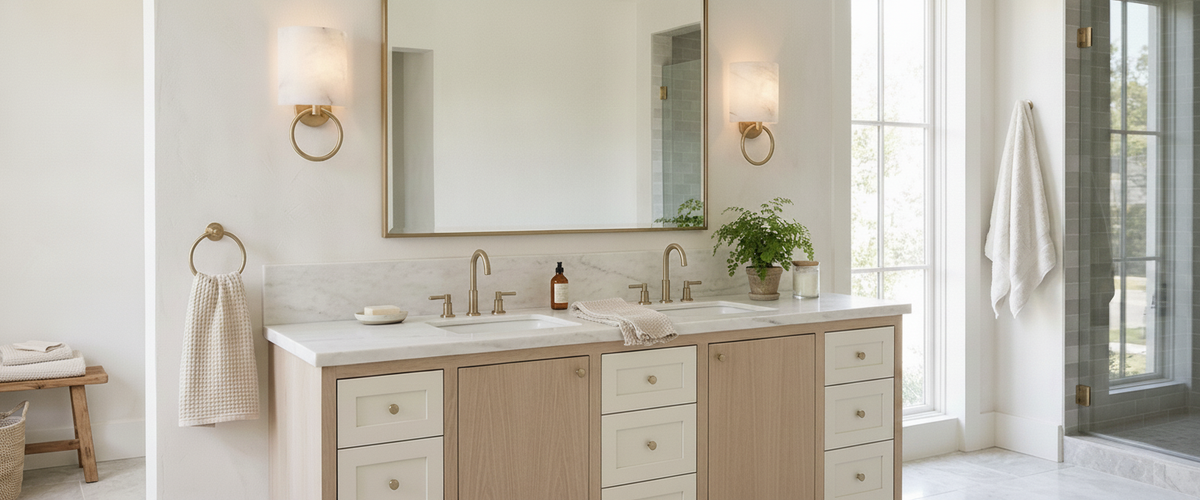

Stand under a single ceiling downlight at your basin and the mirror will tell you a lie. Shadows pool under your eyes, your jaw looks heavier than it is, and you start blaming the glass or the late night. The glass is fine. The lighting is the problem, and most of the best bathroom vanity lighting ideas come down to one fix: light the face from the sides, not just the top.
At Niori we build alabaster and natural-stone fittings, so we spend a lot of time on how light lands on skin. A vanity is the one place in the house where you inspect your own face at close range in a fixed spot. Get the light wrong and every morning starts on the back foot. The strongest bathroom vanity lighting ideas all start from that close-range test.
Sconces flanking the mirror at face level cross-light the face and cancel shadows.

Key Takeaways
Overhead-only light creates under-eye and jaw shadows; add light at eye level to fix it.
Flank the mirror with sconces at roughly 60 to 66 inches (1.5 to 1.7 m) centre height, spaced 28 to 40 inches (700 mm to 1 m) apart.
Aim for 2700K to 3000K colour temperature and CRI 90 or higher so skin tones read honestly.
Alabaster and stone diffusers soften glare without stealing brightness.
Small and light-blue bathrooms can bounce light off pale surfaces to spread it further.
Water zones dictate IP ratings; a qualified electrician signs off placement.

Why Overhead-Only Light Carves Those Under-Eye Shadows
A downlight sends light straight down. Your brow, nose, and cheekbones then cast shadows into the exact hollows you are trying to see clearly: the under-eye area, the sides of the nose, the jawline. That is why a bathroom lit only from the ceiling makes almost everyone look drawn. Most bathroom vanity lighting ideas that fail do so right here.
The correction is cross-lighting. Two sources at roughly face height, one either side of the mirror, fill in those shadows from the front. Overhead light still earns its place as general fill; it just should not be doing the job alone. Think of ceiling fittings as the room's ambient layer and the vanity sconces as the working light for your face.
Sconces Flanking the Glass: Height and Spacing That Light a Face
Position matters more than wattage, and it drives the best bathroom vanity lighting ideas. Mount a pair of wall lights vertically on each side of the mirror, centred around eye level, roughly 60 to 66 inches (1.5 to 1.7 m) from the floor. Space them 28 to 40 inches (700 mm to 1 m) apart depending on mirror width. That spread wraps light around both sides of the face and kills the central shadow a single overhead source creates.
For a mirror wide enough to flank properly, a slim single fitting on each side such as the Paulson 1 Light Bathroom Wall Light keeps the source compact and at face level rather than dominating the wall. If your mirror is too wide to flank, a horizontal bar fitting mounted above works as a compromise, but keep the diffuser generous and the source soft so it does not glare down onto you. For a face-first result, side-mounted sconces beat a top bar almost every time. Browse the wall-light options across our full lighting range to see which forms suit a vanity run.
One detail from the studio: clients often mount sconces too high, up near the ceiling, treating them as decoration rather than working light. Bring them down to face level and the same fitting suddenly does its job. Height is the single most common miss we correct, and it undoes more bathroom vanity lighting ideas than any other mistake.
Colour Temperature and CRI That Tell the Truth About Skin
Two numbers decide whether your mirror is honest. Colour temperature sets the warmth; CRI (colour rendering index) sets the accuracy. Both belong in any list of bathroom vanity lighting ideas worth following.
For a vanity, aim for 2700K to 3000K. That warm-white band flatters skin without going orange, and it matches the light most homes use in living spaces, so your make-up or grooming reads the same when you leave the room. Cooler 4000K light can feel clinical and drain warmth from the face.
CRI is the one people skip. A high CRI, ideally 90 or above, means the fitting renders reds and skin tones truthfully. Cheap lamps with low CRI make foundation look grey and lips look wrong, which is exactly how you end up doing make-up in the wrong light entirely. The Chartered Institution of Building Services Engineers publishes lighting guidance that underlines why colour rendering matters in spaces where accuracy counts (see the CIBSE resources). Buy lamps that state both numbers and match every bulb at the vanity so nothing casts a colour cast onto your face.
How Alabaster and Stone Diffusers Soften a Vanity Fitting Without Dimming It
Translucent alabaster softens glare while keeping brightness up at the mirror.
Bare bulbs beside a mirror create glare and hard reflections; frosted glass helps but can look flat. Alabaster and natural stone do something better. Because these materials are genuinely translucent, light passes through the stone and comes out softened and even, carrying the faint veining of the material with it. You get a gentle, wraparound glow rather than a hot point of light. This is where the material-led bathroom vanity lighting ideas earn their keep.
The advantage at a vanity is that the diffusion softens shadows on the face while keeping brightness up. You are not trading light for comfort. A slim alabaster sconce either side of the mirror gives flattering fill and reads as a considered piece of the room rather than a utility fitting. Our alabaster lighting collection shows how the stone handles warm light, which is the same quality you want working on skin. Each piece of alabaster is unique, so the veining varies from fitting to fitting.
Small Bathroom Lighting Ideas and Light-Blue Schemes
Compact rooms have a hidden advantage: pale, close walls bounce light back at you. Use that. Among the most useful small bathroom lights ideas, one pair of well-placed sconces plus modest overhead fill often does more than a ceiling crammed with downlights. Overload a small ceiling and you get glare and flat, shadowless light that still leaves your face poorly lit. The same bathroom vanity lighting ideas scale down neatly to tight spaces.
For light blue bathroom ideas, a cool wall colour can pull the room chilly if your lighting follows suit. Counter it by keeping lamps firmly in the 2700K to 3000K range so the warm light balances the cool tiles. Warm brass or aged-brass detailing on a sconce also sits well against pale blue and stops the scheme feeling clinical; where you want that warmth against the tiles rather than more chrome, a piece like the Malibu 1 Light Wall Light in Brushed Brass gives the finish the scheme is asking for. Matt or satin surfaces bounce light more softly than high-gloss tile, which can throw sharp hotspots.
Bathroom Ceiling Lighting Ideas That Support the Vanity
Ceiling fittings do the ambient work: even fill so the room is safe and comfortable to move around. For bathroom ceiling lighting ideas that support rather than fight the vanity, keep the ceiling layer on the same warm colour temperature as your sconces and put it on a separate switch or dimmer. That way you can drop the overhead to a low glow for a bath and bring the vanity sconces up for detailed work. Good ceiling bathroom lighting ideas layer with the mirror lights rather than replacing them, and they pair naturally with the bathroom vanity lighting ideas above.
Recessed downlights work well set back from the mirror wall rather than directly above your head at the basin, which avoids re-introducing the top-down shadows you just solved. A flush alabaster or stone ceiling fitting can serve as the soft general light in a smaller room where recessed spots feel too busy. If you are weighing up different bathroom ceiling lights ideas, favour soft, diffused sources over hard spots aimed straight down.
IP Zones and Safe Placement Near Water
Bathrooms are split into IP zones based on distance from water, and each zone dictates the minimum ingress-protection rating a fitting must meet. Any bathroom vanity lighting ideas you settle on have to respect these zones first. Fittings near the basin generally need an appropriate rating for splashing, commonly IP44 or higher depending on position; a rated sconce such as the Payne 1 Light Bathroom Wall Light IP44 is built for those splash zones rather than adapted from a dry-room fitting. Fittings inside a shower or above a bath sit in stricter zones again.
This is where you stop and bring in a professional. A qualified electrician must confirm the zone for each fitting position and the correct IP rating, and complete the wiring to current regulations. Electrical-safety guidance is clear that bathroom electrical work should be done and certified by a competent person; treat any wiring as a job for a registered electrician, not a weekend project. When in doubt, ask before you buy so the fitting you choose is rated for where you want it.
The Vanity Mistakes That Leave You in the Wrong Light
Overhead only. No side light means permanent under-eye shadow.
Sconces too high. Mount them at face level, not near the ceiling.
Mixed colour temperatures. One warm lamp beside one cool lamp throws a colour cast across your face.
Low CRI bulbs. Skin tones read grey and make-up looks wrong.
Bare or over-bright bulbs. Glare beside a mirror tires the eyes; a stone or alabaster diffuser fixes it.
Ignoring IP zones. Wrong rating near water is unsafe and non-compliant.
No dimming. One brightness for shaving and early showers is a compromise you do not need.
Fix the height, match the temperature, respect the water zones, and let a translucent stone diffuser do the softening. That is most of the work behind the best bathroom vanity lighting ideas. The mirror will start telling the truth again, and you will stop blaming your reflection for what the lighting was doing all along. If you want a fitting specified for a particular vanity or bathroom zone, ask us for a tailored recommendation on bathroom vanity lighting ideas; budget depends on material, scale, and finish rather than a fixed price.