
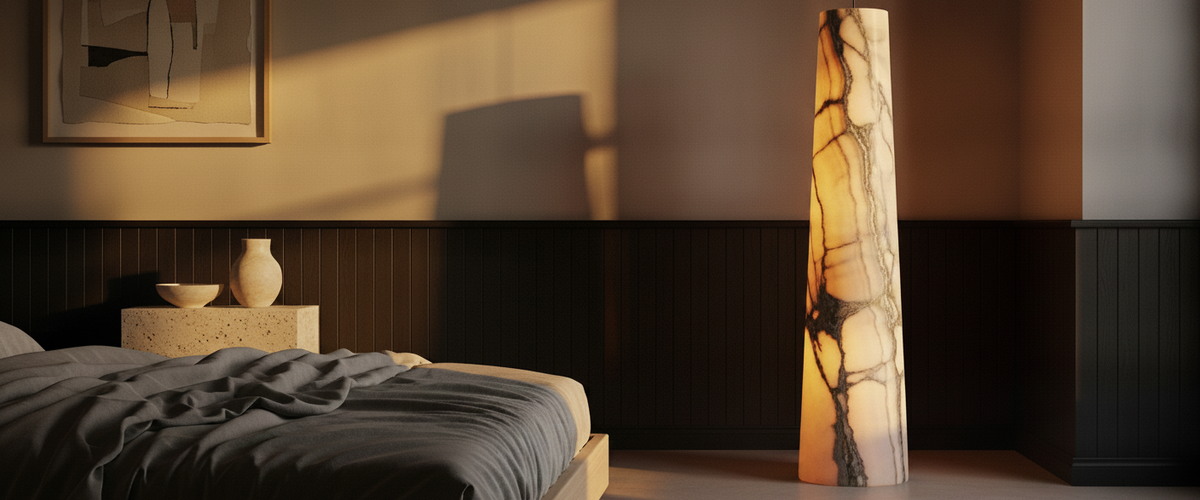

Hold a thin slice of onyx up to a window and it lights up like stained glass. Do the same with most granite and you get a dark slab with a sunny edge. That single difference, the way a stone carries light rather than blocking it, decides whether natural stone lighting fixtures read as quiet jewellery or as a lamp wearing a heavy coat. Before you choose a pendant, a wall light, or a table lamp, you need to know which stones glow and which simply sit there lit.
Niori works almost entirely with the materials that pass that test, so the advice below comes from natural stone light fixtures we ship and install rather than a generic spec sheet.

Key Takeaways Before You Buy
Translucency, not colour, is the first thing to check. Alabaster and onyx transmit light; basalt and most granite do not.
Backlighting reads as jewellery; downlighting reads as architecture. Decide which effect you want before you pick a fixture type.
The room's natural light rewrites the same stone. A cool north-facing kitchen and a warm south-facing terrace will not show the same lamp the same way.
Veining is unique per block. No two alabaster shades match exactly, which is part of the appeal and a planning point for matched pairs.
Budget depends on material, scale, engineering and finishing. Ask for a tailored quote rather than guessing from a stock figure.

The Translucency Test: Which Stones Glow and Which Simply Sit There Lit
Run this test in your head with any stone you are offered. Could you put a bulb behind it and see warmth come through the surface? Alabaster passes easily; it is a fine, soft gypsum stone that softens and scatters light into an even glow with no hot spot. Onyx passes too, but louder, throwing its banding into sharp relief when lit from behind. Marble is a halfway case: thin sections glow gently, thicker pieces mostly reflect. Travertine and basalt sit firmly in the opaque camp, which does not make them poor materials for natural stone light fixtures. It means they want to be lit from the outside, not the inside.
This is why Niori builds its translucent natural stone light fixtures in alabaster and onyx and saves dense stone like basalt for outdoor bollards where the stone is the housing, not the lampshade. The alabaster lighting range leans into the glow; the broader natural stone light fixtures use opacity on purpose. Where the stone is the housing rather than the shade, a basalt piece such as the Parkstone Medium LED Bollard shows how opacity carries light from the top rather than through the body. If you want the candle-from-within effect, you need a stone that transmits light. If you want a solid sculptural column with light spilling from the top, opacity is your friend.
Colour follows the same logic. A lighting blue natural stone or a soft light green natural stone can read beautifully when backlit, but only if the stone is thin and translucent enough to carry the tone. A light grey natural stone often holds its character better under direct light, where the surface and veining do the work rather than the glow. If you are still weighing materials, our guide to alabaster versus marble lighting breaks down how each handles a bulb in practice.
Kitchen Island Versus Stairwell Versus Covered Terrace: Three Rooms, Three Readings
The same fixture behaves very differently depending on where it hangs.
Over a kitchen island, you are working at eye level and people stand under the light for hours. Natural stone pendant lights in alabaster suit this perfectly because the diffusion kills glare; no one squints across the worktop. We usually advise a linear run or a pair of pendants centred on the island, hung roughly 30 to 36 inches (76 to 91 cm) above the surface so heads clear them and the glow reaches the counter without blinding anyone seated.
In a stairwell, the fixture is seen from above, below and the side as you move. A tall alabaster pendant or a small stone chandelier dropped down a double-height void becomes a vertical event. Here the stone is read against shadow, so veining and form matter more than even wash. One client in a townhouse refit dropped a single elongated alabaster pendant three storeys and it carried the whole stairwell; we did not need any secondary lighting on the landings. This is where natural stone light fixtures earn their keep as a single bold gesture.
On a covered terrace, daylight competes with the fixture, so a delicate glow disappears at noon and only earns its keep at dusk. This is where outdoor-rated natural stone light fixtures change tack. A basalt bollard reads as solid architecture in daylight and a warm marker after dark, which is a different job from the inside-out glow of alabaster. For a wider terrace or a longer path where the marker needs more presence, the Parkstone Large LED Bollard holds the same logic at a bigger scale. Match the fixture to how the room is actually used through the day, not just how it photographs at night.
Why Backlit Onyx Reads as Jewellery and Downlit Travertine Reads as Architecture
Light direction is the quiet decision most buyers of natural stone light fixtures skip. Backlit onyx, with the source behind a thin slice, turns the stone into the spectacle. The banding glows, the colour deepens, and the piece behaves like a lit gem. It pulls focus, so place it where you want the eye to land: a bar front, a single feature wall light, a hero pendant over a dining table.
Downlit travertine does the opposite. The light grazes a solid, opaque surface and reveals texture and pitting without pretending the stone is glowing. It reads as architecture: grounded, calm, structural. That is the right call for a stone table lamp where you want a warm column anchoring a console rather than a glowing object stealing the room. Where the brief is exactly that grounded column, the Tervel LED Travertine Stone Table Lamp washes the stone and the surface around it rather than shining through the body.
The American Museum of Natural History notes that onyx and travertine are both calcium carbonate formations, yet they handle light in opposite ways because of how densely they are layered (amnh.org). Two related stones, two completely different natural stone light fixtures.
Cool Northern Light Versus Warm Southern Light: How Each Rewrites the Same Fixture
A north-facing room in Manchester gets cool, blue-leaning daylight; a south-facing room gets warmer, longer light. The same alabaster pendant will look slightly grey and crisp in the first and noticeably honeyed in the second. This matters when you choose your bulb for natural stone light fixtures.
In cool, north-lit rooms, a warm bulb around 2700K restores the comfort the daylight strips out, and the stone's cream tones come back to life after dark. In warm, south-lit rooms you can push slightly cooler, towards 2700K to 3000K, so the glow does not turn orange in the evening. Always specify dimmable LEDs and a compatible dimmer; alabaster looks its best dimmed down to a low, candle-like level where the veining floats. Test the bulb colour against a sample in the actual room before committing to a matched set. We have remade orders simply because a buyer judged the colour under shop lighting rather than at home.
If you want to see the full spread of fixture types before deciding, the lighting collection covers pendants, wall lights, table and floor lamps in one place.
Placement Mistakes We Keep Correcting on Second Visits
A few errors come up again and again when we revisit a project that uses natural stone light fixtures.
Hanging stone pendants too high. Lifted to ceiling-hugging height, an alabaster pendant stops washing the table and becomes a distant smudge. Drop it.
Mixing warm and cool bulbs in one room. Two alabaster wall lights at 2700K beside a downlight at 4000K will make the stone look dirty. Keep colour temperature consistent across your natural stone light fixtures.
Backlighting an opaque stone and wondering why it stays dark. If the stone failed the translucency test, no bulb will rescue it. Switch to downlighting or change the stone.
Ignoring weight on the fixing. Stone is heavy. A large alabaster pendant or chandelier needs a fixing rated for the load and a qualified electrician to mount it; never hang it from a standard ceiling rose without checking the structure.
Buying a matched pair expecting identical veining. Natural stone varies block to block. Embrace it or order both pieces from the same batch and accept they will be close cousins, not twins.
Care and Mounting in Brief
Alabaster is softer than marble and porous, so it dislikes water and harsh cleaners. Dust with a dry, soft cloth and wipe spills quickly. For natural stone counters and pavers nearby, sealing and gentle pH-neutral cleaning keeps surfaces stable, advice echoed by the Natural Stone Institute's care guidance (naturalstoneinstitute.org). When you mount any of your natural stone light fixtures, fix into solid structure, use the supplied bracket or a load-rated alternative, and leave the wiring to a qualified electrician.
Get the stone, the direction of light and the room's natural light pulling in the same direction, and natural stone light fixtures stop being a lamp and become the thing people notice first.