
Introduction
Modern chandeliers can transform a room quickly, but they can also look oddly small, uncomfortably dominant, or simply “not quite right” if the proportions are off. We see the same frustrations repeat: the wrong diameter for the space, the wrong drop for the ceiling height, and the wrong type of light for how the room is actually used. When you get the sizing right, everything else style, placement, and comfort falls into place.

Why Do Modern Chandeliers So Often Disappoint Once They’re Fitted?
Modern chandeliers usually disappoint because people choose the design first and only think about scale once it arrives.
In a showroom, the ceiling is high, the room is uncluttered, and the fixture is displayed at the perfect height with ideal surrounding finishes. At home, your chandelier has to work with real life: doorways, sightlines from the sofa, head height in walkways, and furniture that may not sit exactly where you imagined.
A typical example: A compact dining space where the table is centred but the room isn’t. A chandelier that looks “safe” online ends up too small once it’s above the table, and the whole area feels unfinished. The opposite happens too an oversized fitting may look dramatic in a styled photo but feels oppressive when you’re seated beneath it every day. If the chandelier doesn’t suit the room’s scale and the way you move through it, you’ll notice it constantly.

What Counts As “Modern” When We Talk About Modern Chandeliers?
Modern chandeliers are defined by clean forms, restrained detailing, and a strong focus on proportion.
You’ll often see rings, linear bars, sculptural arms, slim globes, or integrated LED profiles rather than ornate curls and heavy embellishment. The overall look tends to be lighter and more architectural, which is exactly why sizing is so important: there’s less decorative “noise” to hide a fixture that’s too small, too large, or hung at the wrong height.
Modern styles also lean towards intentional negative space space that’s meant to be seen. That means the silhouette needs to relate to the room: the table beneath it, the seating zone it anchors, and the ceiling plane it sits against. Even finish plays a role; a modern brushed metal can look sleek in daylight but feel cold in the evening if the light temperature is wrong. In other words, “modern” isn’t just the shape it’s the whole effect.

Why Does Sizing Matter More Than Almost Anything Else?
Sizing matters because Modern chandeliers are meant to balance the room, not dominate it or disappear into it.
When a chandelier is too small, it looks like it was added last minute and the zone beneath it can feel less considered. When it’s too large, it can visually lower the ceiling, interrupt views across the room, and make the space feel crowded.
The right size creates calm. It frames the table without swallowing it, or defines a living area without blocking sightlines. It also affects the quality of light: the wrong scale can put glare in your eyes, leave the edges of a table in shadow, or create an awkward pool of light that doesn’t match how you use the room.

What Are The Most Common Mistakes To Avoid With Modern Chandeliers?
The most common mistakes are choosing the wrong scale, hanging at the wrong height, and ignoring light quality.
Here are the errors we see most often:
Going too small: because you’re worried about overpowering the room
Going too large: because the ceiling is high (height helps, but it’s not the only factor)
Hanging too high: so the chandelier feels disconnected from the space below
Hanging too low: so it blocks conversation, views, or safe movement
Assuming it will light the whole room: without support from other fittings
Choosing harsh light: that feels clinical rather than comfortable
Forgetting about installation: (ceiling type, fixing points, weight) until the last moment
Each of these has a simple fix once you know what to look for.

How Do I Size Modern Chandeliers Properly? (Step-by-Step)
You size Modern chandeliers properly by using room measurements, then checking furniture scale and hanging height.
Step 1: Use the room as your starting point
Measure the length and width of the room. Add them together (in feet) and convert that number to inches to estimate a useful chandelier diameter. It’s a guide, not a rule, but it prevents the most common “too small” mistake.
Step 2: Let the furniture lead the decision
For a dining table, aim for the chandelier to be roughly half to two-thirds of the table width. For a kitchen island, keep it tighter and longer rather than wide and bulky. For a living room, size to the seating zone (often the rug or coffee table footprint), not the full room dimensions.
Step 3: Match drop to ceiling height
A chandelier should sit within the room’s visual zone. With higher ceilings, you usually need a longer drop or a design with vertical presence so it doesn’t look like it’s hovering near the ceiling line.
Step 4: Check “visual weight,” not just dimensions
A thin ring can be wide without feeling heavy. A dense cluster can feel heavy even when the measurements are modest. Consider how open or solid the design looks from the side.
Step 5: Plan the lighting layer
Treat the chandelier as part of a scheme. Add lamps or wall lights so you can soften the room and avoid relying on one fitting for every task.

How Do Modern Chandeliers Work In a Small Dining Room?
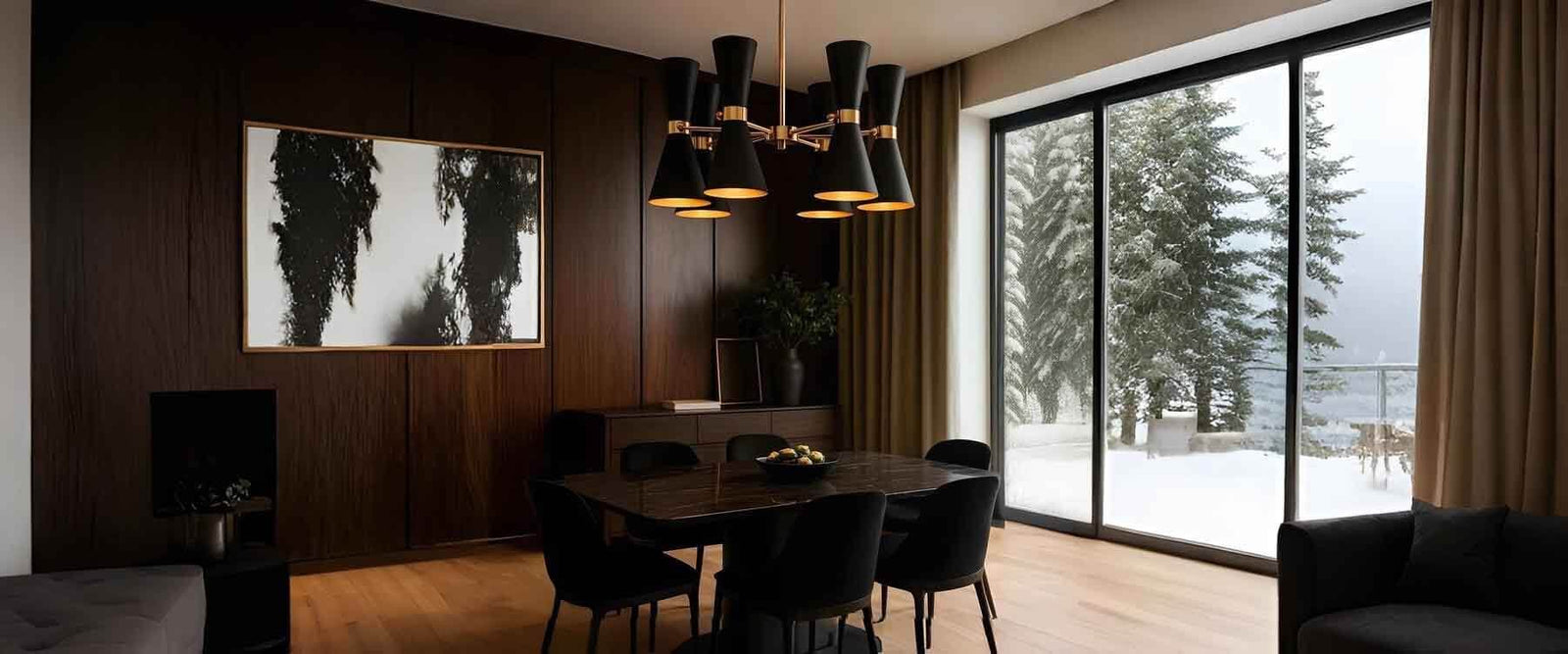
Modern chandeliers work in a small dining room when the design is visually open, table-led in scale, and warm in light output.
In compact spaces, a chandelier often becomes the main “anchor” above the table, so it needs to be confident without being bulky. Open frames, slim arms, and linear designs keep the ceiling feeling taller. A diffuser (or shaded light source) helps prevent glare when you’re seated.
A real-world approach that works well: if your table is narrow, choose a more elongated silhouette rather than a wide, dense cluster. This keeps the chandelier aligned with the table surface and makes the room feel intentionally designed. If the dining area sits within an open-plan layout, size and position the chandelier to that specific zone so it feels like a dining room, not just a table placed in a larger space.

How Do I Choose Modern Chandeliers For High Ceilings Without Making The Room Feel Empty?
You choose Modern chandeliers for high ceilings by increasing drop, presence, or both so the fixture connects the ceiling to the living space.
The mistake we see most is a small chandelier mounted near the ceiling, leaving a tall empty volume beneath it. A longer stem or multi-drop suspension brings the chandelier into the room’s visual field, where it can actually do its job.
For very tall spaces, think beyond one fitting. Layering helps: a chandelier for identity and ambient glow, plus wall lights to give the room depth and to stop the walls feeling dark. If the room has strong vertical lines tall windows, double-height shelving, or stair voids choose a chandelier that echoes that verticality rather than fighting it.

What Are Good Modern Chandeliers Ideas For Living Rooms?
Modern chandeliers ideas for living rooms work best when they anchor the seating zone and support the rest of the lighting.
Living rooms rarely need a single central light to do everything. They need comfort, flattering light on faces, and flexibility. Position the chandelier over the coffee table or the centre of the seating layout, then use floor lamps and wall lighting to create layers.
If you like a softer, classic note, it can help to look at traditional chandeliers for proportion ideas, then translate that into a cleaner modern shape. The aim is the same: balance the room, keep sightlines clear, and avoid glare when you’re relaxing.

Are There Modern Chandeliers That Aren’t Too Heavy To Hang?
Yes many Modern chandeliers are designed to be lighter than older styles, but you still need to confirm weight and fixing requirements.
Modern fittings often use aluminium frames, slimmer components, acrylic diffusers, and integrated LEDs that reduce the overall load. Even so, ceiling type matters. Plasterboard usually needs the right anchors or a joist position; older ceilings can vary and may require a proper assessment before installation.
If you’re trying to keep things straightforward, look for:
A clear stated weight and fitting method
A canopy that suits your ceiling rose position
A drop range that works without awkward extensions
And if you’re drawn to sparkle, remember that crystal chandeliers can look airy while being heavier than expected always check before you buy.

How Do I Get Soft Ambient Light From Modern Chandeliers?
You get soft ambient light from Modern chandeliers by choosing warm colour temperature, good diffusion, and sensible brightness for the space.
Warm white (around 2700K-3000K) is typically the most flattering in homes. Diffusers, shaded sources, or indirect LED designs reduce hotspots and soften shadows. Dimming is the finishing touch it lets you shift from everyday brightness to evening ambience without changing the fitting.
A practical guideline: if your chandelier is your main ceiling feature, don’t expect it to be your only light source. Combine it with lamps or wall lighting so the room feels balanced from corner to corner, not bright in the middle and gloomy at the edges.

Where Do People Go Wrong With Style Matching?
People go wrong with style matching when they copy a look without considering finishes, scale, and the room’s existing details.
A modern chandelier can look stunning in a period home, but only if you choose a finish that relates to the space think warm metals that echo door furniture, or a soft black that ties into window frames. In contemporary homes, the mistake is often mixing too many statement finishes at once, making the ceiling line feel busy.
If your décor includes colour or decorative glass, you can bring that in gently without overpowering the room. Even a subtle nod to tifanny lighting can work if the form stays clean and the scale is right. Brand choices matter too: we’re often asked about Feiss Lighting for modern-classic options, and the sensible approach is to confirm dimensions, drop range, and light output first, then choose the finish that suits your palette.

Quick Summary
Modern chandeliers look best when scale is led by the room and the furniture beneath
The biggest mistakes are wrong diameter, wrong drop, and harsh light
High ceilings need extra presence so the chandelier sits within the living zone
Soft ambient light comes from warm temperature, diffusion, dimming, and layered lighting
Always plan for ceiling fixing and weight before installation day

Conclusion:
Modern chandeliers succeed when you treat them as a measured design choice rather than a last-minute decoration. This guide covered the main pitfalls choosing the wrong size, hanging at the wrong height, overlooking ceiling and weight requirements, and picking light that’s too harsh for real living. We also looked at how to apply the same principles to small dining rooms, high ceilings, and living rooms, where zoning and layered light make all the difference. When proportion, placement, and soft ambient glow work together, the chandelier becomes a natural focal point that improves the whole room.