
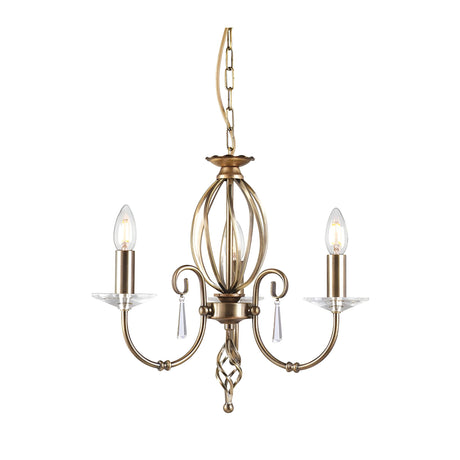
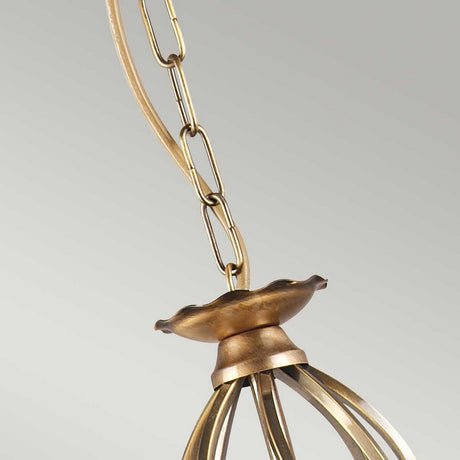
 £16499Unit price Translation missing: en.products.product.price.unit_price_separatorUnavailable
 Free Delivery
 Sold outSave 71%£19900£67900Unit price Translation missing: en.products.product.price.unit_price_separatorUnavailableOut of StockFree Delivery
 Save 30%£60099£85800Unit price Translation missing: en.products.product.price.unit_price_separatorUnavailableFree Delivery


Our dining room chandeliers: what we hand-pick and why
We hand-pick 2,425 dining room chandeliers across more than 17 brands. Our own-brand Niori range covers 317 pieces, sitting alongside selected ranges from Diyas (414), Mantra (410), Impex (345), Ideal Lux (301), Maytoni (154) and others. Every piece in the range, own-brand and third-party, has been chosen for the same thing: it needs to sit over a dining table and hold the room together without trying too hard.
The catalogue breaks down into 1,648 chandeliers, 546 pendants, 190 linear lighting pieces and a small number of ceiling lights and supporting fixtures. Materials run heaviest in metal (2,394 pieces use metal in the frame or arms), with 897 crystal, 773 glass, 245 fabric shade, 180 alabaster and 90 acrylic options across the range. Price bands span under £150 through to £1,500+, with the largest cluster in the £150-£400 working range and a substantial £400-£800 designer band above it.
The dining room chandelier sized for your table
The single most useful rule when choosing a dining room chandelier is sizing it to the table beneath it, not to the room around it. As a starting point, the chandelier diameter should sit between half and two-thirds the width of the dining table. A 90cm round table reads well under a 45-60cm fixture; a 180cm rectangular table carries an 90-120cm linear bar or a wider tiered piece. Going smaller leaves the table feeling unlit at the edges; going wider pushes the fixture into the chairs and into anyone sitting down.
For rectangular and oval tables, a linear chandelier or a pair of pendants spaced along the table length usually works better than a single round fixture. For round and square tables, a single round, drum or tiered piece centred over the table is the standard move. We layer the catalogue filters by table shape, length and diameter so you can shortlist quickly.
Dining table chandelier styles and shapes: linear, round and drum
Within the dining table chandelier category we group the range into four main shape families. Linear chandeliers run as horizontal bars or branched rails, sized for rectangular tables and kitchen-diner islands. The 190 linear lighting pieces in the catalogue sit here, with multi-light configurations from 3-light up to 12+-light spread across the bar. Round chandeliers and ring fixtures suit round and square tables, with circular frames carrying crystal drops, glass shades or exposed bulbs around the perimeter.
Drum chandeliers wrap the lamps inside a fabric shade or perforated metal drum, giving a softer light register and a cleaner silhouette. They work well in spaces where you want the chandelier to read as one calm shape rather than a branched fixture. Tiered chandeliers stack two or three rings of arms, giving the volume needed under higher ceilings and over larger tables. Across all four shapes we cover crystal, alabaster, glass, metal and fabric shade finishes.
Modern dining chandelier: contemporary register
The modern dining chandelier sits in a contemporary register: clean architectural shapes, restrained metalwork, and either crystal or alabaster used as a single design feature rather than layered ornamentation. Mantra, Maytoni and Ideal Lux carry strong contemporary-leaning ranges within the catalogue, with linear LED bars, minimal round rings and matt-black or brushed-brass frames running through their dining chandelier work.
Our Niori own-brand modern dining chandeliers carry the same design language across the wider range: clean metalwork, integrated LED with warm white output, and alabaster or glass diffusers where the design calls for soft light. They pair naturally with walnut, oak and stone dining tables, and read well in open-plan kitchen-diners where the chandelier needs to hold its own visually alongside cabinetry and worktops.
Dining room chandeliers sized for US-style dining rooms
US dining rooms typically run larger than UK dining rooms, both in table footprint and ceiling height, and the dining room chandelier you choose needs to scale accordingly. The clearance convention itself also differs between the two markets. In the UK, the standard guidance is roughly 75cm from the underside of the chandelier to the top of the dining table. In the US, the standard convention is 30 to 36 inches above the table, which translates to a similar range (around 76-91cm) but tends to land at the upper end in practice because US dining tables are often larger and the chandelier needs to sit higher to avoid visual interference.
For US-style dining rooms with 9-foot or 10-foot ceilings, add roughly 3 inches of chandelier height per foot of ceiling height above 8 feet. Larger tables (200cm+ / 80 inches+) take 100-120cm-diameter fixtures comfortably, and tiered or two-ring chandeliers carry the volume well at that scale. The same fixtures sold here as dining room chandeliers are searched for in the US as chandelier lights, dining room chandelier lights and dining room lighting, and the catalogue serves all of those queries from the same range. We ship the full range to the US directly with delivery calculated at checkout.
Alabaster and crystal dining room chandeliers
Two materials carry most of the visual weight in the upper end of the dining room chandelier range: crystal and alabaster. Crystal dining chandeliers use faceted lead crystal or K9 crystal drops, prisms or panels to refract light into the room. We carry 897 crystal pieces across the dining chandelier range, from traditional drop-tier designs through to contemporary linear bars with crystal rod or droplet detailing. Crystal reads as a feature material at every scale, and the refraction effect works particularly well over dining tables where the light source sits in your eyeline.
Alabaster dining chandeliers use real natural alabaster stone as the diffuser, with light passing through the stone rather than bouncing off it. The veining and tonal variation in the alabaster stay visible under light, so each piece carries its own pattern. We carry 180 alabaster pieces in the dining chandelier range, of which 159 sit in our dedicated alabaster chandeliers sub-range. The alabaster is real natural stone, not glass or moulded synthetic, and we select panels for veining quality at the production stage.
Our Niori own-brand designer dining room chandeliers
Within the wider multi-brand catalogue, 317 dining room chandeliers (13.1% of the range) are our own-brand Niori pieces. We design and produce these in-house, with the same metalwork families and material palette running across the wider Niori lighting range. The own-brand designer dining chandeliers sit predominantly in the £400-£1,500 bands and cover crystal, alabaster, glass and brushed-metal finishes across linear, round, drum and tiered shapes.
For a focused view of the own-brand designer dining chandeliers and the wider Niori-designed chandelier range, our designer chandeliers sub-range filters down to the 269 pieces (263 of them dining-room-suitable) we design and produce ourselves. This is also where to look if you want the in-house range distinguished from the selected third-party brands we carry.
How to care for crystal and alabaster dining room chandeliers
Dining room chandeliers sit above a table where food, steam and candle smoke can leave residue on the fixture over time, so a regular light clean keeps the material reading correctly.
For crystal chandeliers, dust the crystals and frame every few weeks with a soft microfibre cloth. For a deeper clean, use a soft cloth dampened with a 50/50 mix of distilled water and isopropyl alcohol, or a dedicated crystal cleaner. Hold each drop or prism while wiping to avoid stressing the wire it hangs from. Switch the power off at the wall first and let any bulbs cool fully before cleaning.
For alabaster chandeliers, dust the surface gently with a soft, dry microfibre cloth. For marks, use a soft cloth dampened with plain water only. Do not use alcohol-based cleaners, soap or abrasive cloths on alabaster - these can erode the natural stone finish. For deeper marks, a pH-neutral stone cleaner applied with a soft cloth removes residue without affecting the stone surface.
For metal-framed and glass chandeliers, dust the frame and shades regularly and clean the glass with standard glass cleaner applied to the cloth, not sprayed directly onto the fixture. Detailed care instructions ship with every piece in the range.
Browse related ranges
To narrow the dining chandelier range further by material or design language, follow the dedicated sub-ranges and related fixture types: alabaster chandeliers for the 159 real-stone alabaster pieces, designer chandeliers for the Niori own-brand designed range, hallway lighting for chandeliers, pendants and ceiling fixtures sized for entrance halls and stairwells, and modern wall lights for layered wall lighting that pairs with an over-table chandelier in a dining room scheme.
Frequently Asked Questions
How do I choose a dining room chandelier sized for my dining table?
How do I choose a dining room chandelier sized for my dining table?
What height should a dining room chandelier hang above the table?
What height should a dining room chandelier hang above the table?
Why are dining room chandeliers called chandelier lights in the US?
Why are dining room chandeliers called chandelier lights in the US?
Which dining room chandeliers work in larger US-style dining rooms?
Which dining room chandeliers work in larger US-style dining rooms?
How many bulbs should a dining room chandelier have?
How many bulbs should a dining room chandelier have?
Which dining room chandeliers in your range are from our Niori own-brand range?
Which dining room chandeliers in your range are from our Niori own-brand range?
Related Collections


BestSellers
-

 £45999Unit price Translation missing: en.products.product.price.unit_price_separatorUnavailableFree Delivery
 -

 £1,29999Unit price Translation missing: en.products.product.price.unit_price_separatorUnavailable
Seraphis LED Medium Alabaster Ring Chandelier - Brushed Brass
Free Delivery -

 £10,79999Unit price Translation missing: en.products.product.price.unit_price_separatorUnavailableFree Delivery
 -

 £1,49999Unit price Translation missing: en.products.product.price.unit_price_separatorUnavailableFree Delivery
 -

 £2699Unit price Translation missing: en.products.product.price.unit_price_separatorUnavailable
Panasonic Eneloop AA HR6 Rechargeable Batteries 2000mAh - 8 Pack
-

 £77999Unit price Translation missing: en.products.product.price.unit_price_separatorUnavailable
Montyra LED Large Panelled Alabaster Chandelier - Brushed Brass
Free Delivery -

 £1,19999Unit price Translation missing: en.products.product.price.unit_price_separatorUnavailableFree Delivery
 -

 £97999Unit price Translation missing: en.products.product.price.unit_price_separatorUnavailableIn StockFree Delivery
 In our showroom
 -

 £2,69999Unit price Translation missing: en.products.product.price.unit_price_separatorUnavailableFree Delivery
 -

 Save 10%£2,25099£2,50000Unit price Translation missing: en.products.product.price.unit_price_separatorUnavailableFree Delivery
 -

 Save 45%£59399£1,08000Unit price Translation missing: en.products.product.price.unit_price_separatorUnavailableFree Delivery
 -

 £2,09999Unit price Translation missing: en.products.product.price.unit_price_separatorUnavailable
Stratalux LED Stacked Alabaster Column Floor Lamp - Matt Black
Free Delivery


Recommended For You
Our Reviews
-

Birmingham Based
British heritage. Worldwide delivery.
