
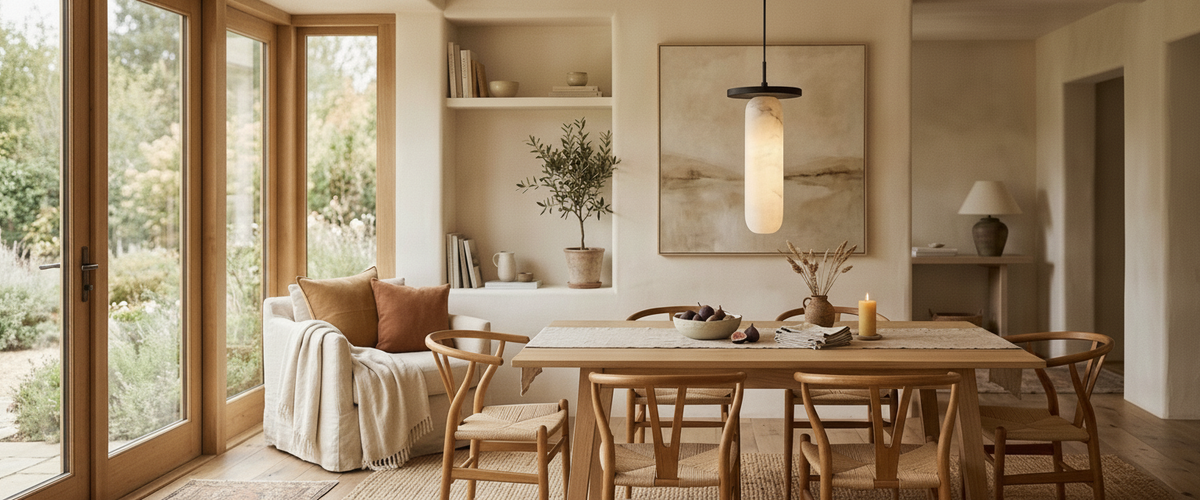

Switch on a cheap alabaster pendant and you see the problem straight away: a bright hot spot where the bulb sits, then dull grey shoulders that never quite catch the light. A good alabaster contemporary pendant light does the opposite. The whole shade lifts to a warm, even glow, the veining reads like weather across the stone, and you forget there is a bulb inside at all. That difference is decided long before the piece reaches your ceiling, and most of it comes down to choices made at the block-cutting bench. If you are shopping our pendant lights, this is the detail that separates the good pieces from the forgettable ones.
Niori works in alabaster and natural stone, so we spend a lot of time looking at how light behaves once it passes through a slab. The short version is that the silhouette gets the attention and the physics gets the credit, and a well-built alabaster contemporary pendant light earns its glow from the physics.
An evenly lit shade forgets it has a bulb inside.

Key Takeaways
Even glow comes from consistent wall thickness and honest translucency, not from the outline of the shade.
Veining should be oriented to spread light across the stone rather than trap it in dark bands.
Socket position and bulb choice matter as much as the alabaster itself.
A quiet metal fitting lets the stone carry the room; a busy one competes with it.
Budget follows material grade, wall thickness, hand finishing and engineering, so ask for a tailored quote rather than trusting a flat price.

The Workshop Decisions That Separate a Clean Glow From a Patchy One
Alabaster is a soft, layered stone, and no two blocks light up the same way. Before a shade is turned, the block is cut and held against a bright source so the maker can read where the stone is dense and where it thins. That inspection decides which face becomes the outside and how the piece is oriented on the lathe. Skip it, and you get a shade that looks fine switched off and blotchy switched on. Every alabaster contemporary pendant light starts with that read.
The second decision is wall thickness, and it is the one buyers almost never think about. A shade turned to a steady wall glows like a single sheet of light. A shade left thick on one side and thin on another burns hot where it is thin and stays dull where it is thick. In our studio the finishing pass is really a thickness pass; the surface is checked lit, not just dry, because the stone tells the truth only when a bulb is behind it. That is how an alabaster contemporary pendant light ends up glowing evenly rather than in patches.

Why Stone Thickness and Translucency Matter More Than the Silhouette
You can carve alabaster into a drum, a dome, a slim cylinder or a soft egg. The outline barely changes how it glows. What changes everything is how far light has to travel through the stone. Thin translucent alabaster reads bright and creamy; denser or thicker stone reads soft and moody. Neither is wrong, but they are different products, and a good maker chooses on purpose rather than by accident. The right alabaster contemporary pendant light is the one where that choice was made on purpose.
Alabaster is gypsum-based and genuinely translucent, which is why it has been prized for light-filtering windows and lamps since antiquity; the Metropolitan Museum of Art holds carved alabaster pieces that show how long this stone has been used to soften daylight. That translucency is the whole point of the design, and it is also why the material cannot be faked convincingly with resin. Resin scatters light flatly. Stone carries depth because the light passes through mineral layers, not a moulded skin.
If you are comparing pieces across our range, it helps to see the material next to other fixture types before you commit. Browse the full lighting collection to get a feel for how the same stone reads as an alabaster contemporary pendant light, a wall light or a table lamp.
How Veining Is Oriented So the Light Spreads Instead of Pooling
Veining is the signature of natural stone, and it is also a trap. Those darker mineral bands block more light than the pale ground around them. Orient them badly and you get a shadow line running through a lit shade. Orient them well and they become the feature: soft ribbons of contrast that shift as you walk past. Vein orientation is where an alabaster contemporary pendant light is either made or ruined.
Veining run across the widest part of the shade reads as a feature, not a flaw.
The rule we follow is to run the strongest veining across the widest part of the shade, where the glow is broadest, so the light has room to flow around it. Tight vein clusters get pushed toward the top rim, near the fitting, where a little extra density reads as natural shading rather than a flaw. This is hand-matched work. Two shades from the same block can be turned to glow differently depending only on which way up they sit, which is one reason a genuine alabaster contemporary pendant light is never truly mass-produced.
The Natural Stone Institute is a useful reference on how gypsum alabaster differs from calcite and marble in hardness and behaviour, which affects both how it is cut and how it should be cared for later.
Wiring, Socket Placement and the Bulb That Suits the Stone
A perfectly turned shade can still glow badly if the light source is wrong. Socket placement decides where the light originates inside the stone. Sit the bulb too high and the lower half of the shade goes dark; sit it too low and the top rim burns. The sweet spot centres the source so light reaches the whole inner wall at a similar distance, and that placement is what lets an alabaster contemporary pendant light glow top to bottom.
Bulb choice is where a lot of contemporary pendants go astray. Alabaster looks its best under warm light, because the stone already carries honey and cream tones that a cool bulb fights. We steer buyers toward a warm white around 2700K for living and dining spaces, with dimming as standard. A cool 4000K lamp can suit a crisp, technical scheme in a kitchen or workspace, but it flattens the stone's natural warmth, so treat it as a deliberate choice rather than a default. If your scheme genuinely calls for that cooler temperature, a fixture built around it from the start, such as the Gemini Pendant Light 105cm 4000K in White, is a more honest choice than forcing a cool lamp into a stone shade that wants warmth.
Use a warm dimmable LED around 2700K for lounges, bedrooms and dining rooms.
Match the bulb to the socket the fixture is designed for; an E27 fitting wants an E27 lamp with a suitable shape, not an oversized globe that touches the stone.
Check dimmer compatibility so you avoid flicker and buzz at low output.
Keep heat down. LEDs run cool, which matters for a natural material sitting close to the source.
Leave the wiring to a qualified electrician. Alabaster is heavy for its size, so the ceiling fixing and connection should be signed off by a professional.
Modern Minimal Shapes: Keeping the Fitting Quiet So the Stone Speaks
The point of an alabaster modern pendant lights is the stone. Everything metal should stay in the background. A slim brushed-brass suspension, a fine chrome collar or a plain matte rod reads as punctuation, not headline. When the metalwork gets loud, with heavy cages or ornate cups, it argues with the very thing you paid for. Where you want a multi-lamp arrangement to feel restrained rather than busy, a fixture like the CALLA E27 Contemporary 3 Light Pendant in Brushed Chrome shows how quiet metalwork can hold several sources without shouting over them.
We have shipped an alabaster contemporary pendant light into a dining room where the client had originally specced a black industrial fitting; we swapped it for a thin brushed-brass suspension and the whole piece changed character. The stone stopped looking like a shade bolted onto hardware and started looking like a lamp carved from a single idea. That is the test for a minimal contemporary piece: cover the metal with your hand and the fixture should still make sense.
Scale is the other half of getting a modern shape right. Over a dining table, roughly 30 to 36 inches (75 to 90 cm) of clearance above the surface gives even light without glare in the eyeline. In a stairwell or double-height hall, a longer drop and a larger shade earn their place; the proportions of a piece such as the Gemini Pendant Light 105cm in Brushed Brass illustrate the kind of drop that a tall volume can carry, whereas a smaller shade would simply vanish. An alabaster contemporary pendant light that is too small for the room reads as an afterthought no matter how well it glows. If you want to see how form and scale play together, the alabaster lighting collection is the clearest place to compare.
Red Flags in a Contemporary Alabaster Pendant Before You Buy
Not every pendant sold as alabaster earns the name, and a few checks separate a piece worth living with from one that will disappoint the first evening you switch it on. Use this list before you commit to any alabaster contemporary pendant light.
Ask to see it lit. A stone this translucent should be shown glowing, not just photographed switched off in daylight. If a seller only shows the shade dark, ask why.
Watch for a single hot spot. That is the classic sign of uneven wall thickness or a badly placed socket.
Confirm it is real stone. Resin and moulded acrylic are lighter, warmer to the touch and glow with a flat, plastic evenness. Genuine alabaster has weight, cool contact and depth in the veining.
Look at the vein orientation. Dark bands running straight through the brightest part of the shade suggest the block was turned without matching the light.
Check the fixing and weight rating. Alabaster is dense, so the mount and ceiling fixing must be rated for it. This is where a competent electrician earns their fee.
Beware a flat price with no material grade. Budget on an alabaster contemporary pendant light follows stone quality, wall thickness, hand finishing and engineering. A genuine maker will quote against your piece rather than sell one number for everything.
Get those points right and an alabaster contemporary pendant light does something few fixtures manage: it becomes a source of soft, flattering light and a quiet sculptural object at the same time. The glow is even because someone chose to make it even, one thickness check and one vein at a time.