

Search for the Justice Design alabaster look and you get a clear picture in your head: a pale, softly lit shade with crisp modern hardware, the kind of fitting that reads as quiet luxury without shouting about it. That aesthetic has travelled well, and plenty of shoppers now use "Justice Design alabaster" as shorthand for a whole category of stone-effect lighting. The trouble is that the phrase covers two very different things once the bulb is on: genuine carved stone, and cast resin or acrylic finished to imitate it. Knowing which you are looking at changes what you should pay and what you should expect.
At Niori we work exclusively in alabaster and natural stone, so we spend a lot of time explaining the difference to buyers who arrived expecting one thing and found another. This guide is written to help you read a fitting properly before you commit.
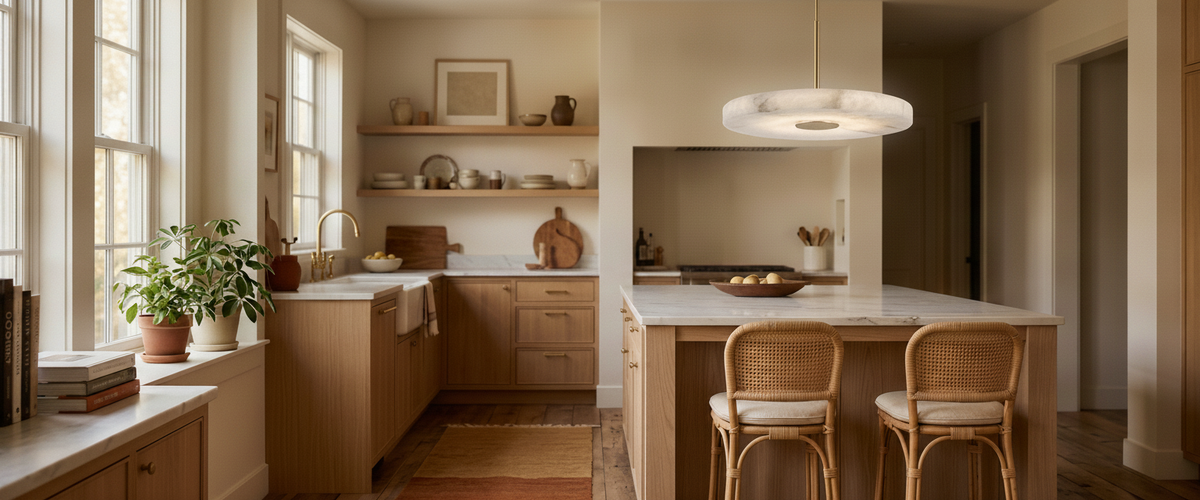
The warm, diffused glow that defines the justice design alabaster style.

Key Takeaways
The "Justice Design alabaster" style is a look, not a guarantee of solid stone. Confirm the material before you buy.
Real alabaster carries visible mineral veining and a warm depth when lit; resin tends to look flatter and more uniform.
Even glow is the sign of good shade thickness and bulb choice. Hotspots usually mean thin material or the wrong lamp.
Placement matters: dining and bedroom suit a warm diffused pendant; hallways want durability and even light.
A designer name adds cost. Ask what the premium buys before you pay it.

What the Justice Design Alabaster Look Promises, and Where It Delivers
The appeal is easy to understand. A pale translucent shade takes a hard electric light and turns it into something closer to candlelight, spreading a warm wash across a room instead of a single bright point. Pair that with a clean brass or matt-black fitting and you get a modern pendant that suits a kitchen island just as happily as a townhouse landing.
Where the look delivers is in mood. A well-made stone or stone-effect shade genuinely softens a space and hides the glare that bare LEDs produce. Where it can disappoint is when the material cannot back up the promise. Thin resin lit by a bright, cool bulb looks plasticky and cold, which is the opposite of what drew you in. The style is real; the results depend entirely on execution.
How Real Alabaster and Cast Resin Diverge Under a Lit Bulb
Switched off, a good resin shade and a real stone shade can look almost identical on a screen. Switched on, they part company fast.
Alabaster is a natural gypsum stone, and light passing through it picks up the internal veining, the cloudy patches, and the faint variations in density across the piece. That is why a lit shade has depth: the glow is not flat, it has movement in it. The Natural Stone Institute describes gypsum alabaster as a soft, translucent stone valued for exactly this quality of transmitted light (see the Natural Stone Institute for material background). Every piece is different because the stone is.
Cast resin is poured and pigmented to imitate that effect. The better versions are convincing, and there is nothing wrong with resin as a material; it is lighter, more consistent, and easier to produce at scale. But it tends to glow evenly and uniformly, without the small surprises that stone gives you. Once you have seen the two side by side, the difference is hard to unsee. If a listing does not clearly state "solid alabaster" or "natural stone", assume it may be resin and ask.
Real stone shows veining and depth; resin glows flat by comparison.
Even Glow Versus Hotspots: Reading the Surface Before You Commit
The single biggest quality tell in any stone-look pendant is how the light sits across the surface. You want an even glow. What you do not want is a hotspot, that bright blob where the bulb sits too close to a thin section of shade.
Hotspots come from three causes. First, the shade material is too thin to diffuse properly. Second, the bulb is too powerful or too concentrated a point source. Third, the fitting places the lamp badly inside the shade. Real carved stone is usually thick enough to diffuse well, which is part of what you pay for. Very cheap imitations often go thin to save weight and cost, and that is where the glow breaks down.
When you are assessing photos, look for images of the piece lit in a real room, not just a studio white-out. If the seller only shows it switched off, that is a small warning sign. A confident maker shows you the glow.
Where These Fittings Sit Best: Hallway, Dining, and Bedroom Compared
Not every room wants the same thing from a stone-look pendant.
Dining: This is the natural home for the look. A pendant hung over a dining table gives you a warm, flattering pool of light at face height, and the diffused glow is kind to both food and faces. Hang the base of the shade roughly 30 to 36 inches (76 to 91 cm) above the table so it lights the surface without blocking sightlines.
Bedroom: Here the priority is calm. A single stone pendant or a pair of smaller ones flanking the bed reads beautifully, especially on a dimmer. The warm transmitted light suits winding down at the end of the day far better than a cool overhead fitting.
Hallway: Hallways ask for durability and consistent light more than atmosphere. If the space is tight or handled often, weigh a robust fitting carefully; solid stone is heavier than resin, so the ceiling fixing has to be right. In a hallway the even-glow test matters most, because you notice a hotspot every time you walk under it.
If you want to compare fixture types across rooms before you decide, our full lighting collection lays out pendants, wall lights, and lamps side by side.
Pairing an Alabaster Modern Pendant Light Without Visual Clutter
The clean-lined silhouette is a large part of why the Justice Design alabaster style caught on. An alabaster modern pendant lights works hardest when the surrounding scheme stays disciplined. A few rules keep it from tipping into clutter.
Keep the metalwork consistent. If your kitchen has brass tap fittings and handles, choose a pendant with brass detailing rather than mixing in chrome or black. Let the stone be the texture in the room and keep everything around it plain. One sculptural fitting reads as intentional; three competing ones read as noise.
Scale is the other trap. A pendant that looks generous in a showroom can vanish over a large island, and a big shade can crowd a modest room. Measure the space it will hang over and match the shade width to it rather than buying on looks alone. If you are drawn to the material and want to see the range of shapes, our alabaster lighting collection shows how the same stone reads across different silhouettes.
What to Interrogate Before You Pay a Designer-Name Premium
A recognisable design name carries a premium, and sometimes it is fully earned. Before you pay it, get straight answers on a few points.
Material: Solid alabaster, natural stone, or resin? This is the first question and the most important one. The word "alabaster" in a product title does not always mean the stone.
Shade construction: Is the shade a single carved piece or thin panels bonded together? Both exist; the answer affects the glow and the longevity.
Bulb and dimming: What bulb does it take, and does it dim? For the warm effect you want a bulb around 2700K and a dimmer. A cool bulb will kill the whole look. Confirm the driver and switch are dimmable rather than assuming.
Weight and fixing: Stone is heavy. Ask the weight and check your ceiling can carry it. Fitting a heavy pendant is a job for a qualified electrician, not a Sunday afternoon.
Care: The stone is porous and dislikes water. Dust it dry and never use household sprays. The Victoria and Albert Museum's guidance on caring for stone and plaster objects is a useful reference on why moisture and abrasive cleaners damage soft stone (V&A).
On price itself, be wary of anyone quoting the material as cheap or a bargain. Genuine stone lighting costs what it costs because of the material, the carving, the engineering, the fixing hardware, and the finishing. If a fitting labelled alabaster is priced far below the rest of the market, that usually tells you something about what is inside. Ask for a tailored quote and a clear material spec, then compare like for like.
A Quick Pre-Purchase Checklist
Confirm in writing whether it is solid alabaster, natural stone, or resin.
Ask to see the fitting photographed lit, in a real room.
Check the shade construction: single carved piece or bonded panels.
Match the bulb to a warm colour temperature and confirm dimmability.
Get the weight and confirm your ceiling and electrician can handle it.
Match metal finishes to what is already in the room.
Size the shade to the surface below it, not to the showroom.
The look that people call "Justice Design alabaster" is worth chasing. It just pays to know whether you are buying the effect or the stone, because the two age and glow very differently. Start from the material and the rest of the decision gets much easier.