
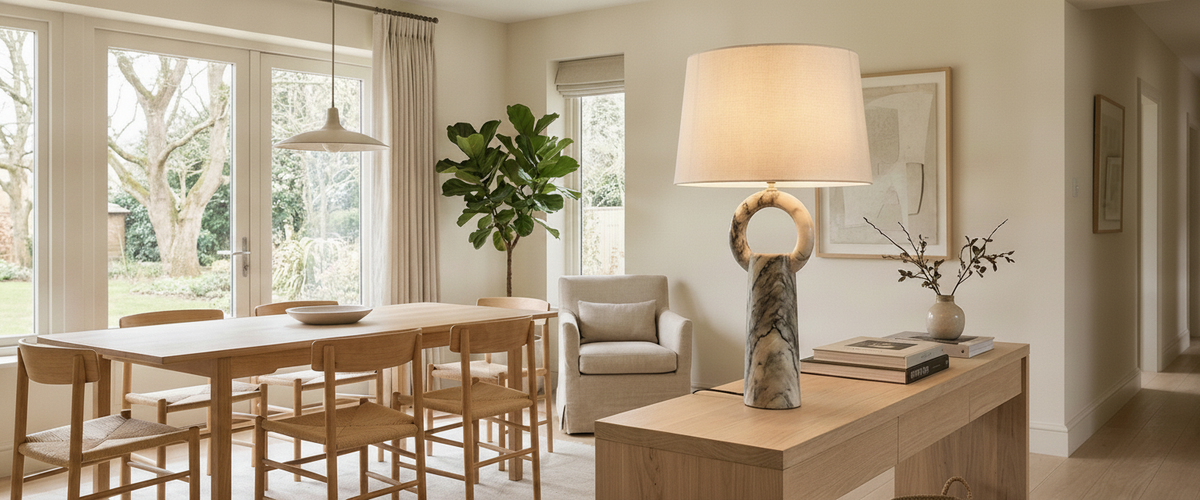

A convincing antique marble table lamp gives itself away in the details most sellers gloss over: the way the veining runs through a turned column rather than sitting on the surface, the soft wear where a hand has gripped the base for decades, the slightly uneven polish that no modern machine leaves behind. Get those reads right and you buy well. Miss them and you pay antique money for a reproduction that will look tired in five years.
Genuine veining wraps through the turned column rather than sitting on the surface.
Marble has carried lamps since gas gave way to electricity in the late 19th century, and a good stone base outlasts three or four rewires without complaint. At Niori we work mostly in alabaster and natural stone, so we spend a lot of time with buyers who love the weight and character of an old antique marble table lamp but want it to actually work in a modern room. This is the guide we wish more of them had read first.

Antique Marble Table Lamp: Key Takeaways
Age shows in the stone, not the switch. Look at veining depth, base wear and polish before you trust any label.
Marble reflects light; alabaster drinks it in. That difference decides whether you want the stone in the base or the shade.
A black or heavily veined base needs contrast around it or it sulks in a dark corner.
Budget for a rewire. Old wiring is often unsafe, and a specialist should carry out any electrical work.
Value depends on stone, maker, condition and original fittings, not age alone.

The Tells of Genuine Age, and the Tricks That Fake Them
Start with the base, turned upside down if the seller allows it. Genuine old marble carries a felt or baize pad that has yellowed and thinned unevenly, and the stone underneath usually shows tiny chips and a matte, unpolished underside. A reproduction dressed up as an antique marble table lamp tends to have crisp, factory-cut bottoms and bright new felt glued dead center.
Then read the veining. In a real marble table lamp the veins travel through the body of the stone, so a turned column shows the same figuring wrapping around the profile. Printed or resin-composite fakes carry veining that stops at the surface and often repeats, like wallpaper. Run a fingernail across a suspicious vein; on natural stone you feel nothing, because the color is part of the crystal structure. Marble is metamorphosed limestone, and that recrystallized calcite is what gives the veining its depth, a point the Encyclopaedia Britannica sets out plainly.
Patina is the last honest witness. Decades of handling leave a faint sheen on the high points and a slight dulling in the recesses, the opposite of a uniform machine polish. On a genuine antique marble table lamp a cold, greasy, perfectly even shine usually means resin. Genuine stone feels cool but breathes; it warms slowly under your palm.

Why Old Veining Carries a Modern Room
New stone can look flawless and, frankly, a little flat. The veining in an old marble base was quarried and cut before anyone optimized slabs for consistency, so you get drama: bold gray rivers, warm honey pockets, the occasional fault line filled and stabilized generations ago. That irregularity is exactly what makes an old antique marble table lamp sit so well against clean plaster walls and contemporary furniture.
An old stone base gives a new interior the feeling of a past.
We shipped a pair of heavily veined gray marble bases to a designer furnishing a Cotswolds barn conversion, and her note afterwards stuck with me: the lamps were the only thing in the room that looked like they had a past, and the whole scheme relaxed because of it. A vintage marble table lamp does that. It stops a new interior from feeling like a showroom.
If you love the material but want a softer light rather than a bold statement base, that is where our own range leans. Browse the alabaster lighting collection to see how a translucent stone shade behaves differently from a solid marble column.
Marble Versus Alabaster: One Reflects, One Drinks It In
This is the single most useful distinction for a buyer. Marble is dense and largely opaque, so it works as a base, a plinth, a solid anchor. Light bounces off its polished surface. Alabaster is translucent; hold a thin slab of around 0.2 to 0.4 inches (5 to 10 mm) to a bulb and it glows from within, scattering a warm, even light with almost no glare. One reflects the light. One drinks it in and hands it back softened.
That tells you where to spend. If you want the stone to be the light source, a glowing shade or column, alabaster earns its place. If you want a weighty, characterful base under a fabric or paper shade, an antique marble table lamp is hard to beat. Plenty of the finest schemes use both in one room. You can see the full spread of stone fixtures across the wider lighting collection if you are weighing shade against base.
A marble lamp table (the small gueridon or side table that so often sits beneath a lamp) plays into this too. A marble-top table with a marble base table lamp on it can read as heavy unless you break the material up, which brings us to placement.
Placing a Black or Heavily Veined Base So It Anchors
A black marble table lamp is a beautiful thing and a common mistake. Set it against a dark wall or in a shadowed corner and it disappears, sulking rather than anchoring. Black and deeply veined stone need light around them and a pale surface beneath to give the material an edge to read against.
Give it a pale ground. A limed oak console, a white marble lamp table, or a linen runner lets a black base carve a clear silhouette.
Pair it with a light shade. A cream or ivory shade throws downward light onto the stone and keeps the whole piece from going murky.
Balance in pairs. Two matched bases either side of a bed or sofa steady a room far better than one lonely antique marble table lamp.
Mind the sightline. Heavy veining reads best at seated eye level, roughly 24 to 26 inches (61 to 66 cm) off the floor, so a lower side table often flatters it more than a tall chest.
Where a desk or workspace calls for a black finish that earns its keep functionally rather than as an antique statement, an adjustable fixture such as the AGZAR 5W E14 Desk Lamp Adjustable, Black sits in a different design language altogether, giving directional light where a fixed stone base would only anchor a scheme. In a bright, sun-filled interior, all that reflected daylight does half the work for you. In a darker flat you have to build the contrast deliberately, or the lamp quietly loses its shape.
What a Rewire Costs You, and Why the Base Earns the Fee
Most genuine antiques come with old wiring, and old wiring is a liability. Brittle rubber flex, no earth on a metal fitting, worn switches; none of it belongs in a modern home. Any rewire on an antique marble table lamp should be carried out by a qualified electrician, and it is worth asking whether the lamp has been PAT tested or brought up to current standards before you use it. The Electrical Safety First guidance is a sensible starting point for what safe looks like.
The good news: a marble base is worth the fee. The stone is the value; the electrics are consumable. A competent rewire, new lampholder, cloth-covered flex and an inline dimmer can be fitted without touching the stone, and it turns an unusable antique marble table lamp into a piece you switch on every night. Fit a warm-white LED (around 2700K) on a dimmer and the light flatters the veining instead of flattening it.
A Quick Buyer's Checklist
Turn it over. Check for aged, uneven felt and an unpolished, chipped underside.
Trace the veining around any turned profile; it should wrap, not sit flat.
Feel for genuine patina, sheen on the high points, dulling in the recesses.
Ask about the wiring and assume it needs replacing.
Confirm the fittings are original; replaced hardware affects both look and value.
Test the placement in your head against a pale ground and a matched pair.
Buy on the stone and the story, then make it safe and make it glow. That is how an old antique marble table lamp earns its place in a room built today.