
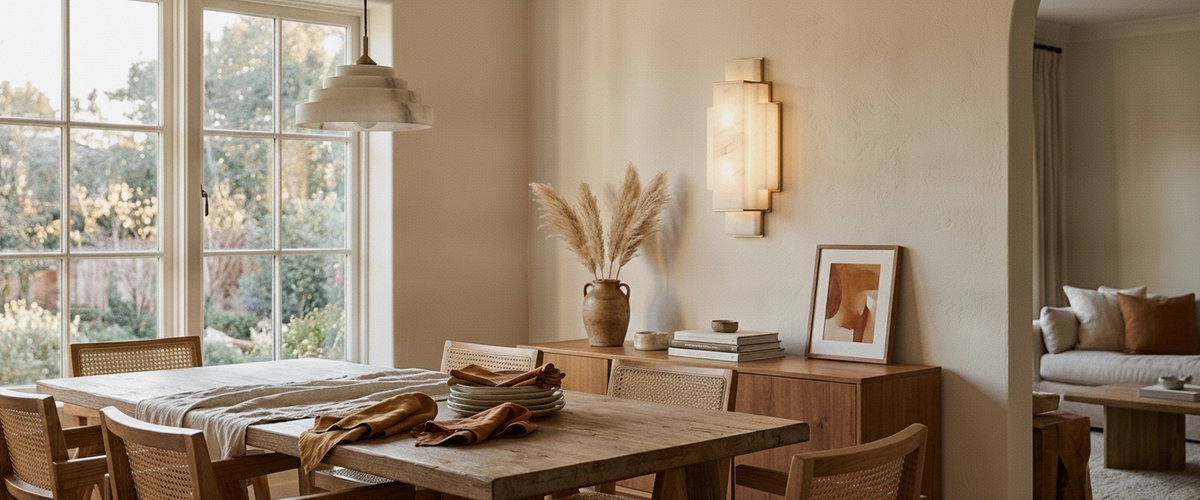

Most Art Deco wall lighting fails for one reason: it copies the shapes without understanding what they were for. A sunburst was never decoration for its own sake; the fanned rays hid the bulb and pushed a soft wash up the wall. Get the motif right and an art deco wall light still reads as confident and quietly grand a century on. Get it wrong and you end up with shiny chrome and etched glass that shouts fancy dress. This guide sorts the motifs that age well from the ones that curdle, and shows how the light itself should behave.
Niori works in alabaster and natural stone, which sits comfortably next to true Deco thinking. The period loved translucent materials that turned a hard bulb into a warm, contained glow, and stone does exactly that. That material honesty is what separates a real art deco wall light from a costume copy.

Key Takeaways
Motif matters: sunburst, chevron and stepped ziggurat still read as elegant on an art deco wall; over-etched panels and mirror-bright chrome usually don't.
Direction of light: fluted slips wash upward, frosted slip shades diffuse outward, skyscraper tiers throw a controlled downward stripe.
Pairs vs singles: a matched pair frames a mantel or mirror; a lone sconce works on a narrow wall where symmetry would crowd.
Get the height right: around 60 to 66 inches (152 to 168 cm) to centre suits most hallways and dining rooms.
Warm-dim bulbs let amber glass and stepped metal do their job. Cold LED kills the whole effect.

The Sunburst, Chevron and Stepped Ziggurat: Which Deco Motifs Still Read as Elegant
Three motifs carry most of Art Deco wall lighting, and each has a different temperament. The sunburst fans rays out from a central point, usually a slip shade or a stone half-disc. On an art deco wall it behaves like a small piece of architecture, so it wants space around it and a plain background to fan against. The chevron is quieter; repeated Vs give a fixture rhythm without drama, which is why chevron detailing survives on sconces that need to sit in a row down a corridor.
The stepped ziggurat is the most architectural of the three. Borrowed from the setback skyscrapers of 1920s New York, it stacks tiers that get narrower as they rise or project. On an art deco wall fitting it gives you clean horizontal lines and a built-in ledge for light to spill from. When we cut these steps in alabaster, the stone's veining runs across the tiers and softens the geometry so it never looks like a plastic moulding. The Victoria and Albert Museum's material on the 1925 Paris Exposition, where the style got its name, is a good reference for how disciplined true Deco geometry actually was.
Fluting, Frosted Slip Shades and Skyscraper Tiers: How Each Throws Light
The shape of an art deco lighting fixture decides where the light goes, and that should drive your choice more than the styling.
Fluting, the vertical ribbing you see on tall slip shades, channels light upward in soft parallel bands. Mount a fluted piece and you get a gentle uplight that grazes the ceiling; ideal for a dining room where you want atmosphere rather than task light. Frosted slip shades, the curved half-bowls that clip into a bracket, throw light outward and down in a wide, even spread. They are the workhorses of any art deco wall scheme and the safest choice for a hall where people actually need to see. Skyscraper tiers project light in a controlled downward stripe over each stepped edge, which reads beautifully but does little for general brightness, so treat them as accent pieces. Where the effect you want is a multi-armed centrepiece rather than a wall wash, a fixture such as the Ascot 4 Light Art Deco Table Lamp shows how the white-and-gold palette and stepped detailing translate onto a surface piece.
Alabaster changes this calculation in a way that pressed glass never could. Because the stone is genuinely translucent, a frosted-style shade cut from alabaster glows across its whole face rather than only at the opening. You can see how that plays across different fixture types in the alabaster lighting range, where the same warm diffusion runs from wall lights through to pendants.
The Tell-Tale Signs of Costume Deco
Plenty of art deco lights on the market are really Deco-flavoured, and a few details give the game away. The most common is chrome that is too shiny. Genuine period plating had a slightly warm, brushed quality; mirror-bright chrome with a blue cast is a modern shortcut and it fights the amber tones the style depends on. A cheap art deco wall fixture usually announces itself here first.
Over-fussed etched glass is the second tell. Real Deco etching was geometric and restrained: a few strong lines, a fan, a clean stepped edge. When you see swirling florals, dense frosting and busy sandblasted scenes crammed onto one shade, that is Art Nouveau nostalgia wearing a Deco badge. The third giveaway is proportion. Authentic sconces were substantial, cast from metal and stone with real weight; a fixture that feels tinny in the hand, or arrives suspiciously light for its size, usually has a hollow zinc or plastic body that will never sit right against a period wall.
One hard-won studio lesson: hold the metalwork up to a warm bulb before you commit. Good brass and bronze pick up the glow and look richer; cheap plating goes flat and slightly grey the moment warm light hits it. That single check tells you more about an art deco wall light than any product photo.
When a Matched Pair Frames a Mantel, and When One Sconce Carries the Wall
Symmetry was central to Deco, so a matched pair of art deco wall lights is often the right answer. Flanking a mantel, a mirror or a headboard, two art deco light sconces set the same distance from the centre create the balanced, framed look the period intended. For a mantel, aim to place each sconce roughly a third of the way in from the outer edge of the chimney breast, so the pair reads as part of the architecture.
A single sconce earns its place on a narrow wall, at the turn of a staircase, or beside a doorway where a pair would crowd. Here the fixture has to hold the wall alone, so choose something with enough presence: a taller fluted slip or a stepped design rather than a small disc that will look stranded. In a long hallway, a run of three or more identical art deco wall sconces at even spacing beats two large pieces, because the repetition is itself a Deco device. If the same geometry needs to carry a covered porch or entrance, a robust weather-rated fitting such as the Outdoor Wall Light E27 IP44 500mm 15W Max in Brown gives you the vertical proportion and warm-toned finish that reads as Deco without the fragile detailing of an indoor sconce.
Mounting Height and Spacing for a Period Scheme
Deco schemes reward precision, and sloppy mounting undoes an otherwise good fixture. As a starting point, centre wall lights around 60 to 66 inches (152 to 168 cm) from the finished floor in a hall or dining room, adjusting up slightly for tall Deco rooms with high skirting and picture rails. In a bathroom, sconces beside a mirror sit best at roughly eye level, around 66 inches (168 cm), so the light falls on the face rather than the top of the head; always follow the wiring zone rules for wet areas and use a qualified electrician.
For spacing, keep pairs symmetrical to the nearest centimetre and give a run of sconces equal gaps, typically 6 to 8 feet (about 1.8 to 2.4 m) apart along a corridor. Any wiring, whether you are fitting an art deco ceiling light in the same room or adding an art deco wall sconce, should be signed off by a qualified electrician; guidance from Electrical Safety First is a sensible reference before work starts. If you are still comparing fixture types across a whole scheme, the full lighting collection is a useful place to see how wall pieces sit beside pendants and table lamps.
Warm-Dimming and Bulb Choice
Amber glass and stepped chrome only work under the right light, and this is where most Deco installations are let down. Choose a warm colour temperature, around 2400K to 2700K, so the glow flatters brass and reads as period-correct rather than clinical. Cold, bluish LED strips the warmth out of alabaster and makes chrome look cheap.
Where the fixture allows it, use warm-dim bulbs that shift towards a candle-like amber as you turn them down, mimicking the old incandescent behaviour the style was designed around. Pair those with a compatible trailing-edge dimmer to avoid flicker. For frosted and alabaster slip shades, a bulb with a soft or opal finish stops any hotspot showing through the translucent face, so the whole shade lights evenly. Get the bulb wrong and even a genuine art deco wall piece will look ordinary; get it right and a good reproduction can pass for the real thing.
An art deco wall light rewards buyers who look past the styling and ask what the fixture is actually doing on the wall. Read the motif, follow the light, check the weight and the plating, then let a warm, dimmable bulb finish the job.