
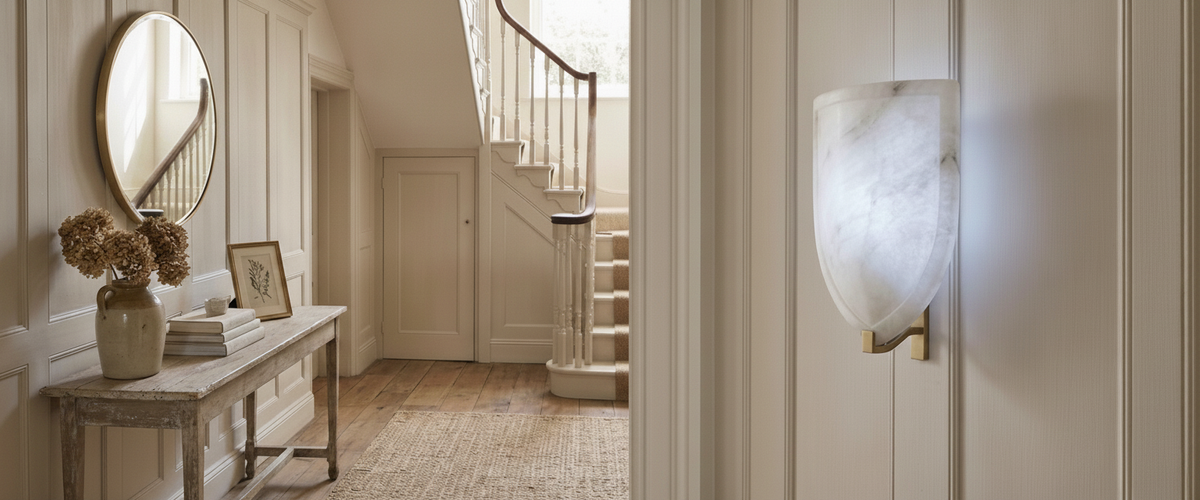

Two alabaster wall lights can hold the exact same slab of stone and still land in completely different rooms. One reads like it belongs beside a panelled staircase in a country house; the other suits a plaster-smooth hallway with no skirting to speak of. The stone did not decide that. The frame did. Once you learn to read the metalwork and the cut of the profile, choosing an alabaster wall light stops being a guessing game and starts feeling obvious.
The same veined stone reads old or new depending entirely on how it is framed.
Alabaster is a soft, translucent gypsum stone, and light passing through it picks up the veining in a way glass never can. That much is constant across every alabaster wall light. What changes is everything around the stone: the bracket, the backplate, the edge treatment and the direction the light throws. Get those right for your room and the piece settles in. Get them wrong and even lovely stone looks stranded.

Key Takeaways Before You Choose
The frame and fixings, not the stone, signal whether an alabaster wall light reads traditional, transitional or contemporary.
Carved shield shapes suit period detail; clean-cut profiles suit flat, modern walls.
Decide on uplight, downlight or full-cavity glow based on ceiling height and what sits below the fitting.
Brass warms the stone, bronze grounds it, plaster-white lets veining lead.
Read the wall first: skirting, cornicing and switch height all shape the right choice.

How the Frame Tells You Old or New
Start with the backplate and the arm. A traditional alabaster wall light tends to carry visible structure: a shaped bracket, a moulded backplate, sometimes a small decorative finial or a scalloped edge on the stone itself. Your eye reads all that detail as heritage before it even registers the glow. This is where good alabaster wall sconce lighting earns its place in an older scheme.
A contemporary alabaster wall light strips most of that away. The backplate shrinks or disappears behind the stone, the mounting reads as a clean rectangle or disc, and the edges of the alabaster are cut square rather than carved. Less metal on show, more stone. That single decision does most of the styling work, which is why the same quarry block can end up in a Georgian dining room or a minimalist new-build depending entirely on how it is framed.

Carved Shield Sconces: Where Traditional Detail Earns Its Keep
The carved shield shape, a broad alabaster panel that fans slightly outward and often tapers at the base, is the classic alabaster traditional wall light. It works because it echoes the proportions of older architecture: the gentle curve answers a cornice, the weight of the stone suits a solid wall.
These belong in rooms that already have detail to talk to. Panelled libraries, hallways with dado rails, formal dining rooms with heavy drapery. We once shipped a pair of carved shield sconces to flank a stone fireplace in a converted barn, and the client had worried they would fight the exposed beams. They did the opposite. The warm, veined glow softened all that hard timber and the room finally felt lit rather than floodlit.
One caution: a carved alabaster wall light casts its own small shadows, so a shield sconce reads busiest of all the styles. In a plain modern room it can look like it wandered in from another house. Match it to detail, not to blank plaster.
Clean-Cut Contemporary Profiles: Fewer Edges, Softer Wash
An alabaster contemporary wall light does the opposite job. Square-cut edges, a slim or hidden mount, and often a simple slab or cylinder of stone. Because there is so little metal to catch the eye, the light itself becomes the feature, and a clean profile throws a smoother, more even wash up the wall.
A pair of square-cut panels gives a modern bedroom rhythm without clutter.
This is the style that suits new-build and renovated spaces where the walls are flat and the skirting is minimal. A pair of rectangular alabaster panels either side of a bed, or a run of them down a corridor, gives you rhythm without clutter. An alabaster modern wall light is also more forgiving in mixed-material rooms, sitting happily next to concrete, oak and matte metal. You can browse the range of shapes across our alabaster lighting collection to see how much the same stone shifts once the framing changes.
Transitional Sconces: The Quiet Middle
Most homes are not purely period or purely modern, which is why the alabaster transitional wall light is often the safest buy. Think a softly rounded stone with a simple, unfussy bracket. There is enough shape to feel considered, but no carving loud enough to demand a specific era around it. Where you want that same restraint without the stone, a simple metal form such as the Carisbrooke Wall Uplighter shows how far a quiet bracket can carry the same ambient wash.
A transitional alabaster wall light suits the buyer who is renovating an older home in a lighter, current style: keeping the bones, losing the fuss. These pieces also travel well between rooms, so if you buy a pair and later reshuffle the house, they rarely look wrong in their new spot.
Uplight, Downlight or Full-Cavity Glow
Style aside, the single most practical decision is where the light goes. An alabaster wall light does three jobs, and the right one depends on the wall.
Uplight throws a soft cone toward the ceiling. It flatters cornicing and high ceilings and reads gentle and ambient. It is the classic choice for a traditional or transitional scheme, though it does highlight anything imperfect in the plaster above.
Downlight pushes the wash down the wall, which suits corridors, stairs and any spot where you want to graze a textured surface below. It is more directional and a touch more modern in feel.
Full-cavity glow is where the whole slab of stone lights from within and reads like a lantern. This is the most sculptural option and the one that shows off alabaster veining best, because the entire face is lit rather than just a spill. It works beautifully as a standalone feature but needs breathing room; crowd it with pictures and shelves and the effect is lost.
Because alabaster is translucent, warm bulbs matter more here than with any opaque shade. Aim for a colour temperature around 2700K and use dimmable LEDs so you can pull the level right down in the evening. The Chartered Institution of Building Services Engineers publishes useful guidance on lighting levels if you are planning a whole scheme rather than a single pair.
Brass, Bronze and Plaster: Which Backdrop Lets Veined Stone Breathe
The metal on an alabaster wall light is not a small decision. It changes how the veining reads before the light is even switched on.
Brass warms the stone. Its yellow tone pushes the alabaster toward honey and cream, which suits period rooms and richer palettes. Choose an unlacquered or aged brass if you want it to soften over time; a bright polished brass stays crisp and reads more modern.
Bronze grounds the stone. The darker, browner metal recedes and lets the alabaster feel like the bright object in the pairing. Good for schemes with dark joinery or a moodier finish.
Plaster or matte white mounts almost vanish, which is the point. With no competing colour, the natural grey-and-white veining leads completely. This is the most contemporary look and the one designers reach for when the stone itself is the star.
One studio lesson worth passing on: veined stone and heavily patterned metal fight each other. If your alabaster has bold, dramatic banding, keep the metal quiet. Save the decorative brasswork for calmer, more uniform pieces.
The same logic carries outdoors, where alabaster gives way to sealed metal but the framing question stays identical. A dark graphite fitting like the Outdoor Wall Light E27 IP44 10W Max in Graphite recedes against masonry much the way bronze recedes behind an indoor alabaster wall light, letting the light do the talking rather than the metal.
Reading Your Room Before You Commit
Before you settle on a style of alabaster wall light, walk the wall. A few checks save most regrets.
Existing detail: skirting, cornicing, dado rails and panelling all pull toward carved or transitional shapes. A flat, detail-free wall wants a clean profile.
Mounting height: most sconces sit around 1.5 to 1.7 metres (5 to 5.5 feet) from the floor, but a full-cavity glow at eye level needs to be genuinely comfortable to look at, so check the brightness at that height.
What sits below: a console, a headboard, a stair rail. The fitting should relate to it, not float in isolation.
Switching and dimming: confirm the circuit can dim before you fall for a glowing slab you will only ever run at full power.
Pairs versus singles: symmetry reads formal and traditional; a single asymmetric sconce reads modern.
Alabaster is soft and porous, so treat the finished piece kindly. Dust your alabaster wall light with a dry, soft cloth and skip anything wet or chemical, since the surface can mark. The Natural Stone Institute has straightforward guidance on caring for soft calcareous stone if you want to read further.
Whatever the style, the stone will do its part: warm, diffused, quietly alive when lit. Your job is to frame it for the room you actually have. If you want to compare mounts, profiles and directions side by side, the full niori lighting range shows how one material stretches from carved heritage to pared-back modern without ever losing the glow that makes an alabaster wall light worth buying in the first place.