
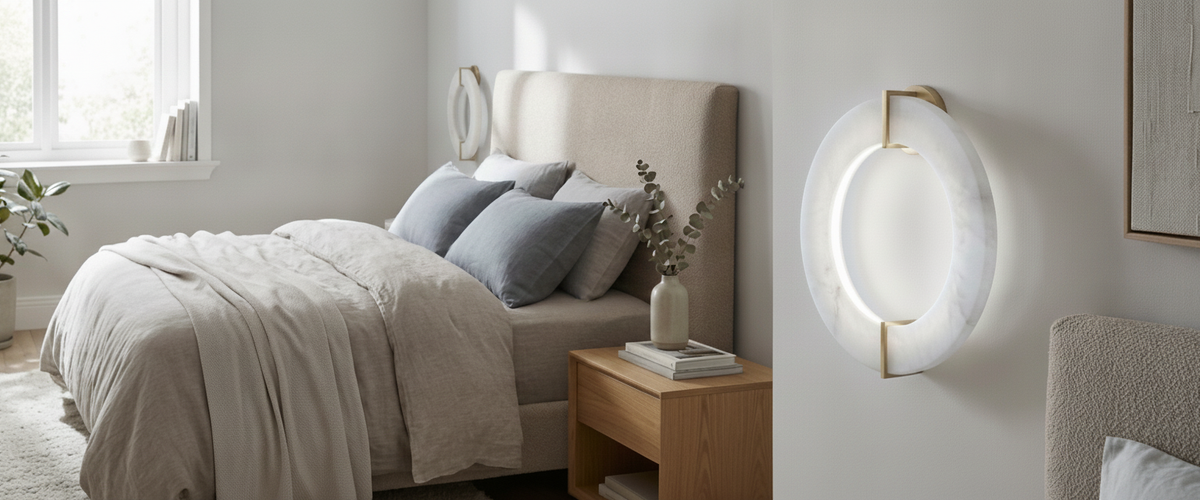

Most bad wall lighting is not a fixture problem. It is a placement problem. A beautiful sconce mounted six inches too high, or aimed so it scorches a strip of plaster while leaving the rest of the wall in shadow, will always disappoint. Get the height, the reach, and the beam direction right, and a pair of wall lights can do more for a room than any ceiling fitting, softening corners, washing texture across a wall, and giving you light at the level where people actually live.
At Niori we build wall lights in alabaster and natural stone, and the material forces a certain discipline: when light passes through carved stone it glows rather than glares, so placement becomes about shaping that glow, not fighting it. This guide walks through where sconces earn their keep and where people keep getting them wrong.

Key Takeaways
Height matters more than fixture choice. Most wall sconces sit best with the center of the fitting around 60 to 66 inches (152 to 168 cm) from the floor in living spaces.
Flanking a bed is different from lighting a hallway. Bedside sconces sit lower and closer; hallway sconces work in rhythm along a run.
Beam direction decides the mood. Uplight opens a room, downlight grounds it, up-and-down draws the eye along the wall.
The wall behind the fitting is part of the design. Dark plaster and pale render read completely differently under the same lamp.
Alabaster and stone diffuse the source, so you get warmth without the hotspot most metal or glass sconces create.

How a Sconce Reads in a Hallway Versus Flanking a Bed
Even spacing keeps a corridor continuous rather than dotted with bright and dark patches.
A hallway asks a sconce to do repetitive, rhythmic work. You want a run of fittings spaced evenly, each throwing a gentle pool that overlaps the next, so the corridor feels continuous rather than dotted with bright and dark patches. In a long hall, space wall lights roughly 6 to 8 feet (1.8 to 2.4 m) apart and keep them at a consistent height. An alabaster sconce suits this well because the stone spreads light sideways as well as up and down, filling the gaps between fittings.
Flanking a bed is the opposite job. Here a wall sconce lighting replaces the bedside lamp, freeing the nightstand and putting task light exactly where a reader needs it. Mount the pair so the lower edge of the light sits around 30 to 36 inches (76 to 91 cm) above the mattress, and set them out wide enough to clear shoulders when someone sits up. Where you want a bedside glow that reads soft and diffused rather than a hard directional beam, a piece like the Essence Round Wall Light 115cm, Brass sits closer to the right design language. One correction we make often: clients want matching sconces centered on the headboard, but the reading light lands on the pillows instead of the page. Dropping each fitting by three or four inches usually fixes it.

Mounting Height and Reach: The Sightline That Makes or Breaks the Fitting
The single most common correction we make is height. A wall light hung too high turns into a glare source; hung too low it lights your knees. As a working rule, put the center of a general-purpose sconce at eye level for a standing adult, which lands around 60 to 66 inches (152 to 168 cm) from the floor. Then check the sightline. Stand where people will actually be, sitting on the sofa, walking the hall, climbing the stairs, and make sure you cannot see straight into the bulb.
Reach is the second variable. A fitting that projects several inches off the wall throws light forward and casts a longer shadow; a flush, low-profile sconce hugs the surface and grazes texture. With alabaster and stone shades the projection also controls how much of the glow you see edge-on, which is part of the appeal. You can browse how different forms sit against a wall across our alabaster lighting range to see how depth changes the effect.
Living Rooms, Stairwells, Bathrooms: Where Wall Light Beats Overhead Glare
Overhead downlights flatten a room and cast unflattering shadows under the eyes. Wall lighting works at the height faces occupy, which is why it feels warmer and more human.
In a living room, a pair of sconces flanking a fireplace or artwork gives you layered light that a single ceiling fixture never will. Set them symmetrically and dim them low for evenings.
On a stairwell, wall lights solve a genuine safety issue: they light the treads without a pendant dangling into the void. Stagger them to follow the rise so each landing and turn is covered.
In a bathroom, sconces mounted either side of a mirror at roughly face height beat a single light above it, because side lighting removes the shadows that overhead fittings drop under the brow and chin. Bathroom zones carry IP ratings for moisture protection; the UK guidance on bathroom zoning from the electrical safety bodies is worth a look before you commit to a location, and any wet-area fitting should be installed by a qualified electrician (Electrical Safety First).
Uplight, Downlight, or Both: What the Beam Does to the Wall Behind
An up-and-down fitting draws two soft cones that pull the eye vertically along the wall.
Beam direction is the quiet decision that changes everything. An uplight throws a fan of light toward the ceiling, opening a room and softening low ceilings visually. A downlight pools light toward the floor, grounding a space and creating intimacy. An up-and-down fitting does both, drawing two soft cones that pull the eye vertically along the wall.
Outdoors, up-and-down sconces are a favorite for framing a front door or marking a run of exterior wall, and this is where exterior wall lights and outdoor wall lighting earn their IP-rated engineering. For a porch or garden wall where you want the beam to add depth to render and stone facades after dark, a weather-rated fitting such as the Rex Up Down Outdoor Wall Light, Grey is built for the two-cone effect that flat downlights cannot manage. Indoors, alabaster changes the calculation: because the stone itself glows, even a downlight fitting emits a soft ambient halo, so you rarely need the aggressive contrast that metal sconces produce.
Backdrop and Contrast: Dark Plaster, Pale Render, and Papered Walls
The wall behind a sconce is not neutral. Dark plaster absorbs light and makes the fitting itself the focal point, so the glow reads as a jewel against shadow; this suits dramatic dining rooms and moody hallways. Pale render and white walls bounce light back into the room, so the same lamp feels brighter and airier, and any beam scallop on the wall shows clearly. Papered walls sit in between, and a textured or patterned paper can catch a grazing beam in a way that flat paint never will.
With alabaster and marble, the veining in the stone becomes part of this conversation. Backlit against a dark wall, the natural markings glow like a map; against pale render, they read as subtle texture. The Metropolitan Museum's notes on alabaster describe how the stone's translucency has been prized for exactly this quality for centuries, letting light bleed through carved surfaces (The Met). It is worth holding a sample against your actual wall color before deciding.
Placement Mistakes We Keep Correcting in Real Homes
Hanging too high. Sconces creep upward when people align them with door frames instead of eye level. Trust the sightline, not the trim.
Symmetry ignored. A single sconce on one side of a mirror or headboard looks like a fitting that lost its twin. Pair them or center them deliberately.
Bulb visible from the sofa. Always check the seated sightline, not just the standing one.
Wrong beam for the room. Downlight in a low-ceilinged hall makes it feel like a bunker; add an uplight component.
Cool bulbs in warm stone. Alabaster wants a warm color temperature, around 2700K, to show its honeyed glow. A cold LED kills it.
Forgetting the dimmer. Wall lights live or die on dimming. Specify a compatible dimmable driver from the start.
If you are weighing sconces against pendants and floor lamps for a whole scheme, it helps to see the fitting types side by side across the full lighting range before you lock in wall positions, because wall lights work best as one layer among several.
A Quick Placement Checklist
Mark the center height at 60 to 66 inches (152 to 168 cm) for general rooms; lower for bedside.
Sit and stand in the space to check no bulb is visible in normal use.
Space runs evenly, roughly 6 to 8 feet (1.8 to 2.4 m) apart in halls.
Choose your beam: uplight to open, downlight to ground, both to accent.
Test the fitting against your actual wall color, not a swatch.
Confirm IP rating for bathrooms and outdoor positions.
Fit a warm, dimmable source and a compatible dimmer.
Use a qualified electrician for any hard-wired or wet-area install.