
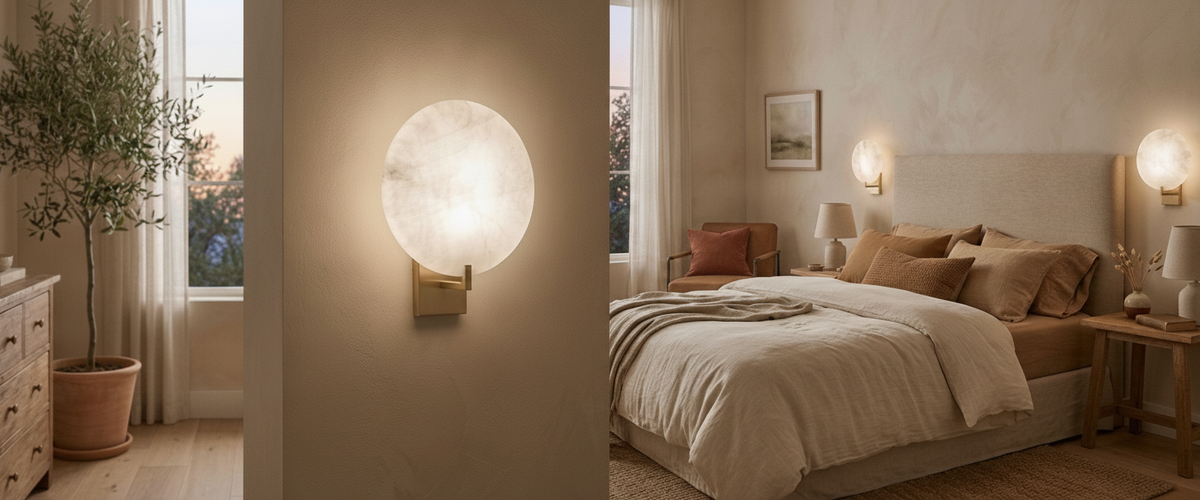

Your bedside table is smaller than you think, and a lamp with a broad base eats most of it. Add a book, a glass of water, a phone and a charger, and there is nowhere left to set anything down. That is the quiet argument for wall lights for bedroom schemes: they clear the surface entirely and put the light where you actually need it, at eye and page height rather than pooling on the tabletop.
At Niori we design in alabaster and natural stone, so wall lights for bedroom use are rarely just a fitting on a bracket. Each one is a slab of translucent material that turns lamplight into a soft, mineral wash. That changes how you plan the whole scheme.
A matched pair of alabaster fittings clears both nightstands and centres the light at reading height.

Key Takeaways Before You Buy
Height matters more than style. Aim for the light source to sit roughly at seated eye level when you are propped up reading.
Pairs read as intentional; a single sconce can look unfinished unless you deliberately build an asymmetric scheme around it.
Decide switching early. Pull-cord, wall rocker, or a bedside dimmer all suit different sleepers.
Alabaster gives a warm ambient wash; a directional arm gives a reading beam. Many bedrooms want one of each.
Wiring is the part you cannot undo. Plan cable runs before the plaster closes.

When Wall Lights Free Up a Bedside Table a Lamp Never Could
The most common brief we get from designers is a narrow nightstand in a small London flat or a period cottage where the bedside surface is barely wider than a book. A table lamp there is a compromise. Move that light onto the wall and the table becomes usable again, and wall lights for bedroom setups become part of the wall composition rather than clutter on top of the furniture.
Wall lights for bedroom use also solve the trailing-flex problem. No cable snaking down behind the table, no plug fighting for the only socket. If you want to browse the range and see how alabaster reads on a wall, the alabaster lighting collection is the place to start.

The Read-in-Bed Sweet Spot: Mounting Height and Arm Reach
Get the height wrong and a beautiful sconce becomes useless. Too high and the light falls behind your head; too low and it glares straight into your eyes. As a working rule, the light source wants to sit around 24 to 30 inches (60 to 75 cm) above the mattress top, adjusted for how upright you sit and how tall your headboard is. This is the single biggest factor in whether wall lights for bedroom reading actually work.
Measure from the finished mattress height, not the floor, because bed builds vary widely. A deep upholstered headboard pushes the ideal mounting point up and slightly out from the wall. If the light has an adjustable arm, reach matters as much as height: you want the head to swing over the page without clipping the headboard or your shoulder.
Measure from the finished mattress top, not the floor, to land the glow near seated eye level.
A quick studio note. We once had a client in a barn conversion with a tall reclaimed timber headboard, and the first mock-up put the sconces so high they lit the ceiling. Dropping them to just above the headboard's top edge fixed everything. Always test with the actual bed in place if you can.
Matched Pairs Over the Headboard, and the Asymmetry That Still Lands
Two identical wall lights for bedroom use, one each side of the bed, is the classic move for a reason. Symmetry reads as calm, and calm is what a bedroom is for. Space them so they sit centred over each nightstand or aligned with the outer edges of the headboard, whichever gives the cleaner line.
Scale is where the choice gets real. Over a compact double or a low-ceilinged room, a smaller fitting such as the Essence Round Wall Light 75cm, Brass holds the wall without crowding it, while a broad feature wall behind a king can carry the larger 115cm version before the proportions feel right. Asymmetry can work, but it has to look chosen rather than accidental. A single larger sconce on one side, balanced by a pendant or a taller stone table lamp on the other, holds together if the visual weight is even. What fails is one lonely wall light on a broad wall with nothing answering it. If you are working with lighting blue bedroom walls, a pair of alabaster fittings is especially effective; the warm cream of the stone lifts the cool blue and stops the room feeling chilly. The same trick rescues light blue bedroom walls that read too cold at night.
Pull-Cord, Rocker or Bedside Dimmer: Switching for Half-Asleep Hands
Switching is where bedroom wall lights are won or lost. Think about the hand that reaches for it at midnight.
Integrated pull-cord: simple, tactile, no wall switch to find in the dark. Good for renters and retrofits where you do not want to chase a new switch drop into the wall.
Wall rocker beside the bed: clean and reliable, but only if it is within arm's reach without sitting up.
Bedside dimmer: the choice we recommend most often. Being able to fade a warm alabaster glow down to a whisper before sleep is worth the extra wiring, and it is why so many good wall lights for bedroom schemes are specified dimmable from the start.
If you share a bed, independent switching per side is close to non-negotiable. One person reading while the other sleeps is the single most common bedroom lighting conflict, and separate controls solve it quietly.
Warm Alabaster Wash Versus a Focused Directional Reading Arm
These are two different jobs, and the best bedrooms often do both. An alabaster or onyx wall light glows across its whole surface, throwing a soft, even light with no hard edge. That is ambient and flattering; it is the light you want on while you wind down. Because the stone is translucent, it never gives you the pinpoint glare a bare bulb would. Where the room wants a soft diffused glow rather than a hard downlight, a stone-bodied fitting like the Essence Round Wall Light 115cm, Brass is closer to the right design language, and it explains why so many alabaster wall lights for bedroom use are chosen for atmosphere first.
A directional arm, by contrast, throws a defined pool onto the page. If you genuinely read in bed, you want that focus, and a diffuse alabaster wash alone will not cut it. For task-led corners where a crisp, graphic edge suits the palette better than warm stone, a compact fitting such as the Look LED Square Wall Light 30cm 3000K, Black reads more modern and delivers a tighter beam. The neat solution is a stone bedside light for atmosphere plus a slim adjustable reading arm, or a fitting that combines a glowing stone body with a directable head.
Natural stone varies piece to piece, which is part of the appeal. The Victoria and Albert Museum notes that alabaster has been prized for centuries precisely because it takes light so beautifully while remaining soft enough to carve into fine forms. Every slab has its own veining, so a matched pair of wall lights for bedroom use will be siblings rather than clones. That is worth knowing before you expect two identical shades.
Choosing the Right Bedroom Wall Sconce Lighting: Decision Criteria
Run through this before you commit to wall lights for bedroom schemes:
Function first. Ambient wash, task reading, or both? This decides fitting type before you pick a finish.
Scale to the wall and bed. A small sconce on a large feature wall disappears; an oversized round fitting can overwhelm a low-ceilinged room.
Finish against your palette. Brass detailing warms a scheme; a black or graphite frame reads more graphic and modern.
Bulb and colour temperature. For bedrooms, stay around 2700K and, where the fitting allows, dimmable. Cooler light kills the mood.
Switching and wiring reality. New build gives you freedom; a retrofit may steer you toward pull-cord or plug-in options.
Because cost depends on material, scale, carving complexity, engineering, and installation, we do not publish fixed prices. If you are specifying wall lights for bedroom projects, request a tailored quote and we will work to the piece and the room. You can see the full spread of fittings across the lighting collection.
Planning the Wiring Before the Plaster Closes Over Your Mistakes
This is the section people skip and later regret. Cable position is fixed once the plaster goes on, so decide the exact mounting height and switching for your wall lights for bedroom setup before the walls close. Mark the centre of each fitting, confirm it against the bed build, and leave the electrician a clear drop.
Wall light wiring should always be done by a qualified electrician. In the UK, fixed wiring falls under Part P of the Building Regulations, and getting a competent professional to sign it off protects both the installation and your resale position. Treat certification as non-negotiable rather than optional paperwork.
Two practical asks for your installer: run a spare conductor if you might add a dimmer later, and confirm the back box depth suits the fitting you have chosen. Stone wall lights can carry more weight than a standard sconce, so fixings should be specified to the actual product, not assumed.
A Note on Fairy Lights, String Lights and Christmas Lights
People search for how to hang fairy lights, string lights and Christmas lights on a bedroom wall, so here is the honest answer. Decorative string lighting is charming and temporary; use removable adhesive hooks or low-tack clips rather than nails, keep transformers accessible, and never run flex under rugs or pinched behind heavy furniture. Think of them as seasonal decoration layered over your permanent scheme, not a replacement for proper bedside light. Carved alabaster wall lights for bedroom use do the everyday work; the fairy lights are the party guest.
Bringing It Together
Good wall lights for bedroom use do three quiet things well: they clear the bedside table, they put light at the right height for your eyes, and they give you control over how bright the room feels at the end of the day. Add the warm, diffused glow of alabaster or stone and you have a fitting that works as hard when it is off as when it is lit. Plan the height, plan the switching, and plan the wiring first, and the rest is choosing a piece you will still love in ten years.