
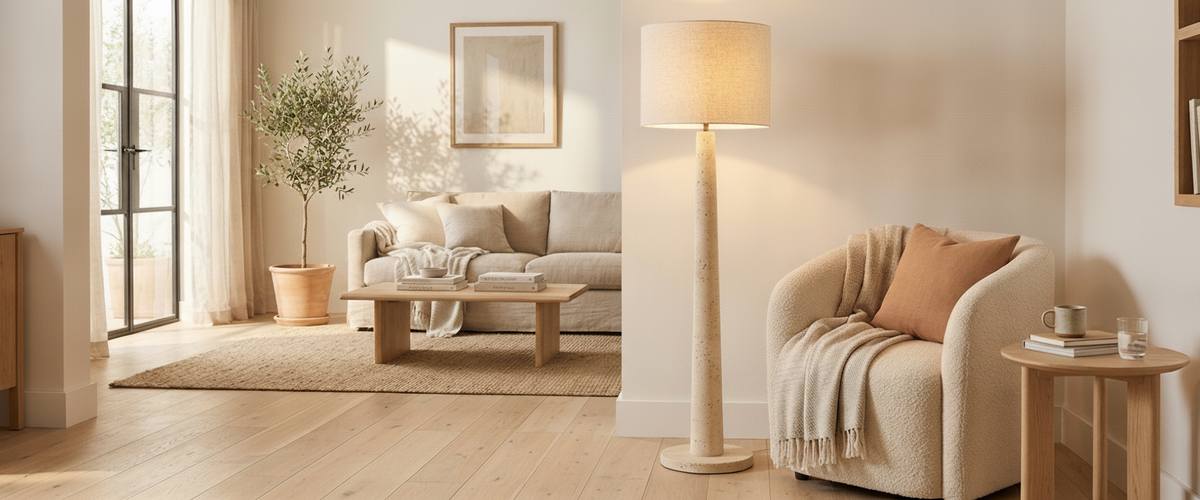

A travertine floor lamps gives you something a metal or glass one cannot: a base with real geological history in it, full of pitted grain and soft colour shifts that catch light in a way polished surfaces never do. That texture is the whole point, and it is also the thing most buyers overlook when they order online. Get the stone and the bulb right and the lamp reads as quiet luxury. Get them wrong and you are left with a heavy object in the corner that swallows the room instead of warming it.
Travertine is a form of limestone laid down around mineral springs, and its open, porous grain is what separates it from marble or onyx. At Niori we work with alabaster and natural stone precisely because these materials shape light rather than simply block it, and travertine sits at the earthier, more grounded end of that family.
Honed stone reads as texture and shadow when warm light rakes across it.

Key Takeaways Before You Buy
Grain scatters light. Travertine's open pores diffuse and soften illumination instead of bouncing it back at you like polished stone.
Read the base finish. Honed leaves the pits open for texture; filled gives a smoother, more even surface that resists dust.
Weight is a feature, not a flaw. A stone base should feel planted. If it feels light, question what is underneath the veneer.
Warm bulbs win. Around 2700K brings out the honey and cream tones; cooler light at 4000K and above flattens them to grey.
Porous means sealed. Travertine needs a light seal and gentle cleaning to stay looking its best over the years.

How Travertine's Open Grain Scatters Light
Hold a piece of polished marble under a lamp and the surface throws light straight back. Travertine does the opposite. Its natural cavities and open grain break up light and scatter it across the surface, so a travertine floor lamp base picks up a low, warm sheen rather than a hard highlight. That matters most in the evening, when a nearby bulb rakes across the stone and every pit and vein reads as a small shadow.
This is why a floor lamp with travertine holds its own in a room that already has a lot going on. The base does not compete with a glossy coffee table or a lacquered console; it settles beneath them. If your scheme leans towards soft, tactile surfaces such as bouclé, linen and aged oak, the stone belongs there naturally. Where the room needs a soft diffused glow overhead rather than a hard downlight, a piece such as the Corvanto Travertine Dome Pendant Light is closer to the same design language, and it shows how translucency does the diffusing while the stone does the grounding across our wider alabaster lighting range.

Reading the Base: Honed Versus Filled, and What the Weight Should Feel Like
Travertine comes to you in two broad finishes, and the difference changes how the lamp looks and how it lives.
Honed and unfilled leaves the natural cavities open. It is the more characterful finish, all texture and shadow, and it reads as more architectural. The trade-off is that those open pores collect dust and the odd crumb, so honed travertine wants a quick brush-down more often.
Filled means the cavities have been packed with a matching resin or stone paste, then smoothed. You lose a little of the raw grain but gain an easier surface to keep clean, which is often the right call for a lamp that lives in a busy family room or a rental you cannot fuss over.
Filled on the left, honed on the right: the same stone, two ways to live with it.
Weight tells you almost as much as finish. A genuine travertine base should feel planted when you nudge it; the whole reason to accept a stone floor lamp is the low centre of gravity that keeps it stable. A solid stone base can add 20 to 40 lbs (9 to 18 kg) to a floor lamp, which is exactly what holds it steady. If a supposed stone base feels suspiciously light, it may be a thin travertine veneer over a hollow core. That is not automatically wrong, and it can make shipping and repositioning easier, but you should know which one you are buying. A maestro travertine floor lamps style suits a large bay window where the piece has to anchor real space, and a solid base earns its keep there: a lighter version would look marooned.
The Corner a Stone Floor Lamp Earns, and the One It Swallows
A travertine base floor lamp is a big visual commitment low down, so placement is where most people go wrong. It works best where the base can be seen and read, not tucked so tightly behind a sofa arm that all you notice is the shade.
Beside a low-slung sofa or reading chair. The stone sits below the seatback and the light falls over the shoulder, which is exactly what a floor lamp is for.
Anchoring a bay window or a bare corner. A grande travertine floor lamp with a tall stem, often 60 inches (150 cm) or more, fills vertical space and gives an empty corner a reason to exist.
Flanking a console or fireplace. One lamp offset to the side reads more relaxed than a rigid matching pair.
The corner it swallows is the cramped one. Wedge a heavy stone base into a narrow gap between a radiator and a doorway and it stops looking deliberate and starts looking stuck. Travertine wants a little breathing room around the base, ideally 12 inches (30 cm) of clearance, so the eye can register the material. If you only have a tight slot, a wall light earns its place where a floor lamp cannot; something like the Dorsa Travertine Cylinder Wall Light keeps the same stone character without claiming floor space, and you can compare formats across the full lighting collection before you commit.
Warm Bulbs and Low Furniture: The Pairing That Lets Travertine Settle In
The bulb makes or breaks a travertine floor lamp. Reach for a warm colour temperature, around 2700K, which pulls the honey, cream and soft rust tones out of the stone. Cooler bulbs at 4000K and above drain that warmth and leave the surface looking flat and slightly grey, which defeats the reason you bought stone in the first place. The Lighting Research Center's work on warm light and perceived comfort backs up what the eye already tells you: lower colour temperatures read as more relaxing in living spaces (see the Lighting Research Center).
Put the lamp on a dimmer if you can. Travertine looks its best at the lower end of the dial in the evening, when the light is soft enough to let the texture show without glare. For a polo travertine floor lamp style with a compact stem and a wide shade, a dimmable warm bulb turns it into a genuine mood light rather than a task lamp.
The furniture around it matters too. Travertine settles most easily next to low, grounded pieces: a deep sofa, a slab coffee table, floor cushions. For a side table that carries the same stone into the seating group without adding another light source, a compact piece such as the Clifton II Light Travertine Side Table keeps the material language consistent. Tall, spindly furniture, by contrast, makes a stone base look like it wandered in from another scheme. Keep the company low and tactile and the lamp looks like it grew there.
Living With Porous Stone: Cleaning It Without Dulling the Surface
Travertine is porous, which is exactly why it feels alive underhand and exactly why it needs a gentle routine. Treat it like the natural material it is and it ages beautifully; treat it like a kitchen worktop and you will dull it.
Dust first, always. A soft dry cloth or a clean brush lifts grit before it gets ground into the pores. Honed and unfilled bases want this more often.
Damp, not wet. A cloth wrung out in plain water, or water with a drop of pH-neutral stone soap, handles most marks. Wipe and dry rather than leaving moisture to sit.
Skip acids and abrasives. Vinegar, lemon, bleach and general-purpose sprays etch and dull limestone-family stone. The Natural Stone Institute's care guidance on sealing and cleaning porous stone is worth reading before you reach for anything under the sink (see the Natural Stone Institute).
Blot spills fast. Wine, oil and coffee can stain untreated travertine. Blot, do not rub, then clean gently.
Re-seal occasionally. A breathable stone sealer every 12 to 18 months keeps the surface protected without leaving a plastic sheen. Check what finish your lamp arrived with before applying anything.
Electrical note: any rewiring, plug changes or hardwiring should go to a qualified electrician. Keep cleaning to the stone and shade, and keep moisture away from the fitting.
How to Decide: A Quick Buyer's Checklist
Finish. Honed for texture, filled for easy upkeep. Match it to how tidy the room needs to be.
Weight and construction. Solid stone for anchoring presence, veneered for easier handling. Ask which you are getting.
Scale. A tall grande travertine floor lamp for a big empty corner, a lower profile for beside a chair.
Shade and diffusion. Linen, alabaster or glass all change the light. Warm, diffused output suits the stone.
Bulb and dimming. 2700K and dimmable, every time.
Budget. Cost depends on the size of the stone, the finish, the fittings and the engineering, so ask for a tailored quote rather than assuming a fixed figure.
Buy on those terms and a travertine floor lamp stops being a heavy object in the corner and becomes the piece that quietly holds a room together after dark.