
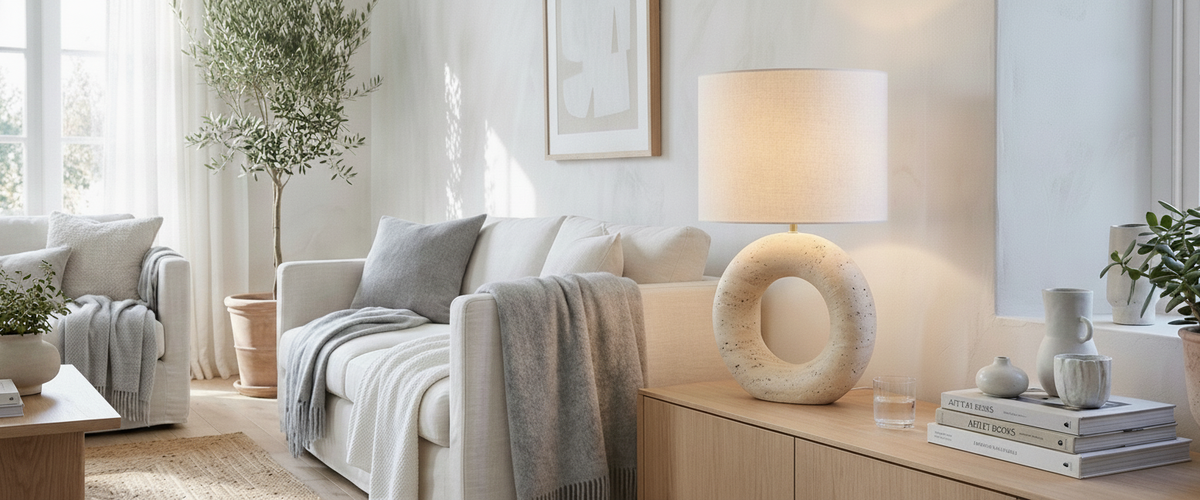

Run your fingers across a travertine table lamps and you feel something a polished marble base never gives you: tiny pits, open channels, a surface that has kept its history. That texture is the whole point. Travertine forms in mineral springs, and the little holes are trapped gas bubbles from when the stone was laid down. On a travertine table lamp, that grain does real work; it catches shadow near the surface, softens the reflection of a bulb, and tells the eye at a glance that this is stone and not a moulded lookalike.
A cream travertine base reads as texture without adding visual weight.
We ship a lot of alabaster and marble lighting at Niori, and the travertine table lamp gets asked about more every season. It sits in a slightly different register: earthier, drier, more Mediterranean than the milky glow of alabaster. Below is how to read one properly before you buy, and where a travertine lamp table pulls a room together rather than getting lost.

Quick Answer: What Makes a Travertine Table Lamp Worth It
The grain is the signal. Pitted, open texture reads as genuine stone from across the room in a way smooth surfaces cannot fake.
Colour changes the mood. Cream feels light and Mediterranean, walnut feels grounded and warm, silver leans cool and architectural.
Filled or unfilled matters. A filled travertine base table lamp feels smoother and more formal; unfilled ones keep the open pores and a rawer character.
Balance the base and shade. A heavy stone base wants a shade with enough presence to answer it.
Placement is everything. A textured stone base anchors low, tactile surfaces and disappears against busy pattern.

What the Pitted Grain of Travertine Signals That Smooth Stone Never Will
Smooth stone is about clarity. Alabaster glows because light passes through it, and polished marble reflects a room back at you in cool detail. Travertine does neither. Its open grain scatters light at the surface, so the base reads as matte and tactile even when it has a light seal on it. That is why a travertine table lamp feels relaxed rather than showy; the material carries a lived-in quality before you even switch it on.
The pits also change how the base behaves next to a lit shade. Warm light spilling down from above catches the edges of each little hollow and throws small shadows across the stone. On a smooth base that light would slide off as a bright highlight. On travertine it settles into the texture. If you want a lamp that feels calm at night, that scattering is a quiet advantage.
One thing worth knowing before you buy: travertine is a form of limestone, and the Natural Stone Institute classes it as a relatively soft, porous stone. That character is exactly what gives it the grain you are paying for, and it is also why the base needs slightly more thought around care than a hard granite one.

Reading Colour: Cream, Walnut and Silver Travertine in a Real Interior
Travertine is not one colour, and the band you choose sets the whole tone of the piece.
Cream and ivory travertine is the most forgiving. It bounces daylight, keeps a room feeling open, and pairs naturally with pale plaster walls, oak, and linen. A cream travertine table lamp on a console in a bright sitting room almost reads as neutral; it adds texture without adding weight.
Walnut travertine, with its brown and rust banding, does the opposite. It grounds a space. We had a client furnishing a low-lit study with dark joinery who went back and forth between marble and a travertine base table lamp; the walnut base won because it held its own against the panelling instead of looking like a pale afterthought against it. If your room already runs warm and moody, walnut belongs there.
Silver travertine reads cooler, with grey and pewter tones and often more dramatic linear veining. It suits architectural, minimalist rooms where you want the texture but not the Mediterranean warmth. Against concrete, brushed steel or a monochrome palette, silver looks deliberate.
Walnut banding holds its own against dark joinery and moody walls.
Whichever band you pick, look at the stone under warm light, not showroom daylight, since that is how you will actually live with it. If you are weighing a travertine table lamp against the softer glow of alabaster, it helps to see the two families side by side across our alabaster lighting range before committing.
Base Weight Versus Shade Balance: The Proportion That Makes It Look Considered
The most common mistake with a table lamp travertine build is a base that overpowers a mean little shade, or a generous shade perched on a base too slight to hold it. Travertine tends toward heft, so the shade has to answer that weight.
A good rule to start from: the shade should be roughly two-thirds to three-quarters as tall as the base and wide enough to sit visually over it, not float above it. A chunky travertine cylinder wants a broad drum or a rounded empire shade with real presence. A slimmer turned base can carry a taller, narrower shade. When the proportion is right, the travertine table lamp looks resolved from across the room; when it is wrong, your eye keeps snagging on the join.
Weight also has a practical side. Travertine is genuinely heavy, and a base can run to a few kilograms depending on scale. That mass is a feature: it keeps the lamp planted on a side table and stops it wandering when a cable is tugged. Just factor it in if you are shipping one abroad or lifting it onto a high shelf.
Filled or Unfilled Travertine, and What the Holes Do to the Light
Travertine is sold two ways, and the difference is more than cosmetic.
Filled travertine has its natural pores filled with resin or a matched stone paste, then honed or polished. The surface is smoother, easier to wipe clean, and reads as more formal. Light glances off it more evenly. This is the safer choice for a travertine table lamp that lives somewhere it will be touched often, like a bedside table.
Unfilled travertine keeps its open holes. It is more textural, more honest to the material, and it drinks light rather than reflecting it. The trade-off is that the open pores collect dust and can catch on a cloth. For a display piece on a console you rarely handle, unfilled stone has more character. For everyday use, filled tends to win.
Neither is better in the abstract. Decide by how the travertine table lamp will be used, then match the finish to the room's tempo.
Pairing the Lamp With a Shade That Lets the Stone Speak
The shade is where a travertine table lamp is won or lost. The base is already doing the talking, so the shade's job is to feed warm light down over the stone without competing.
Favour natural, unfussy shade materials: off-white linen, oatmeal cotton, or a soft parchment. These diffuse the bulb and throw a warm wash down the base that flatters the grain. Avoid glossy or heavily patterned shades; they pull attention up and away from the stone you paid for. A pale card lining helps push light downward rather than losing it out of the top.
On bulbs, stay warm. A dimmable LED around 2700K keeps the light in the amber range that makes the stone look like sun-warmed rock rather than cold laboratory white. Where you want to fine-tune that colour rather than commit to a single fixed tone, a colour-selectable fitting such as the PREDA LED 7.3W Desk Lamp lets you dial the warmth in and see exactly how it lands on the grain. Warmer colour temperatures generally read as more relaxing in living spaces, and that holds true here; a cool bulb makes cream travertine look grey and drains the warmth from walnut. Put the travertine table lamp on a dimmer if you can, so it can shift from reading brightness to a low evening glow.
Where a Travertine Lamp Anchors a Room and Where It Disappears
This is a texture piece, so it earns its place against surfaces that let that grain read.
A travertine table lamp anchors well on a dark wood console in an entryway, on a low sideboard flanking a sofa, or on a bedside table against a plain plaster wall. In an open-plan living space, a pair of matched travertine lamps at either end of a long console gives symmetry and a warm, low light layer beneath the main ceiling fixtures. In a study or reading corner, a single walnut base beside a leather chair holds the space beautifully. Where that corner needs a directed reading light instead of the stone's soft downward wash, an adjustable-arm fitting such as the RAIBO 5W E27 Desk Lamp is closer to the right tool for the job than a fixed stone base.
Where it disappears: against busy wallpaper, on a heavily veined marble surface that fights the stone, or in a room already crowded with pattern. Travertine needs a little quiet around it. Give it a calm backdrop and it looks considered; drop it into visual noise and the grain gets swallowed.
If you are still deciding between stone families for a specific corner, it is worth browsing the wider lighting range to see how table lamps, wall lights and pendants layer together before you settle on a single hero piece.
A Short Buyer's Checklist
Check the colour band (cream, walnut, silver) under warm light, not daylight.
Decide filled or unfilled based on how often the lamp will be handled.
Confirm the shade proportion against the base before ordering.
Choose a warm, dimmable bulb around 2700K.
Plan the placement against a calm backdrop, not busy pattern.
Account for the weight if shipping or shelving the lamp high.
Budget for a genuine travertine table lamp depends on the block the base is cut from, whether it is filled or left open, the scale, and the quality of the shade and wiring. Rather than chase a headline figure, it is worth requesting a tailored quote once you know the size and finish you want, since the same travertine table lamp design can vary widely by material and engineering.