
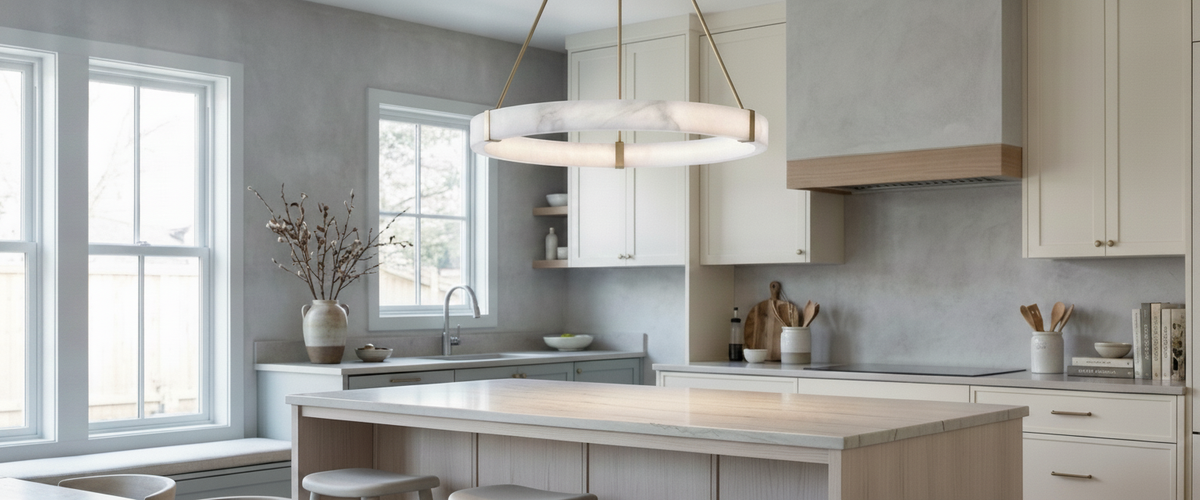

Buy a beautiful piece of stone light, sit it in the wrong spot, and it looks like a lump of pale rock. That is the quiet risk with the Simon Blake alabaster look and the broader style it represents: the material only earns its keep when light moves through it and the eye can see the veining glow. Get the placement right and a single carved lamp can set the mood of a whole room. Get it wrong and you have spent good money on an ornament.
The appeal is easy to understand. Alabaster is soft, translucent, and full of natural pattern, so it turns a hard electric source into something warm and diffuse. At Niori we work only in alabaster and natural stone, and most of the placement questions we field come from buyers who love the Simon Blake alabaster material but are unsure where it belongs in a real home.
A carved stone lamp reads best where the eye sits close enough to catch the veining.

Key Takeaways
Simon Blake alabaster reads best where light can pass through it and where the eye sits close enough to see the veining.
Scale and sightlines change how the stone looks more than the fixture type does.
Cordless alabaster table lamps solve real problems on mantels, shelves, and outdoor tables where no socket exists.
The wall colour behind a piece can either lift the glow or flatten it.
The most common mistakes are over-bright bulbs, cold colour temperature, and burying the lamp in a bright corner.

What the Simon Blake Alabaster Aesthetic Signals Across a Home
This carved stone style, and the wider category of hand-crafted Simon Blake alabaster lighting it sits within, signals restraint. It is the opposite of a mirrored, high-gloss statement fitting. The material does the talking through its own grain, so the shapes tend to be simple: a cylinder, a soft dome, a slab of onyx set in brass. That quiet quality is exactly why it slots into so many interiors, from a pared-back London flat to a country kitchen.
What it should not signal is fuss. When people ask us how to make a room feel considered rather than decorated, a Simon Blake alabaster piece is usually part of the answer, because it adds warmth and texture without shouting. The trick is to let one or two pieces carry the effect rather than dotting soft glow through every corner.
Sightlines and Scale: The Choices That Change How the Stone Reads
Two things decide whether Simon Blake alabaster looks expensive or accidental: how big the piece is relative to its setting, and where the eye lands on it.
Scale first. A small carved lamp on a large sideboard disappears; the same lamp on a bedside table feels generous. As a rough guide, a table lamp should read as roughly a third of the height of the surface plus anything behind it, so it holds its own without towering. On a standard 30 inch (76 cm) bedside table, that points you toward a lamp in the 18 to 24 inch (46 to 61 cm) range. For pendants and chandeliers, the veining only shows from certain distances, so hang them where people actually stand or sit rather than at a height chosen purely for clearance; over a dining table, a base around 30 to 34 inches (76 to 86 cm) above the surface is a safe starting point.
Sightlines matter just as much. A Simon Blake alabaster lamp rewards a close look, because the pattern inside the stone is the whole point. Place it where guests pass within 3 to 6 feet (1 to 2 m) of it (a hallway console, a reading corner, the end of a kitchen island) and the material earns its price. Push it to the far side of a big open-plan space and it becomes a soft blob of light with the detail lost. You can browse the full range across our lighting collection to see how different forms suit near or far viewing.
Matched pairs on bedside tables keep the veining close to the eye and the mood calm.
Living Room, Bedroom, Hallway: Where the Glow Earns Its Keep
Different rooms ask different things of a stone light, and the same piece can behave completely differently depending on the job.
Living room
Here Simon Blake alabaster works best as layered light rather than the main source. A pair of table lamps on either side of a sofa gives a low, warm pool that reads well against a switched-off television and a dim ceiling. If you want a single hero piece, a carved pendant over a coffee table or a side console draws the eye without lighting the whole room flat.
Bedroom
The bedroom is where the material shines, quite literally. Simon Blake alabaster bedside lamps throw a gentle glow that suits winding down far better than a bright downlight. Keep the output low, choose warm bulbs, and put the lamps close enough to read by. We often steer clients toward matched pairs here, because symmetry reads calm and calm is the whole point of the room.
Hallway
Hallways are usually starved of daylight and short on soft light, which makes them the easiest win. A single alabaster wall light or a small lamp on a console changes the feel of an entrance from the moment you open the door. Because people move through rather than linger, this is a good spot for a piece with bold veining you notice in passing.
Cordless Versions and Where Their Portability Actually Pays Off
A cordless alabaster table lamps is one of the more useful developments in stone lighting, and not because it is a gimmick. Rechargeable batteries and warm LED sources mean you can put a lamp exactly where the stone looks best rather than where the nearest socket happens to be.
Where does that portability actually pay off? A few real situations come up again and again with our buyers:
On a mantelpiece or floating shelf with no power behind it.
On a dining table, so the setting can be lit softly without a trailing cable across the cloth.
Outdoors on a covered terrace or in a garden room for an evening, then brought back inside.
In rentals and listed buildings where new wiring is not an option.
Battery life and colour temperature are the two specs worth checking before you buy. A cordless lamp that runs cool and blue undoes the whole reason for choosing Simon Blake alabaster, so look for a warm output and a run time that suits a long evening; many rechargeable models give 6 to 8 hours on a low setting. If you want to compare corded and cordless forms side by side, our alabaster lighting collection is the place to start.
Backdrop and Contrast: The Wall Colour Behind the Light Matters
People obsess over the fixture and forget the surface behind it. The wall colour does a lot of quiet work in how Simon Blake alabaster reads once it is lit.
A pale, warm wall (a soft off-white, a chalky stone shade, a muted clay) lets the glow feel like it is spreading naturally into the room. A deep, saturated colour behind the light does the opposite: it makes the alabaster look brighter and more sculptural because of the contrast, which suits a dining room or a moody snug. What flattens a piece is a cold bright white wall under bright ceiling light, because there is nothing for the soft glow to register against.
Texture counts too. A Simon Blake alabaster piece next to plaster, limewash, or a natural stone surface picks up a family resemblance and looks intentional. The same lamp against high-gloss white can feel stranded. The Natural Stone Institute has good background on how stone finishes interact with light if you want to understand the material more deeply (naturalstoneinstitute.org).
Placement Mistakes That Flatten an Expensive Piece
Most disappointing installs come down to a short list of avoidable errors. Here is the checklist we run through with clients.
Too much light output. A high-lumen bulb blows out the stone and kills the glow. Aim for a low-output bulb, roughly 200 to 400 lumens; Simon Blake alabaster wants a gentle source; think mood, not floodlight.
Cold colour temperature. Anything above about 3000K pulls the stone grey and lifeless. Warm white, around 2700K, keeps the honeyed tone the material is prized for. Guidance from lighting bodies such as CIBSE backs up how colour temperature shapes the feel of a space (cibse.org).
Burying it in bright surroundings. A soft lamp fighting a bank of downlights loses every time. Dim the layer above it or switch it off.
Wrong scale. An undersized lamp on a big surface reads as an afterthought. Match the piece to the furniture, not just the room.
Ignoring sightlines. If nobody passes close enough to see the veining, you have paid for detail you never get to enjoy.
Poor dimming. A dimmable driver and a compatible dimmer let you dial the glow to the hour. Always ask a qualified electrician to handle any hard-wired fitting and dimmer pairing.
Handle the stone kindly, too. Simon Blake alabaster is softer than marble and dislikes water and harsh cleaners. A dry, soft cloth and the odd gentle dust is all it needs; skip the sprays. Placement decides how good the piece looks, but care decides how long it keeps looking that way.
Get the scale, sightline, backdrop, and bulb right, and a single Simon Blake alabaster piece does more for a room than a whole ceiling of recessed spots. That is the case for stone light, and it is why we build the whole Niori range around it.