
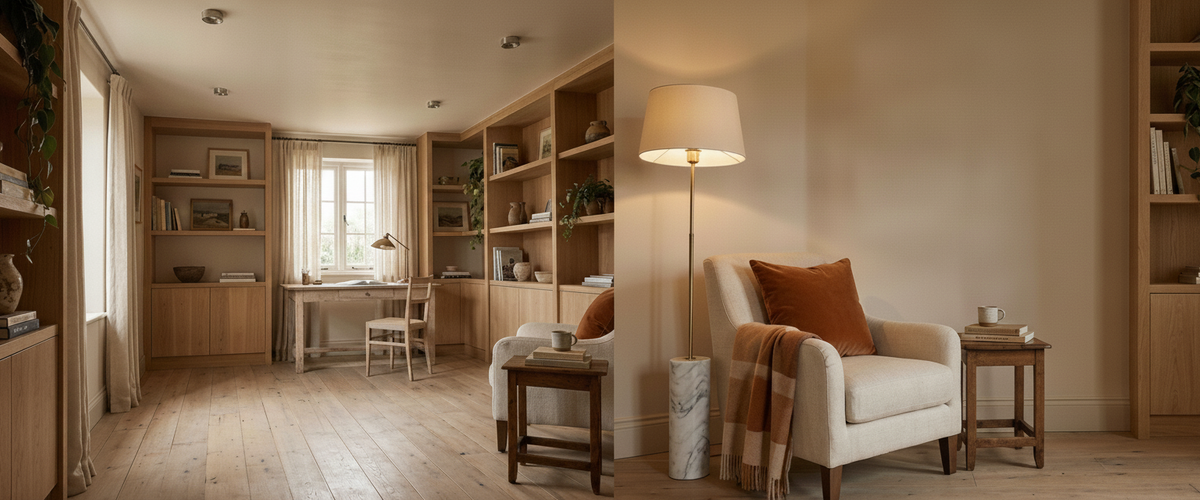

The first thing you notice about a good marble floor lamps is not the shade. It is the moment you try to nudge it a few inches and it refuses to move without a proper shove. That heft is the whole point. A stone base gives a tall, slim marble floor lamp a low centre of gravity, so it stands calm in a room instead of teetering like a plant on a stick. Weight is not a side effect here; it is doing structural work.
Buyers who focus only on the metalwork or the shade tend to regret it. The base is what you feel with your foot every day, what your cleaner has to work around, and what quietly separates a considered marble floor lamp from a flimsy one. So let us judge these lamps the way we judge them in the studio.
A stone base grounds a seating group and lifts light off the ceiling.

Key Takeaways for Choosing a Marble Floor Lamp
Weight equals stability. A solid stone base keeps a tall marble floor lamp from tipping and stops the shade from wobbling every time you pass.
Solid stone and veneer feel different in the hand. Temperature, seams, and sound give the game away.
Vintage and antique bases carry their history in the polish and veining. That patina can be a feature, not a fault.
Placement matters more than size. A stone-based light anchors a corner beautifully but can dominate a tight walkway.
A warm bulb flatters stone. Cool light drains the colour out of marble and alabaster alike.

How Stone Weight Changes the Lamp's Balance and Stance
Marble is dense, weighing roughly 168 lb per cubic foot (about 2,700 kg per cubic metre). A disc of solid stone at the foot of a marble floor lamp can outweigh the entire metal frame above it, and that ratio is what makes the lamp behave. The load sits low, so the tall stem stays vertical and the shade holds its position. You can brush past it in a busy hallway and it does not sway.
This changes the light too. A stable lamp throws a stable pool. If the base is too light for the height, the shade drifts, the beam shifts, and reading by it becomes mildly irritating in a way people struggle to name. When you shop, lift the fixture or ask about the base weight before anything else. A reputable seller will know it.
There is a spatial cost to that mass. A heavy marble floor lamp does not want to be moved seasonally or dragged between rooms. Pick its spot with the assumption it stays there. That is a feature for a reading corner and a nuisance for anyone who rearranges furniture on a whim.

Solid Marble Versus Veneer: The Tells You Can Feel
Not every stone base is what it looks like. Some are solid marble; some are a thin marble veneer bonded to a cheaper core; some are resin printed to imitate veining. All three can look convincing in a photograph, so learn the physical tells.
Temperature. Real stone feels cool to the touch and warms slowly. Resin sits closer to room temperature and warms fast under your palm.
Weight for size. A solid base is heavier than you expect. A hollow or veneered base feels light for its footprint.
Seams and edges. Run a finger around the underside. Veneer often shows a joint line or a wrapped edge where the sheet meets the core.
Sound. Tap it gently. Solid stone gives a dull, dense knock. A hollow core rings or sounds thin.
Veining logic. On real stone the veins run through the edges and continue on the base's underside cut. Printed patterns stop at the surface.
Seams and a wrapped edge on the underside often reveal a veneer over a cheaper core.
None of this makes veneer worthless. A well-made veneered base can be steadier than a bad solid one if it is weighted properly inside. When a maker is confident in the stone, they tend to build the whole marble floor lamp around it, as with a piece like the Odin Floor Lamp with Marble Base in Brushed Brass, where the disc is a genuine load-bearing element rather than a decorative cap. If a listing is vague about whether the base is solid stone, treat that vagueness as an answer.
Vintage and Antique Bases: What Decades Do to the Stone
An antique marble floor lamps tells you where it has been. Older bases were almost always cut from solid stone, so the weight is rarely in question. What changes with age is the surface. Decades of dusting, handling, and light exposure soften a high polish into a gentler sheen, and that matte quality reads as quality to most eyes.
Veining shifts too. Marble is a natural material, and its surfaces react over time to acids, oils, and cleaning products, which is why conservators handle historic stone so carefully. The Getty Conservation Institute has documented how surface treatment and environment change the look of stone over decades. On a vintage marble floor lamp, small etch marks or a warmer tone in the white are usually honest signs of age rather than damage.
Buy vintage with clear eyes. Check that the wiring on the marble floor lamp has been brought up to current standard, and if there is any doubt, have a qualified electrician inspect and rewire it before use. The stone may be a century old; the flex should not be. A cracked base is a different matter, since a structural crack in the load-bearing disc is a genuine safety concern, not a charming flaw.
The Corner Test: Where a Marble Floor Lamp Anchors and Where It Dominates
A marble floor lamp with a stone base wants a job. Give it one. The strongest position is usually a corner beside a sofa or an armchair, where the base grounds the seating group and the shade lifts light off the ceiling. Here the weight reads as reassurance and the fixture becomes the visual anchor of the whole arrangement.
The failure mode is a narrow route. Drop a marble base floor lamp into a tight walkway or beside a doorway and its mass turns into an obstacle you keep clocking with your hip. In a small London flat we shipped to, the client had first placed a stone-based reader by the kitchen door; moving it about 6 feet (roughly 2 metres) into the living-room corner changed the room entirely, and nobody stubbed a toe again.
Scale the base to the room, not just the ceiling height. A broad, heavy disc suits a generous space; a slimmer footprint sits better in a compact one. Where a dark scheme calls for a base that reads as weight without spreading too wide, a black marble floor lamp such as the Kyoto LED Floor Lamp with Black Marble Base holds a corner without overwhelming a tighter footprint. If you want to compare stem heights and base proportions across styles, the full lighting collection is a useful place to see how different bases carry a room.
Matching Base to Shade and a Warm Bulb That Flatters the Stone
The base sets the mood; the shade and bulb decide whether it works. Cool white light is unkind to marble. It flattens the veining and pushes white stone towards a clinical grey. Warm light does the opposite, bringing out the depth in the veins and giving the surface a soft glow.
Aim for bulbs around 2700K for a warm, relaxed tone, and skip anything above 4000K in a living area. The Chartered Institution of Building Services Engineers treats colour temperature as central to how a space feels, and a marble floor lamp in a living area almost always wants the warmer end. Fit a dimmable LED and a dimmer switch so you can drop the level in the evening without the light turning yellow and murky.
For shade choice, let the base lead. A pale stone or an alabaster column pairs beautifully with a warm-toned fabric drum or a translucent stone shade that glows from within. Brushed brass detailing bridges white and grey marbles alike. Black or gold-grey stone bases can take a bolder shade, since the material already carries strong contrast; a marble floor lamp with mixed tones like the Kyoto LED Floor Lamp in Gold and Grey Marble already does much of the visual work, so a plainer shade tends to sit better above it. If you like the idea of stone right through the fixture rather than only in the base, the alabaster lighting range shows how translucent stone shades diffuse light in a way glass cannot quite match.
Keeping Polished Marble From Clouding, Staining, or Dulling
Marble is porous and slightly soft, sitting at 3 on the Mohs hardness scale, which is why the base of a marble floor lamp that looks pristine in year one can dull without much care. A little routine keeps it clear.
Dust dry and often. A soft, dry microfibre cloth lifts grit before it scratches the polish.
Wipe spills at once. Wine, oil, coffee, and citrus can etch or stain the stone quickly. Blot rather than rub.
Avoid acidic cleaners. Vinegar and general-purpose sprays damage the surface. Use warm water with a drop of pH-neutral soap, then dry it off.
Consider a stone sealer. A suitable impregnating sealer, reapplied as advised, reduces staining on lighter marbles.
Use felt pads underneath. They protect both the floor and the marble floor lamp base, and stop grit grinding into the underside.
Clouding usually means moisture or a residue film rather than deep damage. A gentle clean and a thorough dry often bring the sheen back. Persistent etch marks on a treasured piece are a job for a professional stone restorer, not a DIY polish that can make things worse.
A Quick Buyer's Checklist Before You Commit
Confirm whether the base is solid stone or veneer, and ask for the weight.
Check the base footprint against the exact spot you have in mind, not just the room in general.
Match the shade tone to the stone and plan for a warm, dimmable bulb around 2700K.
On a vintage marble floor lamp, confirm the wiring is safe or budget for a rewire by a qualified electrician.
Ask about care and sealing so you protect the surface from day one.
Get the base right and everything above it behaves. As natural-stone lighting specialists, we would rather a client spend an extra minute asking about weight and finish than fall for a photograph. A well-chosen marble floor lamp earns its corner for decades.