
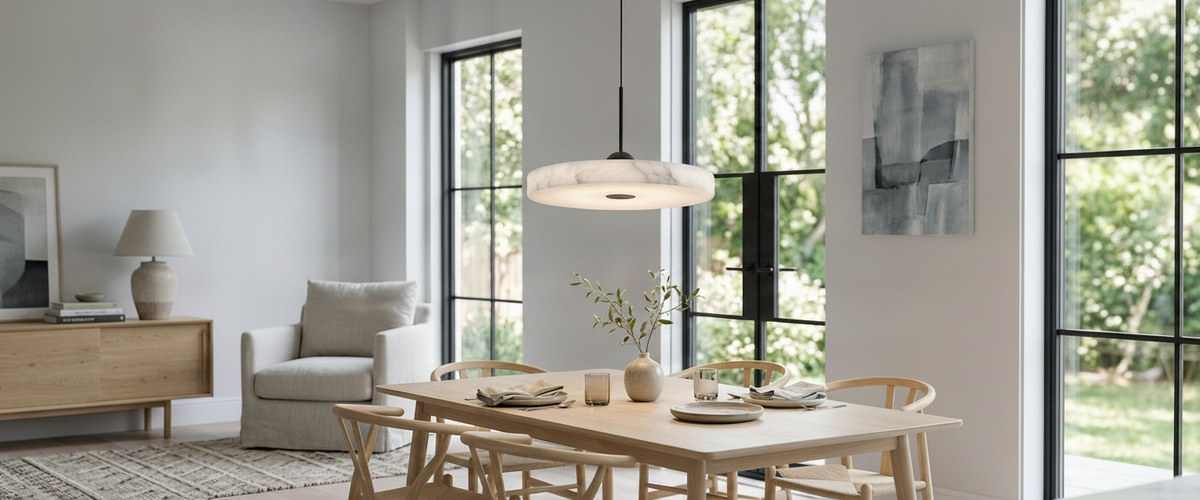

A light modern pendant has almost nowhere to hide. Strip away the ornament, the arms, the crystal drops, and what remains is a single clean form, a bulb, and the quality of the glow it throws. Get the material and the drop right and it reads as quietly considered. Get them wrong and the same fitting looks like something the developer left behind. The line between restraint and blandness is thinner than most people expect, and it is worth understanding before you commit.
At Niori we work in alabaster and natural stone, so we spend a lot of time on that exact line. A light modern pendant made from translucent stone solves a problem the minimalist form creates: a plain shape can feel cold, but stone gives it depth, color and a soft light that a flat opal shade never manages.
A minimal alabaster pendant lets the material carry the design.

Key Takeaways for Choosing a Light Modern Pendant
Material carries the design. With minimal shapes, alabaster, stone or glass is doing the visual work the ornament used to do.
Drop height decides the silhouette. Too high and it disappears; too low and it dominates.
Warm, dimmable LED flatters a plain fitting. A cold flat light exposes a minimal form; a warm glow gives it life.
One, a pair or a run? Let the surface below dictate the count, not the trend.
Budget depends on material, scale and engineering. Ask for a tailored quote rather than assuming a fixed figure.

The Line Between Restraint and Blandness
Modern pendant lights sell on the promise of calm. The risk is that calm slides into forgettable. What separates a good minimal fitting from a dull one is almost never the outline; it is what happens up close. A crisp radius on a rim, a slim brass collar where the flex meets the shade, a piece of stone with veining that shifts as the light comes up. These are small things, and they are the whole game. A light modern pendant lives or dies on that detail.
This is why material choice matters more in a light modern pendant than in a busy decorative one. A chandelier can lean on its complexity. A single clean globe or disc has to earn attention through surface and light alone. That is the argument for stone over plain painted metal or a mass-produced glass dome: it gives the eye somewhere to rest that still feels rich.

Alabaster, Stone and Glass: How Each Material Owns the Bulb
Every translucent material treats the bulb behind it differently, and that difference is the design.
Alabaster scatters light through its natural crystalline structure, so the source softens into a warm, cloudy glow with no hot spot. The veining reads as faint amber and cream, and it changes depending on how the stone was cut. Alabaster has been prized for lighting since antiquity for exactly this quality, so it carries a sense of age even in a light modern pendant. The Metropolitan Museum of Art holds carved alabaster vessels valued in part for how they glowed when lit from within, which tells you the appeal is not a passing trend.
Marble and onyx push further toward drama. Onyx in particular can carry bold banding that lights up like stained glass, so it suits a pendant meant to be a focal point rather than a background note. Marble tends to be denser and less translucent, which makes it better for fittings where you want presence and reflected light rather than glow.
Glass is the honest budget of the group in visual terms: clean, cool, consistent, and completely without the organic variation stone gives you. It has its place in a strict, hard-edged interior. But if the whole point of a light modern pendant is warmth, glass often needs help from the bulb to get there. You can see how these materials read across fittings in the wider lighting collection before you decide which direction suits the room.
Warm LED behind stone turns a plain silhouette into an evening focal point.
One Pendant, a Pair, or a Run
The count is a decision about the surface underneath, not about fashion. A single light modern pendant works over a round table, a small breakfast bar, or a hallway console where you want one clear anchor. A pair brings balance and rhythm over a longer island or a dining table that seats six or more. A run of three or more suits a long kitchen island or a bar, where even spacing does the visual heavy lifting.
A practical studio note: we shipped a run of three matched alabaster pendants to a client with an eleven-foot (3.35 m) island in a converted warehouse, and the first instinct was to center them tightly. Spacing them wider, so each pendant sat over a working zone rather than clustering in the middle, made the whole island read as intentional. The lesson holds generally. Space to the work below, then check the symmetry.
With a run, order matters if you are using natural stone. No two alabaster shades are identical, so ask whether the maker can group the veining so the pieces sit as a family rather than a mismatch. It is the kind of detail that separates a considered light modern pendant from a catalogue order.
Drop and Height That Keep a Minimal Silhouette Legible
Hang a minimal pendant wrong and the form stops making sense. Over a dining table or island, the underside of the shade usually wants to sit around 30 to 36 inches (76 to 91 cm) above the surface. That keeps the fitting in the sightline as an object while leaving the tabletop and the faces around it clear.
In a stairwell or double-height hall the maths changes. Here the light modern pendant reads from several floors, so a longer drop and a larger fitting stop it looking lost. A wide-format fixture such as the Gemini Pendant Light 105cm in Black has the scale to hold a tall void without disappearing into it. Measure from the highest point people will view it and make sure the lowest point clears head height on the landing.
For general room height, a rough guide is to allow around 2.5 to 3 inches of drop per foot of ceiling height (roughly 6 to 8 cm per 30 cm), then adjust for the furniture below. A light modern pendant depends on that clean vertical line, so a fitting jacked up too tight to the ceiling loses the very thing you paid for.
Warm LED and Dimming That Flatter a Fitting With Nowhere to Hide
A minimal light modern pendant shows off its light more honestly than a decorative one, which means the bulb choice is not a detail you can leave to chance. For alabaster and stone, aim for a warm color temperature, roughly 2700K, which brings out the amber and cream in the veining. A cooler 4000K reads crisper and more contemporary and suits a working kitchen, but it can flatten the warmth of natural stone, so decide which effect you actually want in that room.
Choose a high color rendering index, ideally CRI 90 or above, so food, skin and materials look true under the light. Get the dimming right too. Pair a compatible LED driver with a trailing-edge dimmer and confirm the two work together, because a mismatch is the usual cause of flicker and buzz. The Chartered Institution of Building Services Engineers publishes lighting guidance worth reading if you want the technical grounding on levels and glare; you can find it via CIBSE. Any hard-wiring should be signed off by a qualified electrician.
One thing dimming does that people underrate: it lets a single fitting serve two moods. Full output while you cook or work, then dropped to a low warm glow for the evening. With stone, that low setting is where the material really performs, because the glow through the veining becomes the main event.
Islands, Tables and Stairwells: Where a Modern Pendant Lands Right
Kitchen islands. Modern kitchen pendant lights earn their place here because they combine task light with a strong horizontal statement. A run of matched fittings over an island gives even coverage for prep while framing the space. Where the kitchen needs a crisp, contemporary working light rather than a warm evening glow, a compact 4000K fixture such as the Gemini Pendant Light 42.5cm in Brass spaces cleanly across an island. Keep the drop generous enough to clear sightlines across the room.
Dining tables. A single larger fitting or a tight pair centers the table and sets the tone for the meal. This is where a warm alabaster light modern pendant comes into its own, throwing a soft light that flatters everyone at the table rather than the glare of a downlight.
Stairwells and halls. A long-drop fitting in a tall void becomes architecture. Choose one with enough scale to read from below and a color temperature that stays inviting rather than clinical.
Bedrooms. A pair of small pendants either side of the bed frees the surface of the nightstand and gives a softer, more modern look than table lamps. Put them on the same dimmed circuit as the main light for control.
If you want to see how translucent stone behaves across these settings, the alabaster lighting collection is the clearest place to compare forms and finishes. Good modern pendant lighting always starts with the material.
A Quick Buyer's Checklist
Material first: alabaster or onyx for warm glow, marble for presence, glass for a strict cool look.
Confirm the drop against your ceiling height and the surface below before ordering.
Match bulb and dimmer: warm 2700K for stone, high CRI, trailing-edge dimmer, no flicker.
Decide the count from the surface, not the trend: single, pair, or evenly spaced run.
For stone runs, ask the maker to group veining so pieces read as a set.
Get a tailored quote: cost tracks material, scale, engineering and finishing.
Use a qualified electrician for installation and load.
A light modern pendant done well is one of the most efficient design moves in a room. It does the work of ornament without the clutter, provided the material carries it and the light behind it flatters rather than exposes. Start from the surface it will hang over, choose a material that gives the plain form something to say, and get the drop and dimming honest. A well-chosen light modern pendant reads as confidence rather than an empty space where a fitting should be.