
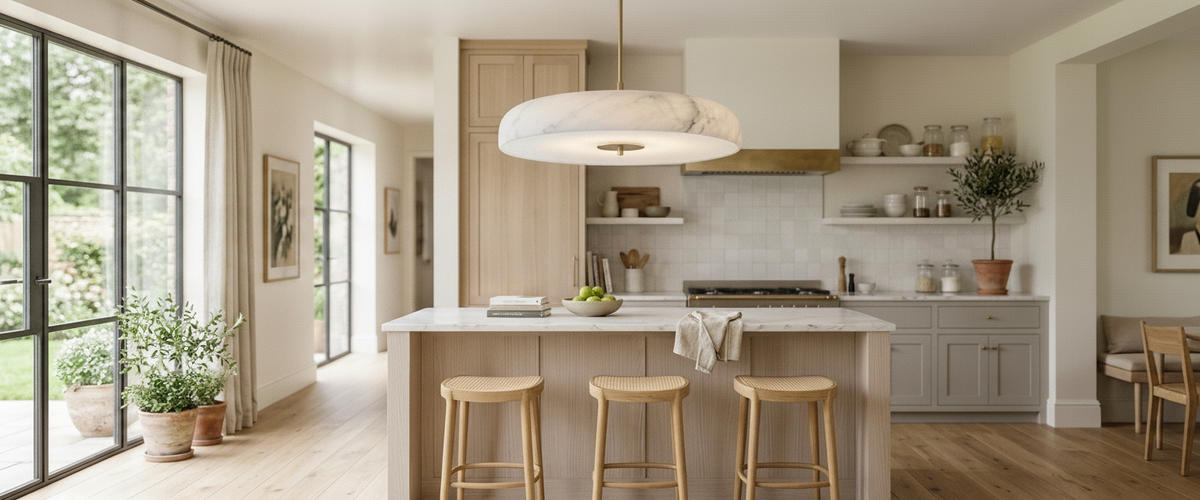

Turn on a globe pendant over a kitchen island and the light goes everywhere at once, which usually means it goes nowhere useful. A gong alabaster pendant lighting does the opposite. The shallow disc profile pools the glow downward onto the surface you actually care about, while the stone itself holds a low, warm blush at eye level. It is a quieter, more deliberate way to light a room, and a gong alabaster pendant light flatters a worktop or a console far better than a hard downlight ever could.
Below is how to choose a gong alabaster pendant light properly: reading the slab, sizing the disc to the surface underneath, getting the bulb temperature right, and avoiding the hanging mistakes that flatten a wide, shallow fixture.

Key Takeaways
A gong disc concentrates downward glow onto a surface; a globe scatters it in every direction.
Veining matters more on a wide, flat plane than on any other shape, so read the slab before you buy.
Size the disc to what sits below it, not to the ceiling, and get the drop height right.
Warm bulbs (roughly 2400K to 2700K) keep alabaster looking honeyed; cool ones turn it grey.
Hang a gong alabaster pendant light dead level and dead centre, or the shallow form reads as a mistake.

What a Shallow Gong Disc Does to Downward Glow That a Globe Never Will
The physics is simple once you picture it. A globe has curved sides that fire light sideways and up as much as down, so a lot of the output ends up washing the ceiling. A gong alabaster pendant light is broad and flat, more like a plate than a ball, so the underside becomes a single wide emitter aimed at the floor. You get a soft, even spill across a table or worktop rather than a bright hot spot ringed by shadow.
Because alabaster is translucent, the stone glows across its whole face instead of just at a bulb-shaped point. Light enters the slab, bounces around inside it, and leaves diffused. That is why an alabaster pendant lighting reads as a lit surface rather than a lit object, and why the gong shape suits the material so well: the more face you give the stone, the more of that diffusion you see. Where a room needs a compact fixture that still glows across its whole face rather than a wide plate, a piece such as the Serava LED Small Alabaster Loop Pendant Light shows how the same diffusion works at a smaller scale.

Reading the Veining Before You Buy: Which Slabs Spread Light Evenly
On a small wall light you barely notice the veining. On a wide gong disc you notice everything, because a lit flat plane shows its internal structure the way a backlit map shows rivers. Some slabs carry fine, even mineral banding that spreads light smoothly. Others have dense clouded patches or dark seams that block the glow and create shadowed zones on an otherwise bright face.
Alabaster is a fine-grained gypsum stone, and its translucency comes from that soft crystalline structure; the Natural Stone Institute describes gypsum alabaster as notably soft and workable, which is exactly why it takes a thin, light-passing carve. When you are choosing a gong alabaster pendant light, ask what the veining does when lit, not just how it looks switched off. A slab that photographs beautifully in daylight can turn patchy once a bulb sits behind it.
Best for even spread: fine, consistent banding with gentle tonal shifts across the face.
Handle with care: dramatic dark seams that photograph well but block light in one zone.
Ask the maker: whether the disc is cut from a single slab or several, since joins change how light travels.
Because every slab differs, no two gong discs are identical. That is part of the appeal, but it means you should see lit imagery of the actual material family before committing. You can compare finishes across the wider alabaster lighting range to get a feel for how veining behaves under warm light.
Where a Single Gong Lands Best: Islands, Long Consoles and Stairwell Voids
A gong disc is a horizontal statement, so it wants a horizontal surface beneath it to answer to. Three spots reward it most.
Kitchen islands. A single wide gong alabaster pendant light over a run of stone or timber gives that even downward wash cooks actually want, without the fussiness of three little pendants competing for attention. If your island is long, two matched discs read cleaner than a row of globes.
Long consoles and dining sideboards. Hung above a console in a hallway or behind a dining table, the gong throws a gentle pool of light down onto the surface and the objects on it. This is where the warm eye-level blush of the stone earns its place, softening a corridor that would otherwise feel flat.
Stairwell voids. Drop a gong disc into a double-height stair void and you get a glowing horizontal plane you look up at from below and down onto from the landing. It reads well from both angles because the disc has two good faces. For rooms with real ceiling height, this is one of the most rewarding uses of an alabaster light pendant we specify.
What a gong alabaster pendant light does not love is a tight, low room. Its whole character is width, so it needs a surface underneath that matches its scale and a little air around it.
Sizing the Disc to the Surface Below by Drop Height and Diameter
Forget sizing to the ceiling. Size to what sits under the pendant. A useful starting point for a dining or island setting is a disc roughly one half to two thirds the width of the surface below it, so the light pool covers the working area without the disc overhanging the edges.
Drop height is the other half of the equation. Over a kitchen island or worktop, aim for the underside of the disc to sit around 30 to 36 inches (76 to 91 cm) above the surface, so it clears sightlines and heads while still pooling light where you need it. Over a dining table you can go a touch lower for intimacy. In a stair void, drop the gong alabaster pendant light so it reads as a deliberate feature at the level people pass, not a thing they duck under.
For a long table where a single disc would leave the ends dim, a linear form such as the Oria LED Linear Alabaster Chandelier stretches the same warm glow along the full run rather than pooling it in one place.
Two practical notes on an alabaster pendant light fixture at this scale:
Stone has weight. A wide gong disc is heavier than a glass equivalent, so confirm your ceiling can carry it and have a qualified electrician check the fixing before install.
The wider the disc, the more level it must sit. On a broad flat plane, even a small tilt is obvious from across the room.
Bulb Temperature and Dimming That Keep the Stone Warm, Not Grey
This is where a good gong alabaster pendant light gets ruined by the wrong bulb. Cool white light drains the honey out of the stone and leaves it looking grey and dead. Warm light does the opposite: it lifts the natural cream and amber tones and makes the veining glow.
Aim for a colour temperature around 2400K to 2700K, with a high colour rendering index (CRI 90 or above) so the stone and everything under it reads true. For a piece that is on for hours, warm-dim behaviour matters too, where the light shifts warmer as you lower it rather than staying at one fixed tone. The Chartered Institution of Building Services Engineers offers useful background on colour temperature and rendering in its lighting guidance if you want the technical grounding.
Put a gong alabaster pendant light on a dimmer as a matter of course. A wide disc at full output over a dining table can be too much; the same fixture at 30 percent turns the stone into a soft lantern. Match the dimmer to the driver, and if the fixture is integrated LED, confirm it is dimmable before you wire anything in. This is worth planning for any alabaster contemporary pendant light, where the whole point is a controllable, warm glow rather than raw brightness.
The Hanging Mistakes That Flatten a Wide, Shallow Pendant
A gong alabaster pendant light is unforgiving of sloppy installation because its geometry is so simple. Get it right and it looks inevitable. Get it wrong and it looks like an accident.
Off-centre. A wide disc must sit centred over the surface below. A few inches off and the eye reads it as a mistake, because there is nothing busy about the shape to hide it.
Hung too high. Lift a gong too far and the light pool spreads thin and weak, losing the concentrated downward glow that makes the shape worth choosing.
Tilt. Any lean shows instantly on a flat plane. Level it in both directions during install, not by eye afterwards.
Cool bulbs. Covered above, but it is the single most common way people undersell a beautiful slab.
Wrong company. A gong is a horizontal gesture. Surround it with tall, fussy fittings and the calm reads as clutter instead.
Care is straightforward once your gong alabaster pendant light is up. Dust the disc with a dry, soft cloth; alabaster is porous and soft, so skip water, sprays, and anything abrasive. Let a professional handle any deeper clean. Treated gently, an alabaster modern pendant light holds its glow for years.
If you are weighing a gong alabaster pendant light against a linear or ring form for a longer table, it is worth browsing the full lighting range to see how each shape distributes light before you commit. Niori works only in alabaster and natural stone, so the advice above comes from hanging these pieces, not guessing at them.