
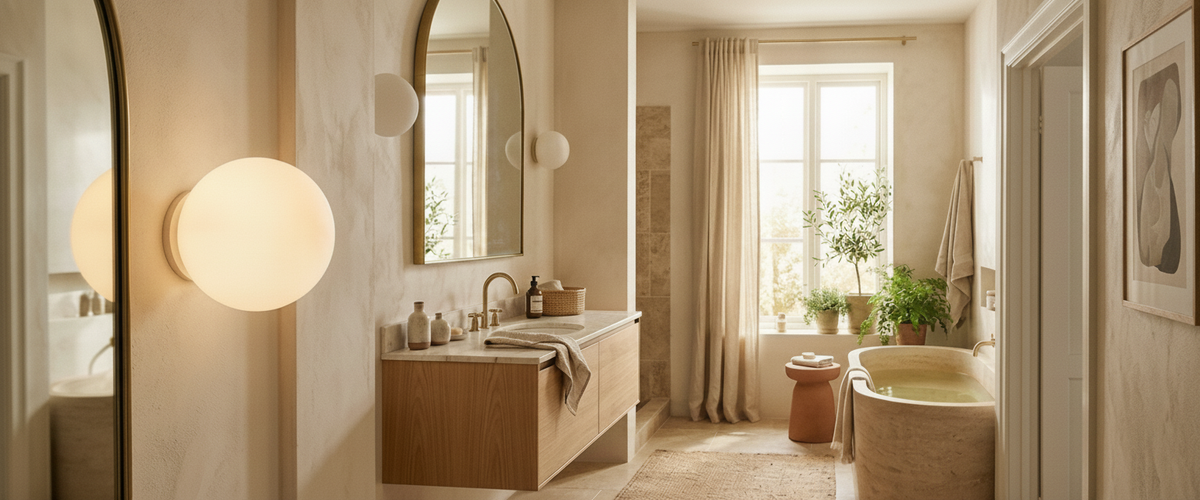

A round shade does something a shallow sconce never manages: it pushes light out in every direction, so the wall behind it glows instead of sitting in shadow. That is the quiet appeal of the glass globe wall lights. There is no hood to aim, no beam to feather, just a soft sphere of illumination that wraps a corner or a corridor in even light. Get the glass and the height right and a glass globe wall light reads as considered. Get them wrong and it looks like a fitting picked in a hurry.
At Niori we work mostly in alabaster and natural stone, where the material itself scatters light. A glass globe wall light belongs to the same conversation, because both are about diffusion rather than direction. Understanding what a globe actually does with light is the difference between a wall that feels warm and one that feels flat.
A run of globes turns a dead corridor into a sequence of soft glows.

Quick Answer: What a Glass Globe Wall Light Does Best
Omnidirectional glow. Light spreads up, down, and sideways, so a glass globe wall light lifts the whole wall rather than a single patch.
Glass choice sets the mood. Clear reads crisp and modern, opal reads soft and even, seeded reads warm and textured.
Height matters more than with a shaded sconce. You see the whole orb, so mounting it too high or too low is immediately obvious.
Best in transitional and ambient roles: hallways, bedsides, and bathrooms where you want fill light, not a reading spotlight.
Pairs well in twos and threes, as long as spacing and symmetry are deliberate.

Why a Globe Throws Light in Every Direction
Most wall lights have a bias. A half-shade sends light up or down; a bathroom sconce fires forward. A glass globe wall light has no such bias. Because the glass wraps the bulb on every side, the fitting behaves more like a small lantern than a directional lamp, and the wall it sits on becomes part of the light source rather than a dark backdrop.
That has a practical consequence. A glass globe wall light is far more forgiving in a room with tricky corners or short runs of wall, because you are not trying to aim anything. It fills. This is why designers reach for orbs in circulation spaces, where you want a gentle wash rather than a set of hard pools. It is also why the bulb inside matters so much: with clear or lightly seeded glass, the filament is on show, so a warm, low-glare LED with a visible element flatters the fitting far more than a cold, industrial capsule.

Clear, Opal, and Seeded Glass: Three Different Glows
The single biggest decision with a glass globe wall light is the glass itself. It changes the character of the light completely.
Clear glass
Crisp and architectural. Clear glass hides nothing, so the bulb becomes a feature and the light stays sharp with defined highlights. It suits modern interiors and looks precise beside brass or blackened detailing. The trade-off is glare: pair clear glass with a decorative filament bulb at a modest wattage, or the naked point of light will nag at you across the room.
Opal glass
The diplomat of the three. Opal (sometimes called milk glass) is treated to scatter light evenly, so the entire globe glows at a uniform brightness with no visible hotspot. This is the softest, most even option and the one that behaves most like our alabaster pieces. If you want a glass globe wall light that reads calm at any brightness, opal is the safe, elegant choice.
Seeded glass
Seeded glass carries tiny bubbles trapped in the material, a nod to older hand-blown techniques. It breaks the light into a warm, slightly sparkling texture, so the glow feels lived-in rather than clinical. It sits well in period homes and in schemes that lean toward natural materials. The same warm, textured quality carries outdoors too, where a lantern-style fitting such as the Halleron 2 Light Outdoor Wall Lantern pairs glazed panels with a burnished bronze frame to soften the light without losing definition. The Corning Museum of Glass has good background on how bubble structure and glass composition affect the way light passes through, which is worth a read if you want to understand why two orbs can look so different lit.
Clear, opal, and seeded glass each give the same sphere a different glow.
If you are weighing a glass globe wall light against stone, it is worth browsing our alabaster lighting alongside them. Alabaster gives a warmer, more mineral glow with visible veining; glass gives a cleaner, more even wash. Many projects use both, glass in the practical spaces and alabaster where the eye lingers.
Mounting Height for an Orb You See From Across the Room
Because a glass globe wall light is fully visible, its position is unforgiving. There is no shade to hide behind. A good starting point for a general wall light is a mounting centre around 60 to 66 inches (roughly 1.5 to 1.7 metres) from the finished floor, which puts the orb near eye level for most adults and keeps the glow off the ceiling and off the skirting.
Adjust from there by role:
Hallways and stairs: aim for consistency. If you are running several orbs down a corridor, fix the centre line and keep every fitting on it, even if door frames tempt you to nudge one up.
Bedsides: mount lower, so the glow falls onto the book, not the headboard. Around 30 to 36 inches (roughly 0.75 to 0.9 metres) above the mattress works for most beds, with the fitting set slightly outboard of the pillow.
Bathrooms: flanking a mirror, position the centre at about eye height so light hits the face rather than the top of the head. This kills the shadows a downlight throws under the brow and chin.
One studio lesson worth passing on: measure from the finished floor, not the subfloor. We once had a client in a new build set out their hall lights before the engineered oak went down, and every fitting ended up too low once the flooring was laid. It looked fine alone and slightly off against the doors. Small errors on a visible glass globe wall light are hard to forgive.
Where the Orb Earns Its Spot
A glass globe wall light is an ambient tool, so give it ambient jobs.
Hallways are the natural home. A run of orbs turns a dead corridor into a sequence of soft glows, and because the light spreads sideways it fills the space between fittings rather than leaving dark gaps. Bedsides are the second obvious win: a sphere frees up the surface a table lamp would occupy and gives a gentle, restful light that suits winding down. Bathrooms are the third, though here you must check the fitting's IP rating and keep it within the zones your electrician confirms are safe.
The same diffusion logic extends to entrances and porches, where an orb flanking a door reads far softer than a hard downlight. For an exterior that needs a lantern shape rather than a sharp forward beam, a fitting such as the Holborn 2 Light Outdoor Wall Light in Verdigris carries the same even, wrap-around glow through glazed panels and a weathered metal frame built to sit outside.
Where a glass globe wall light struggles is task lighting. It will not throw a focused beam onto a worktop or a desk, so treat it as fill and layer something directional alongside. If you want to see how orbs sit within a broader mix of pendants, sconces, and lamps, the full lighting collection is a useful way to compare forms before you commit.
Pairing Orbs in Twos and Threes
Multiples are where a glass globe wall light scheme either sings or slides into showroom territory. The trick is restraint and rhythm.
Flanking a bed or mirror in a pair: keep them level and equidistant from the centre line. Symmetry is the whole point here, so measure twice.
A run of three or more down a hall: space them evenly and resist the urge to fill every wall. Gaps let the glow breathe. One orb every 5 to 6 feet (roughly 1.5 to 1.8 metres) reads generous without becoming a runway.
Mixing sizes: possible, but only with intent. A larger sphere as a focal point with smaller ones stepping away can work; three random sizes in a line will not.
The showroom look usually comes from over-lighting, not from the fittings themselves. If every orb is on full brightness, the eye has nowhere to rest. Put them on a dimmer, run them lower than you think you need, and let the room settle into pools rather than glare.
Bulbs, Dimming, and Care
For a clear or seeded glass globe wall light, choose a warm LED around 2700K with a visible filament and a high colour rendering index; the bulb is on display, so buy a good one. For opal glass, a frosted or capsule LED disappears behind the diffusion, so you have more latitude. Always confirm the fitting and driver are dimmable before you specify a dimmer, and use a qualified electrician for installation and for anything near a bathroom zone. Guidance from a body such as the Health and Safety Executive is a sensible baseline for who should be doing wired work.
Cleaning a glass globe wall light is simple. Let the fitting cool, then wipe clear and opal glass with a soft, barely damp cloth and dry it to avoid water spots. Seeded glass hides marks well but still benefits from an occasional clean. Where a scheme mixes glass with alabaster or marble, treat the stone gently: a dry microfibre cloth, no solvents, and no soaking. The stone rewards patience, and so does the whole layout.