
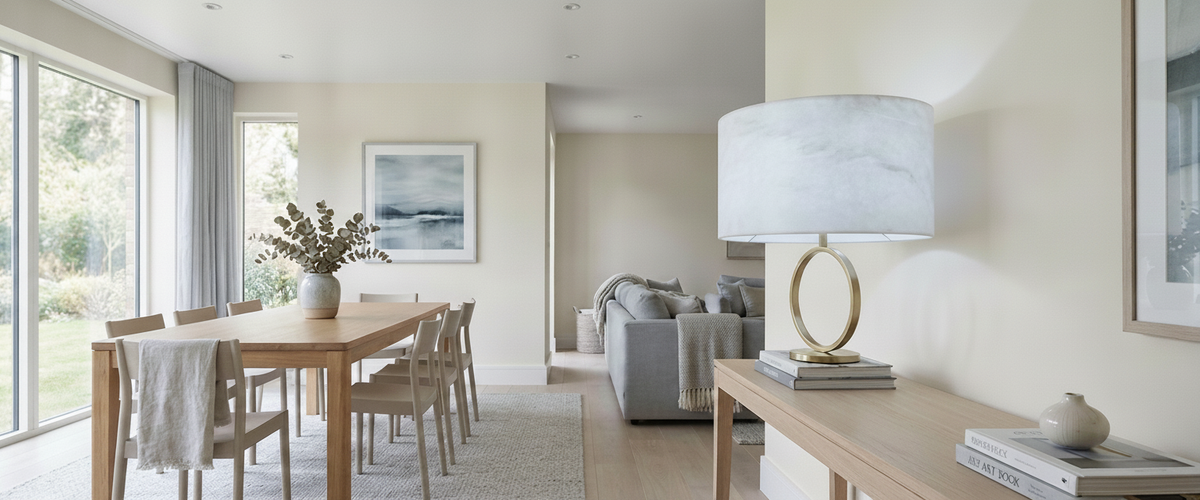

Switch on a wide-shaded lamp with a single central bulb and you can usually spot the problem straight away: a bright hot patch near the top and a shade that fades to shadow at the edges. It reads cheap, even on a handsome base. A 2-light table lamps setup solves this quietly by putting two sources inside one shade, so the light fills the whole surface rather than pooling in the middle. For a large drum shade on a console, or a broad shade beside a bed, a 2-light table lamp is the difference between a fixture that glows and one that glares.
That even wash matters even more with alabaster and natural stone, where the material itself is meant to carry light across its veining. A lopsided source shows every uneven patch; a balanced pair lets the stone do what it does best, which is why a 2-light table lamp suits it so well.
An evenly lit alabaster shade on a console, with no hot spot at the top.

Key Takeaways on the 2-Light Table Lamp
A single socket under a wide shade leaves the edges dim and the top over-bright.
Two bulbs spread output across the shade, giving a smoother, more expensive-looking glow.
Independent switching (or a three-way switch) lets you run one bulb for reading and both for ambient light.
A twin-bulb 2-light table lamp suits consoles, sideboards and large bedsides where a single small lamp looks lost.
Match shade width and lamp height to the surface, not just the room.

Why a Single Socket Leaves a Wide Shade Half-Lit
Light falls off fast with distance. A bulb sitting dead centre in a 16-inch (40 cm) shade throws plenty onto the fabric directly around it and much less toward the rim, so you get a bright halo and darker flanks. On a narrow shade the eye forgives it. On the broad shades that pair with generous consoles and sideboards, the fall-off becomes obvious, and the lamp starts to look like it is straining.
You also lose the material story. With an alabaster or onyx base, part of the appeal is a soft column of light glowing up through the stone. Feed that with one weak, off-centre source and the veining lights unevenly, which flattens the very thing you paid for. This is the case a 2-light table lamp answers, because balance is the point.

How Twin Bulbs Even Out Glow Across the Whole Shade
Set two bulbs a few inches apart and their pools of light overlap. The overlap fills the centre, and each bulb reaches its nearer edge of the shade, so the whole surface lifts to a similar brightness. The result is a 2-light table lamp that reads as one calm block of light rather than a bright dot inside a dim ring.
Lower wattage per bulb helps here too. Two modest LED bulbs at a warm colour temperature, around 2700K, give a gentler, wider spread than one high-output bulb trying to do all the work. The general principle holds across LED lighting: several softer sources usually beat one hard one for comfort. In a stone and alabaster table lamps, that softness is exactly what flatters the material.
Matching a Two-Light Lamp to Consoles, Sideboards and Bedsides
Scale is where most people go wrong. A 2-light table lamp is usually a larger fixture, so it needs a surface that can carry it.
A matched pair on a sideboard, lighting the surface without crowding the art behind.
Consoles and Hallways
A hallway console is often long and shallow, and a pair of matched 2-light table lamps at each end anchors it far better than one lamp adrift in the middle. Twin bulbs give enough spread to light a face at the mirror without a harsh overhead. Leave room for keys, post and a tray between them.
Sideboards in Dining and Living Rooms
A sideboard is deep and visible, so it can take a taller lamp with a broad shade. One larger 2-light table lamp reads well here, especially with a stone base that ties into a marble or timber top. Where you want a rounded silhouette that softens a heavy sideboard, a piece such as the Essence Round Table Lamp in Black holds the surface without competing with the art behind it. If the piece is very long, a pair works, though they should not crowd whatever art or serving space sits behind.
Bedsides
On a wide bedside or a chest used as one, a 2-light table lamp earns its place: one bulb for a low pre-sleep glow, both for reading or dressing. Where the room calls for cleaner lines against a solid headboard, the Essence Square Table Lamp in Black sits more comfortably than a rounded shade. Watch the height, which we cover in the FAQs, so the shade sits at the right level relative to your shoulder when you are propped up in bed.
Independent Switching: Dialling From Reading Light to Ambient Wash
The best twin-bulb lamps let you control the sources separately, either through a rotary three-way switch that steps through one bulb, then two, or through two pull-chains. This turns a single object into two moods. One bulb is a quiet companion light for late evening. Both together push out enough for a book or a card game, which is where a 2-light table lamp pays for itself.
Pair that with a dimmable circuit and you have real range from one lamp. If you want dimming, confirm the bulbs and any wall dimmer are compatible; mismatched LED bulbs and old dimmers are the usual cause of flicker. For anything involving mains wiring or a new switch, use a qualified electrician rather than improvising.
Where a Stone-Base Twin Lamp Holds a Living Room Together
Living rooms often fail on lighting because everything is on the ceiling. A pair of stone-base 2-light table lamps on flanking tables changes the whole feel: light drops to seated eye level, shadows soften, and the room gains a centre of gravity. Picture a double-height living room where a single ceiling fixture has left the seating area cold and cavernous; two alabaster twin-bulb lamps on the end tables do what the big fixture cannot, giving the sofas their own pool of warm light.
Stone earns its keep in that role because the base itself glows faintly when lit, so the lamp works even at its lowest setting. Browse the full niori lighting range to see how table lamps sit alongside pendants and wall lights when you are layering a scheme rather than relying on one fixture.
How to Choose: A Quick Buyer Checklist
Surface first. Measure the depth and length of the console, sideboard or bedside before you look at lamps. A wide shade needs a surface at least as deep as the shade itself.
Shade width. The wider the shade, the more a second bulb pays off. Anything past about 14 inches (36 cm) benefits from a 2-light table lamp.
Switching. Decide whether you want stepped control (one bulb, then two) or full dimming, and buy bulbs to match.
Bulb temperature. Stick to a warm 2700K to 3000K for living and sleeping rooms so alabaster reads soft rather than clinical.
Weight and stability. Natural-stone bases are heavy, which is a feature; check the surface can carry the load comfortably.
Pair or single. A matched pair suits consoles and long sideboards; a single statement lamp suits a shorter surface.
Caring for a Stone-Base Table Lamp
Alabaster and marble are softer and more porous than glass, so treat them gently. Dust with a dry, soft cloth. For marks, a barely damp cloth is safer than any spray, and never use acidic or abrasive cleaners; the principles of stone conservation favour minimal, non-aggressive cleaning. Keep the base out of standing water and lift rather than drag it, since the weight that makes it stable also makes it unforgiving if it tips. Handled sensibly, a stone 2-light table lamp outlasts almost everything else on the table.