
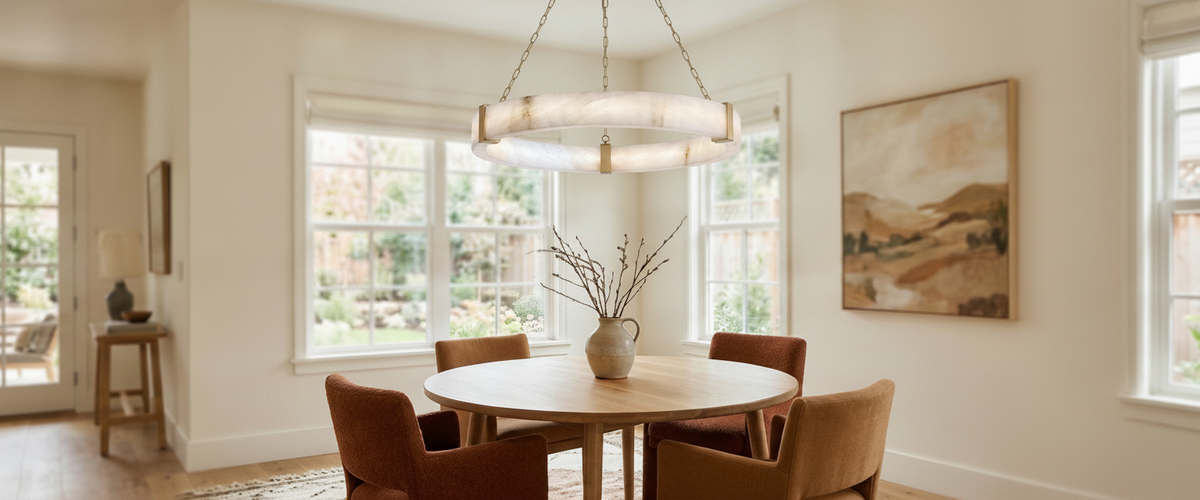

A ring does something a cluster cannot: it lets light escape from the inside of the circle as well as the outside. That single trait is why an alabaster chandelier reads so differently overhead. Instead of a knot of shades dropping a pool straight down, you get a continuous band of stone that glows outward in every direction, softening the whole space rather than spotlighting one patch of floor. Get the diameter and drop right and it frames a room. Get them wrong and it hangs like a hoop nobody asked for.
This guide is for buyers, designers, and anyone weighing an alabaster ring chandelier against the usual linear bar or grape-bunch cluster.
A circle of stone lights every seat evenly, not just the tabletop.

Key Takeaways
An alabaster ring chandelier pushes glow sideways and down, so it lights walls and faces, not just the tabletop.
Rings need vertical breathing room; low ceilings and tight voids fight them.
Size the diameter to the table or the zone it sits over, not the whole room.
Alabaster warms the light and hides the LED source, which suits a shape you look up into.
Over long tables or narrow halls, a linear chandelier usually beats a ring.

Why a Ring Throws Light Differently from a Cluster or a Bar
Picture the three shapes lit. A cluster of pendants sends most of its output downward in overlapping cones, bright directly below and dim at the edges. A linear bar stretches that pool into a long rectangle, ideal above a run of worktop or a rectangular dining table. An alabaster ring chandelier behaves like neither. Because the emitting surface curves back on itself, light leaves the inner face and crosses the open center, then spills past the outer edge too. You end up with a soft, even wash that reaches the walls.
The stone changes the character of that wash. Alabaster is naturally translucent, so the LED strip inside never shows as a hard line; it diffuses into a warm, honeyed band. That matters more on a circular fixture than on almost any other form, because you spend so much time looking up into the underside of the loop from a sofa or a dining chair. A bare source there would glare. Stone turns it into something you can sit beneath comfortably. Where a single continuous band is the goal, a piece such as the Cintura LED Alabaster Ring Chandelier shows how leather and copper detailing can warm the metalwork to match the glow of the stone. You can see the range of ring and loop forms across our alabaster lighting collection to compare how different sections of stone read when lit.

Ceiling Height and Room Width a Ring Needs to Breathe
An alabaster ring chandelier is a horizontal statement, and horizontal statements need height above them to avoid looking squashed. As a rough working rule, standard eight-foot (2.4 m) ceilings can carry a modest circle over a table where the fixture sits well above head height, but the shape truly comes alive on nine or ten-foot (2.7 to 3 m) ceilings and above. In a double-height entrance or a converted barn, a ring finally has the air it wants.
Width matters as much as height. A ring wants clear space around its circumference so the eye reads a complete circle, not a disc jammed between two beams. In a narrow room the outer edge crowds the walls and the sideways glow bounces back too hard. Give it a generous footprint. Over a dining table, leave roughly 30 to 36 inches (76 to 91 cm) between the bottom of the ring and the tabletop so guests can see across without the stone cutting the sightline.
Where an Alabaster Ring Chandelier Earns Its Place
Three settings suit an alabaster ring chandelier almost perfectly.
Over a round table. This is the obvious pairing, and it works because the geometry echoes. A circular fixture above a circular table looks intentional, and the outward glow lights every seat evenly rather than favoring the ends. A single ring sized to about two-thirds of the table diameter usually lands well.
In a stairwell, a staggered set of circles reads from several floors at once.
In a stairwell void. Hung in the open shaft of a staircase, an alabaster ring chandelier reads from multiple floors at once. You look up into the lit underside from the hall and down onto the glowing band from the landing. Where a tall void needs filling without a solid column of light, a layered fixture such as the Vireon LED Triple Ring Alabaster Chandelier, with its circles staggered at different heights, is closer to the right approach than a single band. This is one of the few places where a bigger, layered fixture genuinely earns the drop.
Over an open-plan hub. In a kitchen-diner or a broad living space, a ring can anchor the central zone the way a rug does on the floor. Because the glow travels sideways, it ties the surrounding area together instead of leaving a bright island and dark corners. A copper-and-leather ring hung over the seating end of a long open-plan floor can quietly separate it from the kitchen without a single wall going up.
How the Glow Spills Sideways, Not Just Down
The sideways spill is the whole argument for an alabaster ring chandelier, so it is worth understanding what it actually lights. The inner face of the circle throws light across the open center, which means anything below the middle, a table centerpiece, a bowl, a set of glasses, catches a soft cross-light rather than a flat top-down beam. The outer face reaches the walls and any art or joinery nearby, lifting them gently.
Alabaster's translucency is doing quiet work here. Because the stone glows across its whole surface, the band itself becomes a light source you notice, not just a fitting that produces light elsewhere. The Victoria and Albert Museum notes how alabaster's fine, slightly waxy grain lets light pass through the stone, which is exactly the quality that turns a ring into a floating band of warmth. Put a ring on a dimmer and, low, it reads almost like a halo; high, it becomes a proper working light for a dining table or reading corner. Browse the wider lighting range if you want to see how the same warm quality carries across wall lights and table lamps in the same material.
Scaling the Diameter So It Frames the Room
The commonest mistake is buying an alabaster ring chandelier too small for the space, so it looks like a bangle lost on a big ceiling. The second commonest is going too large over a small table and boxing people in. A few reference points help.
Over a round table: aim for a ring diameter of roughly two-thirds the table's diameter.
In a room, as a floating centerpiece: add the room's length and width in feet, and treat that number in inches as a sensible fixture diameter. A 14 by 16 foot room points you toward a ring around 30 inches (76 cm) across.
In a stairwell: let vertical drop lead. A layered multi-ring piece can be visually taller than it is wide, so measure the void first.
Weight is the quiet factor buyers forget. Stone is heavy, and a large ring loads a single ceiling point hard. Always have the fixing checked and installed by a qualified electrician who can confirm the ceiling structure will carry it; this is not a hang-it-yourself job on a plasterboard hook.
Where a Ring Struggles and Another Shape Wins
An alabaster ring chandelier is not the answer to every ceiling. Over a long rectangular dining table, a single circle leaves the ends underlit and looks awkwardly stranded in the middle; a linear alabaster chandelier such as the Oria LED Linear Alabaster Chandelier tracks the length of the table far better. In a low-ceilinged room, the horizontal shape flattens and you lose the sideways glow that justifies it, so a close-mounted or a compact cluster serves you better. And over a kitchen island that is essentially a long rectangle, the geometry simply does not match; a linear bar or a row of pendants gives even coverage where a ring would darken the ends.
Think of it as a shape with a strong opinion. When the space is round, tall, or open, an alabaster ring chandelier rewards you. When the space is long and low, respect what the room is telling you and pick the form that fits it.
A Quick Buyer's Checklist
Measure ceiling height and confirm you have at least nine feet (2.7 m) for a ring to sit well, or a tall void.
Match diameter to the table or zone, not the whole room, using the ratios above.
Choose warm-white LEDs, ideally around 2700K, to flatter the stone's natural tone.
Specify dimming so the ring can move from halo to working light.
Check the fixing point and weight with a qualified electrician before ordering.
Consider a layered multi-ring only where the drop genuinely needs filling.
An alabaster ring chandelier asks a little more of the room than a cluster does, and gives more back when the room can take it. Size it honestly, hang it high enough, and the alabaster ring chandelier becomes the piece guests keep looking up at.