
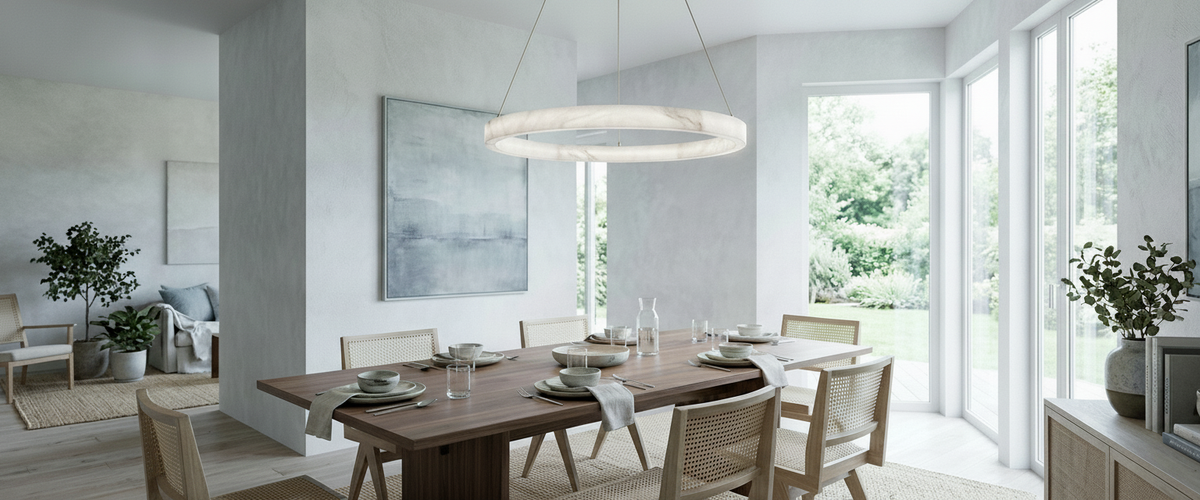

The candle is the honest ancestor of a good dining light: low, warm, and sitting right there among the plates. A linear chandelier chases that same feeling, and an alabaster linear chandelier does it with a material that was made for the job. Stone lit from within does not throw light at your guests; it holds the light and lets it seep out slow and even. Run that stone in a bar along the table and every place setting gets the same treatment, from the person carving at the head to the ones stranded at the far end. Alabaster is dense enough to soften a bulb into a wash, yet translucent enough that the veining still reads as the light passes through it. The result glows rather than shines, which is precisely the difference between a table you want to linger at and one you eat quickly to escape.
We ship these constantly to clients who have just bought a longer table and realised their old ceiling light no longer fits the room. The fix is almost always a linear form, sized to the table rather than the ceiling, and an alabaster linear chandelier does that job better than any single round fitting.

Key Takeaways
A round chandelier lights a pool; a linear one lights a line, which is what a long table needs.
Aim for a fixture roughly one-half to two-thirds the length of the table it sits over.
Hang the base around 30 to 36 inches (76 to 91 cm) above the tabletop in a standard room.
Space the internal lamps evenly so the alabaster glows as one continuous wash, not in bright and dim patches.
Warm bulbs around 2700K on a good dimmer keep the stone flattering from end to end.

Why a Round Chandelier Leaves the Ends in Shadow
Light falls off with distance. A single central source, however lovely, is brightest directly beneath it and fades toward the edges. On a square or round table that is fine, because every seat sits roughly the same distance from the centre. Stretch the table into a rectangle and the maths breaks. The people at the head and foot are now a yard further from the light than the people in the middle, and they feel it.
An alabaster linear chandelier spreads the source along the length of the table instead of concentrating it. Rather than one bright point, you get a bar of diffused stone that runs parallel to the table edge, so each place setting sits under its own share of the glow. The effect is even and quiet, which is exactly what alabaster does best. The stone scatters light internally before it leaves the surface, so you never get the hard glare of a bare bulb or clear glass.
That does not mean round forms have no place. An alabaster bowl chandelier or an alabaster ring chandelier can be the right answer over a round breakfast table, a square games table, or a landing where the geometry is compact. If your table is genuinely long, though, an alabaster linear chandelier is the honest choice, and you can compare the shapes side by side across our alabaster lighting range.

Getting Length and Drop Right
Two numbers decide whether an alabaster linear chandelier frames the table or floats awkwardly above it: how long the fixture is, and how far it hangs.
For length, a reliable starting point is one-half to two-thirds of the table length. A ten-foot (3 m) table sits well under a fixture somewhere between five and six and a half feet (1.5 to 2 m). Go too short and the chandelier looks stranded in the middle; go too long and it reads as a beam rather than a centrepiece. Leave clear space at each end so the fixture never overhangs the last chairs. A single continuous bar such as the Oria LED Linear Alabaster Chandelier 1m suits a smaller table or a shorter island, where a longer multi-light run would crowd the surface.
For drop, the tabletop is your reference, not the floor. In a room with a standard ceiling around eight feet (2.4 m), the base of the chandelier usually wants to sit 30 to 36 inches (76 to 91 cm) above the surface. That keeps the light close enough to wash the table without blocking the eyeline of people talking across it. Add a couple of inches for every extra foot of ceiling height above the standard, so a taller room can carry the fixture a little higher without losing the intimate feel. Always sit down at the table and check the sightline before you fix anything; the view from a chair is the one that matters.
Spacing the Internal Lamps for an Even Glow
Here is the detail that separates a considered fixture from a cheap one. Inside an alabaster linear chandelier, several lamps or LED modules sit behind or within the stone. If they are spaced badly, or if the stone is thin in places, you get hot patches: bright blooms above each lamp and dim gaps between them. The whole point of alabaster is a continuous, even wash, so spacing matters as much as the stone itself.
Well-engineered pieces set the lamps at regular intervals along the run and place them far enough behind the surface for the light to spread before it hits the stone. Alabaster is naturally translucent, and its density varies with the veining, so a good maker selects and orients panels to keep brightness consistent. Where a room needs a longer, clearly articulated run rather than a single seamless bar, a horizontal multi-light piece such as the Selvara 3 Light Horizontal Alabaster Linear Chandelier spaces its stone shades along the table so each section carries its own share of light. When you are looking at an alabaster chandelier modern enough to use LED strips rather than individual bulbs, ask how the light is diffused behind the stone. A continuous LED behind a solid alabaster bar tends to give the smoothest result; a row of point sources needs more depth to blend.
This is one place where you get what you pay for. Budget for an alabaster linear chandelier depends on the material grade, the length, the internal engineering and the finishing, so it is worth requesting a tailored quote rather than assuming all linear pieces are equal. The difference shows the moment you dim the lights and every lamp position reveals itself, or doesn't.
Beyond the Dining Room
The dining table is the obvious home for a linear form, but it is not the only one. A kitchen island of six feet (1.8 m) or more has the same long footprint and benefits from the same treatment. A pair of shorter linear fixtures, or one long linear alabaster chandelier, gives you working light along the whole prep surface without the visual clutter of three separate pendants.
A long hallway console is another quiet win. Where a single pendant would spotlight the middle of the run and leave the ends grey, an alabaster linear chandelier washes the whole console and the wall behind it, which is flattering to art and to a mirror. Where an island calls for a longer, more architectural run with plenty of individual light points, the Axis 27 Light Alabaster Linear Chandelier in matte black keeps the whole length lit evenly while reading as a single deliberate line. Boardrooms and private dining rooms in hospitality settings use the form for the same reason: the light has to reach every seat equally, and stone gives it a warmth that a technical fixture never will. You can see how the linear pieces sit against bowl, ring and tiered forms across our full lighting collection.
Ceiling and Sightline Checks Before You Commit
Run these quick checks before you order an alabaster linear chandelier:
Ceiling height. Below about eight feet (2.4 m), keep the drop shallow and choose a slimmer profile so the fixture does not press on the room.
Table position. The chandelier centres on the table, not the room. If your table is not centred, your fixture will look off unless it follows the table.
Fixing point. Alabaster is stone, and a linear piece carries real weight. Confirm the ceiling structure can take it, and use a qualified electrician for the wiring and the mounting. This is not a DIY hook-and-hope job.
Sightlines. Sit at each end of the table and check nobody has to duck to see across.
Room traffic. Make sure the ends of a long fixture clear doorways, cabinet doors and the swing of chairs.
Bulb Temperature and Dimming
Alabaster wants warm light. A colour temperature around 2700K brings out the honey and cream tones in the stone and keeps the glow relaxed; push toward cool white and the veining looks grey and clinical, which defeats the material. Use bulbs or modules with a high colour rendering index (CRI 90 or above) so food, faces and the stone itself all read true. The Chartered Institution of Building Services Engineers is a sound reference if you want to understand how colour temperature and rendering shape a room's atmosphere.
Dimming is not optional on a dining fixture. You want full brightness for laying the table and a low, candle-like level for the meal itself. Across the long run of an alabaster linear chandelier, uneven dimming is the enemy: cheap drivers make some sections flicker or drop out before others. Specify a dimmer matched to the fixture's driver, ideally one tested with it, so the whole length fades together as one warm bar of light. For a modern LED linear piece, a good trailing-edge or purpose-built LED dimmer usually gives the smoothest low-end.
Choosing Your Linear Chandelier
Work through it in order. Measure the table first, then set the fixture length to roughly half to two-thirds of it. Check your ceiling height to fix the drop. Ask how the internal lamps are spaced and diffused, because that decides whether the stone glows evenly. Confirm the finish, whether brass, matt black or brushed metal, suits the room's other metals. Then request a quote for the length and specification you actually need. A well-chosen alabaster linear chandelier should look considered from every seat, and light every plate the same.