
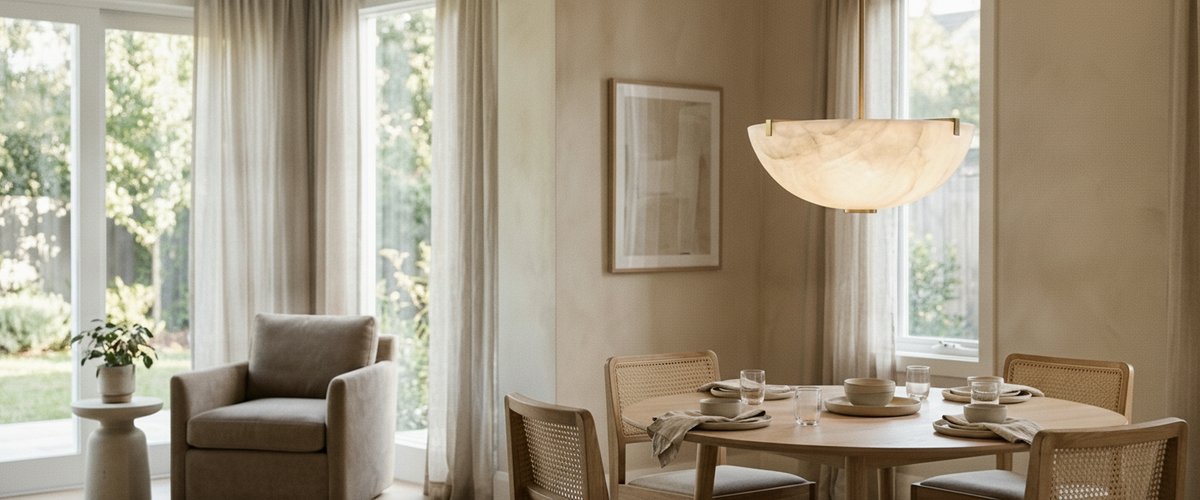

Turn on a ring fitting and the light escapes downward and outward, thrown loose across the room. Turn on an alabaster bowl chandelier and something different happens: the concave stone catches the light, holds it, and hands it back as a soft, contained glow. The shape is not decoration. It is the whole point. An alabaster bowl chandelier behaves like a cupped hand around the bulb, and that changes how the veining reads, how the ceiling is lit, and how far the piece carries a room.
If you are weighing a bowl against a linear or ring design, the decision comes down to how you want the light to sit in the space, not just how the fitting looks switched off. An alabaster bowl chandelier answers that question with the shape itself.
The concave stone cups the light and glows through its veining.

Key Takeaways
A bowl cups and diffuses light; a ring lets it escape, giving a looser, brighter spread.
Concave alabaster reads warmer and more three-dimensional than a flat disc, because the veining catches light at angles.
An alabaster bowl chandelier traps useful uplight and washes the ceiling; most buyers forget to plan for that.
Size the bowl to read generous without dominating, roughly a third of the table or a proportion of the room.
Warm bulbs (2700K), even dimming, and matched output keep the pool of light smooth.
A bowl suits round tables and calm rooms; a linear fitting wins over a long table.

How a Bowl Catches the Light Where a Ring Lets It Escape
The mechanics are simple once you see them side by side. A ring chandelier presents a band of stone with open air in the middle, so light travels through the alabaster panels and also spills straight out of the center. You get brightness and reach, but a diffuse, unfocused wash. An alabaster bowl chandelier closes that center. The stone curves under and around the light source, so almost everything you see is filtered through the alabaster before it reaches your eye.
That filtering is where the material earns its keep. The stone is naturally translucent, and museums have long prized it precisely because thin sections glow when backlit. It was carved into window panes and lamp bowls in antiquity for exactly this reason, as collections at the Metropolitan Museum of Art show. In a bowl, that translucency works across a curved surface, so the glow has depth rather than sitting flat.

Veining That Glows in a Concave Stone Versus a Flat Disc
Look at a flat alabaster disc lit from behind and the veining reads like a photograph: a single plane, evenly backlit. Curve that same stone into a bowl and the veining starts to move. Light hits the mineral streaks at shifting angles as the surface bends, so some veins catch and brighten while others fall into shadow. The result is a piece that looks carved from a solid block rather than assembled from panels, and it changes as you walk around it.
This matters when you are choosing between a modern alabaster chandelier with clean flat facets and a sculptural alabaster bowl chandelier. The bowl will nearly always feel more like stone and less like a shade. In the Niori studio we have shipped bowls where a single amber vein runs up one side of the basin, and clients tell us that vein becomes the thing guests notice first. A flat disc rarely does that.
Over a round table, the bowl gathers the room around a single point of light.
Uplight in the Basin, and the Ceiling Wash Most People Forget
Here is the detail buyers miss. A bowl points its opening upward, which means a portion of the light bounces off the inside of the basin and washes across the ceiling. Handled well, that uplight softens the whole room and stops the fitting reading as a bright spot in a dark ceiling. Handled badly, it makes a low or textured ceiling look busy.
Before you commit to an alabaster chandelier bowl, look up. A smooth, pale ceiling will take the wash beautifully and give you a second, gentler layer of ambient light. A heavily beamed or dark ceiling absorbs that bounce, so you lose some of the effect and the room can feel dimmer than the wattage suggests. This is also why an alabaster bowl chandelier works so well in rooms with a little height; the uplight has somewhere to go.
Sizing the Bowl So It Reads Generous Without Swallowing the Room
A bowl is a solid, weighty shape, so scale matters more than it does with an open ring. Too small and it looks like a pendant that lost its nerve. Too large and it dominates.
Over a dining table: aim for the bowl diameter to sit around a third of the table width. On a 48-inch (122 cm) round table, a bowl of roughly 16 to 20 inches (40 to 50 cm) reads generous without crowding place settings.
In an open room: add the room's length and width in feet, and treat that number in inches as a rough guide for fitting diameter. A 14 by 16 foot room points toward something around 30 inches (76 cm).
Hanging height: over a table, leave roughly 30 to 36 inches (76 to 91 cm) between the tabletop and the base of the bowl, so the light pools on the surface rather than in people's eyes.
Ceiling height changes everything, so treat these as starting points rather than rules. Our broader alabaster lighting range spans compact bowls for intimate rooms up to larger statement pieces, and it is worth measuring your ceiling drop before you settle on the size of your alabaster bowl chandelier.
Warm Bulbs, Gentle Dimming, and an Even Pool of Light
Alabaster is a warm material by nature, and it looks best lit warm. Reach for bulbs around 2700K; anything cooler fights the honeyed tone of the stone and can make the veining look gray. For color accuracy, a high CRI (90 or above) keeps skin tones and food looking right at the table, which matters if the fitting hangs where people eat.
Dimming is where a bowl shows its quality. Because the stone diffuses so heavily, an alabaster bowl chandelier dims gracefully; it fades to a low, candle-like glow without the harsh cut-off you sometimes get from bare LEDs. Use a dimmable driver matched to your bulbs, and if the fitting takes several lamps, match their output so the pool of light stays even across the basin. A single brighter bulb will show as a hot patch through the stone. For dimming and driver compatibility, and for any hard-wiring, use a qualified electrician; guidance from Electrical Safety First is a sensible reference before work starts.
When a Bowl Beats a Linear Fitting, and When It Loses the Table
The honest answer is that shape should follow the room. An alabaster bowl chandelier is a centered, symmetrical form, so it belongs over centered, symmetrical spaces: a round dining table, a square entrance hall, the middle of a calm sitting room. It gathers the room around a single point.
Over a long rectangular table, a bowl struggles. One bowl leaves the ends of the table dim, and two bowls start to look fussy. That is exactly where a linear alabaster chandelier earns its place, running the length of the table and spreading light evenly from end to end. Where a room calls for that continuous run rather than a single pool, a fitting like the Oria LED Linear Alabaster Chandelier 1m, Brass carries light along the whole table in a way a bowl cannot. If you want that reach with a darker, more graphic frame, the Selvara 3 Light Horizontal Alabaster Linear Chandelier, Matt Black keeps the stone glowing while the matt-black structure recedes. A bowl, by contrast, gives you focus and a stronger sculptural presence. An antique alabaster chandelier tends to be more open and tiered, closer in behavior to a ring than a bowl.
You can browse the full spread of shapes across our lighting collection to compare how an alabaster bowl chandelier, a ring, and a linear bar each throw their light before you decide which suits your room.
A Quick Buyer's Checklist
Is your table round or square? An alabaster bowl chandelier suits it. Long and rectangular? Consider linear.
Is the ceiling pale and smooth enough to take the uplight wash?
Have you measured the drop so the base clears heads and eyeline?
Are your bulbs 2700K, high CRI, and dimmable on a matched driver?
Does the bowl diameter read as roughly a third of the table, or in proportion to the room?
Is there a piece of veining you love, and does it sit where guests will see it?
Get those right and an alabaster bowl chandelier does something a flatter fitting cannot: it holds the light, warms it through the stone, and gives the room a single, quiet center of gravity.