
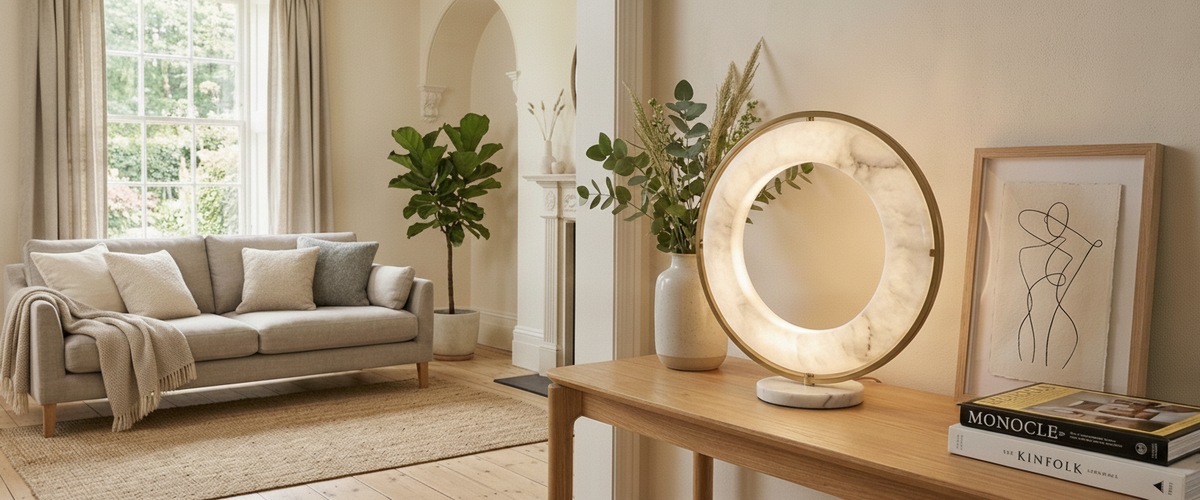

Pick up most table lamps sold in the UK and you feel the problem before you switch them on. The base is light, hollow, and hollow-sounding, and the whole thing shuffles when you nudge the table. A good table lamp should sit still, throw a soft pool of light, and look considered from every seat in the room. That steadiness is where a stone base earns its keep, and it is the first thing we tell buyers to test.
Alabaster and marble change the brief entirely. The weight anchors the lamp, and when the shade or the stone itself is translucent, the light comes through warm rather than hard. If you are shopping for table lamps in the UK and want something that behaves like furniture rather than a gadget, the material decisions matter more than the label.

Key Takeaways Before You Buy
- Weight steadies the look: a stone base sits still on a real console; resin tends to skate.
- Shade diffusion decides the mood: the difference between a soft glow and a harsh glare is almost always the shade or the stone.
- Power to suit the spot: corded for a fixed console, rechargeable or battery for a dining table or a spot with no nearby socket.
- Size to the surface: the lamp height should relate to the table and the seated eyeline around it.
- Warm white, dimmable: British interiors read best around 2700K with a dimmer in the circuit.

Why a Stone Base Reads Steadier Than Resin on a Real Table
Resin and moulded composite lamps photograph well and cost little to ship, which is why so many Amazon uk table lamps look identical from the front. The trouble shows up in use. A light base transmits every knock, and on a polished console or a narrow hall table it drifts a few millimetres each time someone passes. You end up nudging it straight without noticing you do it.
Alabaster and marble solve that by mass. A carved stone base holds position, and because natural stone carries its own veining, no two pieces read exactly alike. That variation is the point. We shipped a pair of alabaster lamps to a client furnishing a Georgian sitting room in Bath, and they specifically asked for two bases that did not match perfectly, because a hand-carved pair should not. That is the sort of detail resin cannot fake.
Stone also ages differently. A quality alabaster base keeps its surface for decades with light care, where a painted composite finish chips and yellows. To compare stone forms side by side, the full alabaster lighting range shows how the material behaves across shapes and finishes.

Shade Diffusion: The Line Between a Glow and a Glare
The single biggest reason a table lamp disappoints is the shade. Fit a thin, bright-white drum over a strong bulb and you get glare straight into the eyeline of anyone seated. Get the diffusion right and the same bulb reads as a gentle wash.
Alabaster works in your favour here because the stone itself diffuses. Light passing through a translucent alabaster shade or a carved stone dome softens as it travels, picking up a faint warmth from the mineral. The Natural Stone Institute notes that calcite alabaster is prized precisely for that translucency (naturalstoneinstitute.org), which is why it has lit interiors since antiquity. Where a room needs a soft, contained pool of light rather than a hard downward beam, a rounded stone form such as the Essence Round Table Lamp is closer to the right design language, because the curved shade spreads the glow rather than pointing it. A fabric shade can do a decent job too, but line it, and choose a warm-toned lining rather than cold white.
Two quick tests when you shop. Switch the lamp on at seated height and check whether you can see the bulb outline through the shade; if you can, expect glare. Then look at the pool of light on the surface below. You want a soft edge, not a hard ring.
Corded, Rechargeable or Battery for How UK Rooms Actually Live
Where the lamp lives should decide how it is powered. A fixed console, bedside table or sideboard suits a corded lamp on a switched socket or an inline dimmer. Nothing beats mains power for consistent output over a long evening.
A battery table lamp makes sense where there is no socket in reach: a dining table centre, a garden room, a windowsill, or a courtyard table in the warmer months. Rechargeable cordless lamps have improved sharply, and many now run several hours on a charge with a small dimmer built in. If you are searching for a battery table lamp in the UK for a table that has no power near it, look at run time and colour temperature rather than headline brightness. A cordless lamp on a dining table should sit low and warm, not floodlit.
One honest caveat: a heavy stone base and a battery pack are not always natural partners, because the base adds weight without adding run time. For cordless use, a moderately scaled stone lamp usually works better than a large statement piece.
Sizing the Lamp to the Table and the Chairs Around It
People search for tables for lamps in the UK as if the table is the afterthought, but the two should be chosen together. A console lamp that towers over the surface looks top-heavy; one that sits too low leaves the shade below eyeline and shows the bulb.
- Bedside: the bottom of the shade should sit around eye level when you are propped up reading, roughly 24 to 28 inches (60 to 70 cm) of lamp on a standard bedside height.
- Console and hall: allow the lamp to take up no more than about two-thirds of the table depth so it does not crowd the surface.
- Living room side table: match the shade base to the width of the table it sits on, so the lamp feels planted rather than perched.
- Dining or centre table: keep it low. A tall lamp blocks sightlines across the table.
Scale also depends on the stone. A carved alabaster base carries visual weight, so a smaller alabaster lamp can hold a table that would swallow a slim metal one. On a narrow console or a squared-off sideboard where a rounded lamp can look adrift, a straight-sided form such as the Essence Square Table Lamp sits more comfortably against the edges of the surface. Browse the wider lighting collection to see how table lamps sit next to pendants and wall lights in the same material family, which helps you keep a room coherent.
Fittings, Wattage and Warm White That Suit British Interiors
UK lamps use bayonet (B22) or Edison screw (E27 and smaller E14) fittings, so check which your lamp takes before you stock bulbs. For most table lamps, an LED bulb of 5 to 8 watts giving 400 to 600 lumens is plenty; the shade and stone do the softening, not brute output.
Colour temperature is where British interiors are fussy, and rightly so. Aim for 2700K warm white, which flatters plaster, timber and natural stone without turning everything orange. Put the lamp on a dimmer if the circuit allows, and confirm the bulb is marked dimmable. The Chartered Institution of Building Services Engineers treats warm, controllable light as central to comfortable domestic lighting (cibse.org), and a single dimmable table lamp often does more for an evening room than a bright ceiling fixture.
A note on the playful end of the market. Searches for a cat table lamp in the UK or animal table lamps in the UK point to novelty pieces, and there is nothing wrong with charm on a child's shelf or a study corner. Just apply the same rules: a steady base, a diffusing shade, and a warm dimmable bulb. A figurative lamp that glares is still a glaring lamp.
Lead Times, Delivery and Quoting a Bespoke Piece
Natural stone is not a mass-stamped material, so lead times reflect carving, finishing and, for a pair, matching the veining. Niori ships worldwide as an alabaster and natural-stone lighting brand, and standard pieces move faster than bespoke commissions. If you need a specific size, finish, or a matched pair for either side of a bed, ask for a tailored quote rather than expecting a fixed shelf price.
Price depends on material, scale, carving complexity, the fittings specified and any custom finishing, so a considered quote will always beat a guessed number. For UK orders, confirm the fitting and voltage suit your home before you buy, and if a lamp needs hard-wiring into a switched supply, use a qualified electrician.
A Quick Buyer's Checklist
- Lift the base. If it feels light, it will drift on a real table.
- Switch it on at seated height and check for glare and bulb shadow.
- Confirm the fitting: B22, E27 or E14, and buy a dimmable warm-white LED.
- Match the lamp height to the table and the seated eyeline.
- Decide corded, rechargeable or battery by where the lamp will actually live.
- For a pair, ask whether the stone is matched or deliberately varied.
- For anything bespoke, request a quote and realistic lead time up front.