
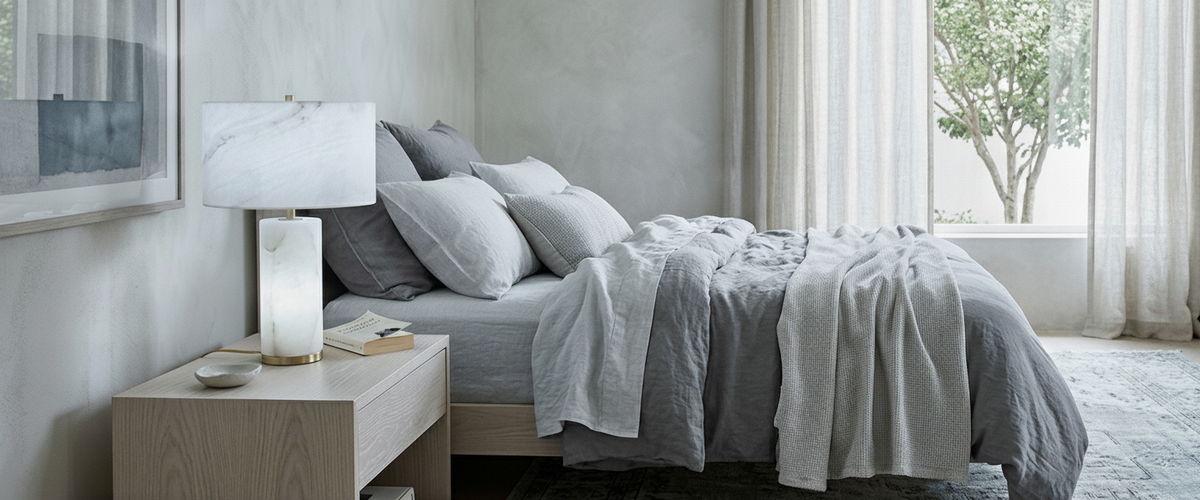

The best table lamps for bedroom setups live or die on three details: height, warmth, and how easily you can reach the switch from a pillow. Get them right and the light lands where you actually use it, a soft wash across the pillow and the top of a book. Aim for a total lamp height of 24 to 27 inches (61 to 69 cm) on a standard nightstand so the bottom of the shade sits near your eye line when you read; use a warm, dimmable bulb of 400 to 600 lumens at 2400K to 2700K; and make sure you can turn it off without leaning out of bed. This article walks through each of those, plus base weight, matched pairs, and the shadow zones nobody notices until the bulb is on.
The quickest way to ruin a bedside is buying a lamp that is too tall, so the bulb sits above eye level and the glow you wanted never arrives. Getting this right is less about how the lamp looks switched off and more about where the light falls when you are lying down at eleven at night. That is the difference between table lamps for bedroom use that work and ones you resent.
At Niori we make alabaster and natural-stone lighting, and the bedside is where these materials earn their keep. Carved alabaster glows from within rather than firing a beam outward, so the light feels warm and low-glare exactly where you need it. Below is how to buy well, room-tested rather than theoretical.
Carved alabaster spreads a soft, even glow across a bedside.

Key Takeaways for Bedside Lamps
Height matters most: aim for the bottom of the shade to sit around eye level when you are sitting up in bed, usually a total lamp height of 24 to 27 inches (61 to 69 cm) on a standard nightstand.
Soft, directed output beats bright: you want to read without lighting the whole room.
A weighted stone base steadies a cluttered nightstand and resists a knocked elbow.
Matched pairs suit a symmetrical bed; a single lamp works when one side is against a wall.
Switch placement should let you kill the light without leaning out of bed.

The Height Mistake That Pools Light on the Floor
Here is the rule worth memorizing: when you sit up against the headboard, the bottom edge of the shade should sit close to your eye line. Too high and you stare straight at the bulb; too low and the light dies before it reaches your book. On a nightstand of around 24 to 26 inches (61 to 66 cm), that usually means a lamp between 24 and 27 inches (61 to 69 cm) tall including the shade. Most table lamps for bedroom nightstands fail this test simply because nobody measured.
To measure it properly, sit on the bed as you would to read. Have someone hold a tape from the nightstand surface up to your eye level, then subtract the height of the nightstand itself to find the lamp height you need. A tall bed frame or a deep upholstered headboard shifts everything upward, so measure your own setup rather than trusting a generic number. This is the single check that separates a lamp that works from one that photographs well and frustrates you nightly.

Where a Stone Base Steadies a Cluttered Nightstand
Nightstands collect chaos: a water glass, a phone charger, reading glasses, a paperback face-down. A lightweight lamp with a slim base tips at the first knock. A carved stone or alabaster base carries real weight low down, so it stays put when you reach across in the dark. The center of gravity sits lower, which is why a stone lamp holds its place where a light ceramic one topples against a tray or a book. For a compact nightstand that needs a low, stable footprint rather than a wide statement base, a rounded form such as the Essence Round Table Lamp in black keeps its weight close to the surface. Among table lamps for bedroom duty, the weighted stone base is the quiet advantage.
A weighted stone base stays put on a crowded nightstand.
Alabaster and marble also read as calm objects during the day. A bedside lamp is on display far more hours than it is switched on, and natural stone gives you veining and a soft surface that a printed finish never matches. If you want to see the range of forms, from rounded to square bases, the alabaster lighting collection is the place to start.
Shade and Output for Reading Without Lighting the Whole Room
Reading light should feel like a pool, not a floodlight. For most bedrooms, a single bulb around 400 to 600 lumens per lamp is plenty, at a warm color temperature between 2400K and 2700K. Cooler light reads as clinical at night and works against the wind-down your body is trying to do; warm light supports it. The best table lamps for bedroom reading let you lean into that warmth rather than fighting it. The Chartered Institution of Building Services Engineers publishes guidance on lighting levels and comfort that is worth a look if you want the technical grounding (cibse.org).
Alabaster shades and diffusers do something a fabric shade cannot: they glow across the whole surface, spreading a gentle light rather than punching it downward. That softness is why stone works so well by a bed. If you read a lot, look for a lamp that directs some light downward onto the page while the stone body handles the ambient glow. Fit a dimmable bulb and put the lamp on a dimmer switch or a dimming bulb so you can drop it to a low ember for late reading and lift it for getting dressed.
Matched Pair or Lone Lamp: When the Bed Asks for Symmetry
A double or king bed centered on a wall with a nightstand on each side almost always wants a matched pair. Symmetry calms a room, and two identical table lamps for bedroom sides frame the bed the way two wall sconces would. It also means both people get their own switch and their own pool of light, which prevents the nightly negotiation over whether the light stays on. Where the room already leans architectural, a squared form such as the Essence Square Table Lamp in black holds symmetry more crisply than a rounded silhouette across a pair.
A single lamp earns its place when one side of the bed sits against a wall, in a small guest room, or where a wall light covers the second side. If you are mixing a lamp on one side with a wall light or a pendant on the other, keep the color temperature and brightness close so the two sides feel like one scheme. You can compare fixture types across the wider lighting collection to see how these bedroom table lamps sit alongside wall lights and pendants.
Switch Placement So You Never Lean Out of Bed
The best bedside lamp in the world fails if you have to sit up, reach past the water glass, and fumble for a tiny switch under the shade. Before you buy, find out where the switch lives. An inline cord switch that falls to the side of the nightstand, a base-mounted push switch, or a smart bulb controlled from your phone all beat a fiddly socket switch hidden beneath the shade. It is an easy detail to overlook when you shop for table lamps for bedroom setups online.
For couples, independent control is the point of a pair. If you like the idea of dimming from bed without a wall dimmer, a warm-dimming smart bulb paired with a bedside remote keeps things simple and avoids any rewiring. Any hardwired dimmer or new circuit should be fitted by a qualified electrician; Electrical Safety First has clear homeowner guidance worth reading before you commit (electricalsafetyfirst.org.uk).
The Shadow Zones People Forget Until the Bulb Is On
Switch a new lamp on for the first time and you notice what it misses. A lamp pushed too far back behind an alarm clock throws the clock's shadow across the wall. A shade that flares wide can dump light onto a mirror and bounce glare straight back at the bed. And a lamp placed dead center on a narrow nightstand often leaves no landing space for a book, so it migrates to the edge and wobbles. The best table lamps for bedroom use solve these problems before you notice them.
Position the lamp toward the back corner nearest the headboard, leave the front of the nightstand clear, and check the light from the mattress before you settle on it. In a bedroom with a dressing area, a taller natural-stone lamp on a chest can cover the gap that a single bedside pair leaves near the wardrobe. Small adjustments here matter more than the lamp's spec sheet.
A Quick Buyer's Checklist
Measure your nightstand height and your seated eye level before choosing a lamp height.
Aim for 400 to 600 lumens per lamp, 2400K to 2700K, and dimmable.
Choose a weighted stone or alabaster base for a busy or wobbly nightstand.
Decide pair versus single based on bed placement and symmetry.
Confirm switch type and reach from a lying position.
Check for shadow zones and glare from the mattress once it is switched on.
Buy for the light first and the object second, and table lamps for bedroom nights become the thing you actually reach for every evening rather than pretty ornaments you rarely turn on. Alabaster and natural stone happen to serve both jobs at once: a calm daytime object and a warm, low-glare glow after dark. That is what good table lamps for bedroom corners should always deliver.