
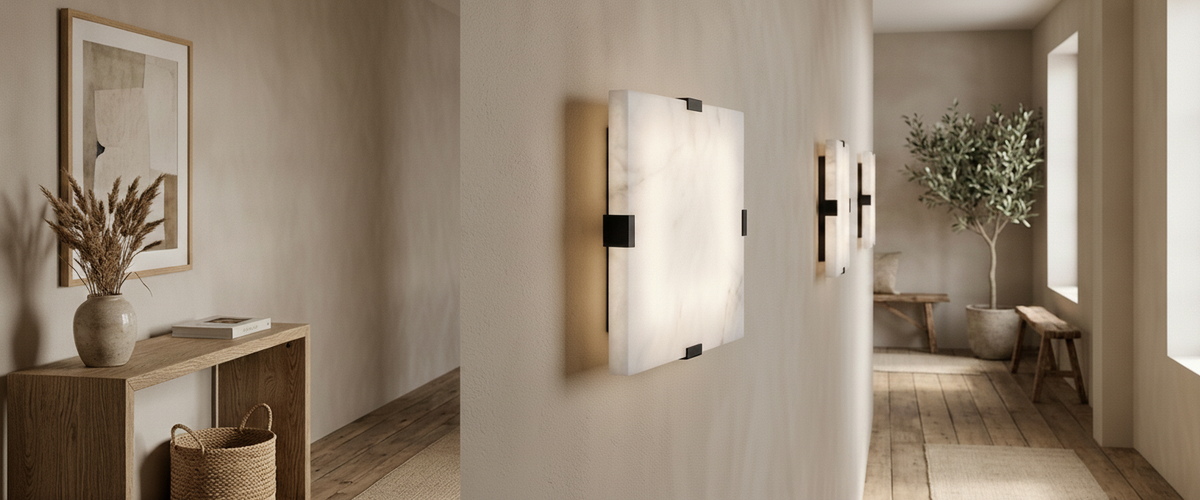

Swap a round wall disc for a square one and something shifts before a single lumen appears. A square housing reads as architecture; a round disc reads as decoration. That difference is why square led wall lights have quietly become the default for anyone building a run of light along a hall, a stairwell, or a fireplace wall and wanting it to look considered rather than added on afterwards.
At Niori we work in alabaster and natural stone, so most of what we mount on a wall carries visible grain and a warm, diffused glow. But the geometry lesson holds whatever the material: a crisp square edge belongs in the same visual family as door architraves, window reveals, and skirting. That is the quiet appeal of square led wall lights; they line up with the room where a circle only floats against it.
A run of square wall lights lining a flush-plaster corridor.

Key Takeaways Before You Buy
Shape signals intent. Square fixtures read as built-in architecture; round ones read as ornament.
Beam matters more than brightness. An up-down wash and a single throw create very different walls from the same wattage.
Height and spacing carry the run. Consistency down a corridor or staircase does the heavy lifting.
Colour temperature decides the mood. Warmer light flatters plaster and stone; cooler light can turn a wall clinical.
Geometry needs the right home. Square led wall lights love flat modern walls and struggle against heavy period cornicing.

Why a Square Reads as Architecture and a Disc Reads as Decoration
Our eyes hunt for alignment. When square led wall lights sit above a doorway or beside a run of joinery, their edges echo the straight lines already in the room, and the fixture stops looking like an object and starts looking like part of the structure. A round fixture cannot do this. It has no edge to agree with, so it always reads as something placed on the wall rather than born from it.
This is why square led wall lights suit contemporary and pared-back interiors so well. In a new-build with flush plaster, minimal skirting, and full-height doors, a square profile disappears into the logic of the space. A square in alabaster then brings warmth back to all that precision. The stone softens the hard outline with its translucency, so you get architectural discipline and a glow that is anything but cold. You can see how that balance plays out across our alabaster lighting range, where square and rectilinear forms sit alongside softer shapes.

Up-Down Wash Versus Single Throw
Two square fixtures of identical size can light a wall in completely different ways, and the difference comes down to beam shape. Understand this before you fall for a photograph.
The Up-Down Wash
Open at top and bottom, this fixture throws two fans of light that graze the wall above and below it. On a textured surface such as tadelakt, exposed brick, or a veined stone, the grazing light rakes across the texture and brings it forward. Along a corridor, a row of up-down washers creates rhythm: a repeating hourglass of light that pulls you down the space. It is the most architectural choice for square led wall lights, and it flatters materials with any relief.
The Single Throw
A single downward (or upward) throw is quieter. It puts one pool of light on the wall and leaves the rest to shadow. This suits a reading position beside a bed, a spot over a piece of art, or a stair where you want the tread lit without a busy pattern climbing the wall. A square housing shapes that single throw into a clean rectangle rather than a soft circle, which is part of why the effect feels deliberate.
With alabaster, both beam types soften at the source. The stone itself glows, so even a single throw has a lit body rather than a bare aperture. That halo is what stops the fixture looking like a bracket with a bulb in it.
Fixtures measured from each tread nosing so the run climbs true with the stairs.
Getting Mounting Height and Spacing Right
A run of square led wall lights lives or dies on consistency. Get the height and spacing right and the eye reads a calm, intentional sequence. Get them slightly off and the whole wall looks nervous.
As a working starting point, hallway and corridor wall lights usually sit somewhere around 60 to 66 inches (roughly 1.5 to 1.7 metres) from the finished floor to the centre of the fixture, so light lands at eye level rather than glaring or grazing your ankles. On a stairwell, the reference point changes: measure from the nosing of each tread, not the floor below, so the fixtures step up in parallel with the stairs instead of drifting out of true. Nothing gives away a rushed install faster than square wall led lighting that ignore the staircase they are climbing.
For spacing along a straight run, aim for even gaps that relate to the doorways and features already on the wall, typically in the region of 6 to 8 feet (about 1.8 to 2.4 metres) apart. Fewer, larger fixtures generally look more assured than many small ones crowded together. The same discipline applies outdoors, where a run down a path or beside an entrance needs an IP-rated body: something like the Outdoor Wall Light E27 IP44 in black holds the rectilinear language while surviving the weather. Mock the positions up with painter's tape squares before anyone drills; ten minutes of masking tape has saved more than one of our clients from a wall of misaligned holes. And because these are mains fixtures, the wiring and any recessed boxes should be set out by a qualified electrician working to current wiring regulations, not improvised on the day.
Colour Temperature That Keeps a Wall Flattering, Not Clinical
The most common mistake with LED wall lights is choosing the fixture carefully and then ignoring the light it emits. Colour temperature, measured in kelvin, decides whether a lit wall feels like a hotel bar or a hospital corridor.
For living spaces, halls, bedrooms, and anywhere with plaster, timber, or stone, warm light in the region of 2700K flatters the surface and keeps skin tones healthy. Push much cooler than 3000K and plaster starts to look grey, wood loses its warmth, and the room turns brisk. Cooler temperatures earn their place in a garage, a utility area, or a very stark gallery wall, but rarely in a home you actually relax in.
Alabaster and onyx add their own bias. Because the stone is warm-toned and slightly golden, it pulls light towards amber as it passes through, so a warm LED behind alabaster reads even softer and richer than the same bulb in bare glass. If you are running led square wall lights in stone alongside other fixtures, match the kelvin across the whole scheme; one cool fitting in a warm room is instantly obvious. Look for genuinely dimmable drivers too, so you can drop the level in the evening. A high colour rendering index, ideally CRI 90 or above, keeps colours honest, and the Chartered Institution of Building Services Engineers publishes useful guidance on lighting levels if you want to go deeper on the numbers.
Where Crisp Geometry Clashes, and Where It Lands
Square led wall lights are not universal. Set a sharp, rectilinear wall light led beneath a deep Victorian cornice or against ornate ceiling roses and the two languages argue; the square looks imported from another building. Period rooms with heavy plasterwork usually want a softer shape or a fitting whose detailing nods to the era.
Where led wall lights square in form genuinely land is the flat modern wall: new-build corridors, loft conversions, minimalist stair runs, kitchen and dining walls with clean joinery, and hospitality spaces that want a repeatable, disciplined look. For a longer external elevation where a taller vertical proportion carries the wall better than a compact block, a fixture such as the 500mm Outdoor Wall Light in brown gives you that upright rectilinear line. In those settings the geometry of square led wall lights finally has straight lines to agree with, and the fixture stops being decoration and becomes part of the architecture. If you are weighing square against round for a specific wall, it helps to see the forms side by side across the full lighting collection before you commit.
A Quick Buyer's Checklist
Confirm the beam: up-down wash for rhythm and texture, single throw for a quiet focused pool.
Set the height once: around 60 to 66 inches on flat walls, measured from the tread nosing on stairs.
Space to the architecture: even gaps that relate to doors and features, not arbitrary numbers.
Lock the kelvin: around 2700K for living spaces, matched across every fixture, CRI 90+.
Check dimming: a dimmable driver compatible with your dimmer type.
Match shape to room: square led wall lights for flat modern walls, softer forms for heavy period detailing.
Plan the wiring early: recessed boxes and cable runs set out by a qualified electrician.
Choose the shape for the wall it will actually live on, pick a beam that does the job you need, and hold your colour temperature steady. Do that and a run of square led wall lights stops looking like a product decision and starts looking like part of the room was always meant to glow.