
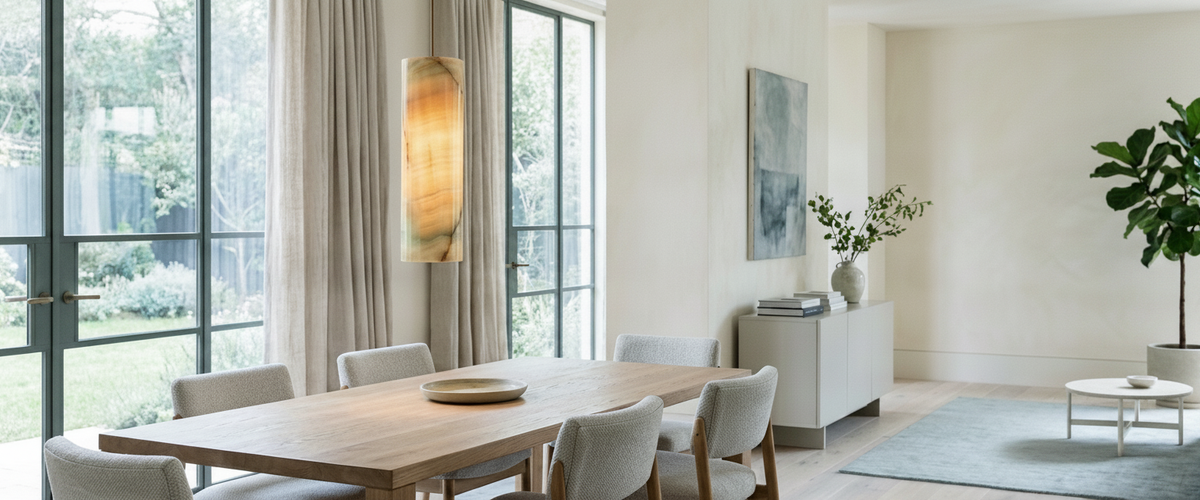

Get the height wrong and an onyx pendant fails twice: it blinds the person sitting under it, and it hides the very veining you paid for. Onyx is a lit material, not a shade with a stone finish. When light passes through the slab it wakes up the honey golds, greys and blue mineral banding that make the piece worth hanging in the first place. So placement is not a finishing detail with onyx pendant lights fixtures. It decides whether you own a glowing stone or an awkward lump on a flex. Onyx pendant light fixtures live or die on where you put them.
Below is how we brief clients before a piece leaves the studio, from island drops to the backdrop behind the fixture. Every note here applies whether you hang one piece or a run of onyx pendant light fixtures.
Drop height over a dining table decides whether onyx glows or glares.

Key Takeaways
Over a dining table, aim for roughly 30 to 34 inches (76 to 86 cm) from tabletop to the base of the pendant.
Over an island or bar, sit a touch higher, around 32 to 36 inches (81 to 91 cm), because people stand and lean there.
For a row of hanging onyx pendant lights, keep 24 to 30 inches (61 to 76 cm) between centres and treat the group as one object.
Onyx glows from behind, so give it a calm, dark-enough backdrop and warm dimmable LEDs at 2700K.
Light the table and the room. A pool of light on the wood with a cold room around it is the most common placement error with onyx pendant light fixtures.

Drop Height Over an Island Versus a Dining Table
The two jobs are different, so the numbers are different. Over a fixed dining table, people are seated, sightlines are lower, and you want the pendant close enough to feel intimate without cutting across the eyeline of the person opposite. Around 30 to 34 inches (76 to 86 cm) from the tabletop to the underside of the fixture works for standard seat and table heights. Taller diners and generous ceilings let you drop a shade lower; a busy family table wants the upper end so nobody knocks it while reaching for the salt. This is where onyx pendant light fixtures earn their drop.
An island is a standing zone. You prep, chop and lean there, so the pendant sits higher, roughly 32 to 36 inches (81 to 91 cm) above the worktop, to keep it clear of raised hands and taller cooks. An onyx cylinder pendant lights is forgiving here because the light exits down and sideways, spreading a warm wash across the stone rather than a hard hotspot on the counter. If you are choosing between forms, a cylinder or drum reads better over a working island than a shallow dome, which can trap glare at eye level. Where you want a compact, contained source over a single seat or corner rather than a broad wash, a small fixture such as the PHLOX GU10 Pendant Light keeps the beam tight and the ceiling clean.

Sightlines: When the Pendant Lights the Table and When It Blinds the Sitter
The test we run in the studio is simple. Sit at the table, look across at the person opposite, and check whether the bright base of the pendant sits in your line of sight. If it does, it will pull attention and tire the eye across a long dinner. Onyx pendant light fixtures help here because the stone itself softens and spreads the source, but a fixture hung too low still throws a bright edge at seated eye height.
The lit slab should live above the sightline while the glow reaches the plates. A honey onyx pendant light does this well; the warm banding scatters light gently so faces stay flattered and food looks appetising. If you find yourself squinting at the base of the fixture, raise it an inch or two before you blame the bulb. Dimming solves brightness, not position.
Single Fixture or a Row, and the Spacing That Keeps Them Honest
One large onyx pendant over a round or square table gives you a single point of drama and the cleanest ceiling. It suits tables up to around 4 feet (1.2 m) wide. Past that, or over a long rectangular table or island, a row of two or three smaller onyx pendant light fixtures distributes the light and keeps the scale honest.
For a row, work from centres rather than gaps. Keep 24 to 30 inches (61 to 76 cm) between the centre of each pendant, and hold the end fixtures at least 12 inches (30 cm) in from the ends of the surface so the run does not spill off the edge. Treat the group as one object: match drop heights exactly, because the eye forgives a wonky single pendant far less than it forgives a mismatched pair. Over a long rectangular table where a single stone piece would look lost, a continuous linear form such as the Solana 30 Light Linear Pendant covers the length in one gesture instead of asking you to align three separate drops. If you are comparing forms and sizes, our alabaster and natural stone lighting collection is a useful place to see how cylinders and drums scale next to each other before you commit to onyx pendant light fixtures.
Work a row of onyx pendants from their centres to keep the group honest.
Ceiling Height and How a Glowing Stone Reads High Versus Low
Ceiling height changes the character of the same fixture. Under a standard 8-foot (2.4 m) ceiling, a compact onyx pendant hung close to the table feels warm and enclosing, almost like candlelight over the meal. Lift the ceiling to 10 or 12 feet (3 to 3.7 m), common in converted warehouse flats and new-build kitchens with vaulted ceilings, and a small pendant marooned high up loses its presence entirely. Tall rooms change how onyx pendant light fixtures read.
High ceilings want either a longer drop to bring the stone back down into the room, or a larger piece that can hold the volume above it. A tall onyx cylinder pendant light reads well in a double-height space because the vertical form gives the eye something to follow. As a rough guide, add around 3 inches (7.5 cm) of drop for every foot of ceiling above 8 feet, then check it against the table sightline test. Numbers get you close; your own eye at the table makes the final call.
The Backdrop Behind the Pendant That Lets Its Veining Show
Onyx is translucent, so what sits behind it matters as much as what sits under it. Hang a pale, glowing stone against a bright white wall in daylight and the veining flattens; there is not enough contrast for the mineral banding to register. Give it a calmer, deeper backdrop, a smoked mirror splashback, a dark stone wall, a muted plaster in greige or charcoal, and the internal structure of the stone comes forward. This is what separates good onyx pendant light fixtures from great ones.
Blue onyx pendant light in particular needs this. The cool mineral banding only sings when the surroundings let it. Against warm oak and brass it can look muddy; against cool greys, dark cabinetry or a bronze mirror it turns crisp and jewel-like. The Natural Stone Institute notes that onyx is a banded calcite formed in caves and around springs, which is why no two slabs share the same figuring (naturalstoneinstitute.org). You are lighting a one-off, so treat the wall behind it as the frame.
Placement Errors That Leave the Table Lit but the Room Cold
The most common mistake we see is treating the pendant as the room's only light source. A single onyx pendant, dimmed low for atmosphere, throws a warm pool onto the table and leaves the corners in gloom. The stone glows, the meal looks good, and the rest of the room feels like a cave. Layer it. Add wall lights, a table lamp on a sideboard, or discreet downlights on a separate circuit so the pendant becomes the jewel rather than the workhorse. Onyx pendant light fixtures shine brightest as part of a scheme, not alone.
Other repeat offenders:
Hanging too high to look tidy. A pendant pushed up near the ceiling to clear the room stops lighting the table and stops showing its veining.
Using cool, bright bulbs. Onyx wants warm light. Cool white flattens the honey tones and makes the stone look grey.
Skipping the dimmer. Dimmable onyx pendant lighting is close to mandatory; you need to drop from prep brightness to dinner glow without changing fixtures.
Centring on the ceiling, not the table. The pendant should centre on the surface it lights, even if that is not the middle of the room.
Bulbs and Dimming for Onyx
Because you are lighting through stone, the bulb sits inside the piece and its colour temperature defines the whole effect. Warm white LED at 2700K to 3000K is the safe home for onyx; it flatters the honey and grey banding and keeps food looking right. Cooler than that and you fight the material. Use good-quality dimmable LEDs with a compatible trailing-edge dimmer so the light glides down smoothly rather than flickering or stepping. Onyx pendant light fixtures reward this care. If you want the dimming curve built in rather than depending on the wall control, an integrated fixture such as the Glistis LED Spiral Pendant is tuned to 3000K and dims cleanly down to a dinner glow.
Have the dimming wired properly. Any hard-wired onyx pendant should be installed by a qualified electrician, both for safety and to get the dimmer paired correctly to the driver. If you are still weighing forms, drops and finishes across a project, browse the full lighting range to see how these onyx pendant light fixtures sit alongside wall lights and table lamps for the layered scheme they need.
A Quick Placement Checklist
Confirm surface use: seated dining or standing island, then set drop height (30 to 34 inches for dining, 32 to 36 inches for islands).
Do the sightline test from a seated position; raise the fixture if the bright base is in view.
Choose single or row by surface length; for rows, work from centres at 24 to 30 inches.
Adjust drop for ceiling height, roughly 3 inches extra per foot above 8 feet.
Check the backdrop; give the stone a calmer, darker surface so the veining shows.
Fit warm 2700K to 3000K dimmable LEDs and a compatible dimmer.
Layer in other light sources so the room does not go cold around the table.
Onyx rewards patience. Hang it at the right height, against the right wall, on a warm dimmer, and the stone does the work: a slow, honeyed glow that shifts with the light through the day. That is what well-placed onyx pendant light fixtures give a room, and it is why Niori treats placement as part of the piece, not an afterthought.