
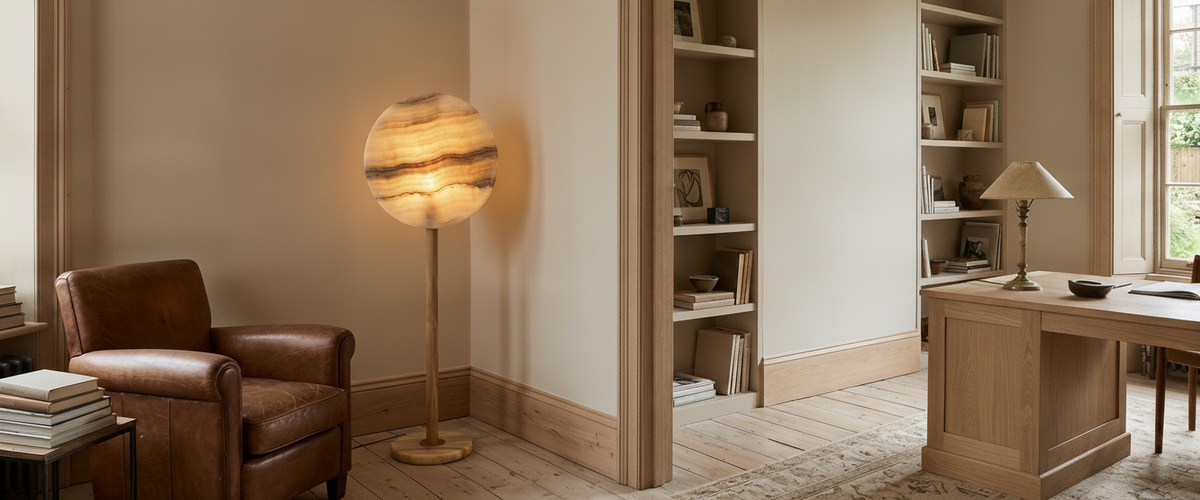

Put cool onyx next to warm elmwood and something happens that neither material manages on its own. The stone stays crisp and slightly aloof; the timber loosens up and warms the whole thing. Get the balance right and an onyx elmwood floor lamp reads richer, deeper, more considered than a piece cut from a single material. Get it wrong and the two finishes squabble for attention. This is a pairing worth understanding before you commit, because the join between stone and wood is where an onyx elmwood floor lamp is either quietly excellent or quietly disappointing.
We spend a lot of time at Niori explaining why alabaster, onyx, and natural stone behave the way they do under light, and why the frame or base you set them into changes the reading entirely. The onyx elmwood floor pairing is one of the more rewarding combinations, and one of the easiest to overstyle.

Key Takeaways
Contrast does the work: onyx runs cool and translucent; elmwood runs warm and grainy. The gap between them is what makes the onyx elmwood floor pairing feel deep rather than flat.
The join matters most: how the stone meets the timber tells you whether the lamp was made well or assembled quickly.
Warm rooms suit it best: studies, snugs, reading corners. Very cool, clinical schemes can leave the elmwood looking out of place.
Bulb choice is a balancing act: too warm and the onyx greys out; too cool and the wood looks dead.
Restraint wins: one strong pairing per corner. Overload it and the room reads like a showroom floor.

Why Cool Onyx and Warm Elmwood Read Richer Together
Onyx is a translucent stone. Light does not just bounce off it; it travels through the outer layer and glows from within, picking up the honey, amber, and grey banding that runs through the material. That inner glow leans cool in tone, even in warmer onyx, because the stone lends the light a slightly mineral quality.
Elmwood pulls in the opposite direction. It is one of the more characterful hardwoods, with a wandering, interlocked grain and a warm brown base that deepens as it ages. Set a slab of glowing onyx above an elmwood base and each material flatters the other by contrast. The wood makes the stone look luminous and precise. The stone makes the timber look grounded and rich. That balance is the heart of the onyx elmwood floor lamp. Pair either with a flat metal instead and you lose half the effect.
This is the same principle behind much of our alabaster lighting: a translucent stone reads best when the surrounding materials give the eye somewhere warm to rest. An onyx elmwood floor pairing simply pushes the contrast further than pale alabaster does.

Reading the Join: How Stone Meets Timber on a Well-Made Lamp
The single most useful thing you can learn about an onyx elmwood floor piece is how to read the seam where the two materials meet. On a well-made lamp, the stone sits into or onto the timber with a clean, deliberate join. No visible glue creep. No gap that catches dust. The grain of the elmwood should run in a direction that makes sense with the shape of the base, not slapped on wherever an offcut fitted.
Onyx and wood expand and contract at different rates with temperature and humidity, so quality makers allow for that in the way they seat the stone. If the two are jammed together with no tolerance, you can see hairline stress at the join over a few years. Ask how the stone is mounted on the onyx elmwood floor lamp before you buy. A vague answer is a warning.
The seam between stone and timber is where craftsmanship shows.
Look, too, at how the onyx has been cut. Because the stone is translucent, a thin, evenly cut slab glows generously and lets the banding read as light travels through. A thick or unevenly cut piece can look heavy and murky when lit. The National Park Service preservation guidance on stone is a useful reminder that natural stone is porous and reacts to its environment, which is exactly why the mounting and finishing deserve scrutiny on an onyx elmwood floor lamp you plan to keep for decades.
Rooms Where the Material Mix Settles In, and Rooms Where It Fights
An onyx floor lamps with an elmwood base wants a room with some warmth already in it. A study lined with timber shelving. A snug with a wool rug and a leather chair. A reading corner in a bedroom where the palette leans toward brown, cream, and soft grey. In those settings the wood base speaks to the room and the onyx becomes the jewel.
Where it fights is in very cool, minimal schemes. Drop the same onyx elmwood floor lamp into a room of white lacquer, chrome, and cold grey stone floors and the elmwood suddenly looks like it wandered in from another house. The warm brown has nothing to answer it, so it reads as an odd note rather than a deliberate one. In a scheme that is committed to black metal and hard edges, a quieter dark-framed piece such as the Essence Round Floor Lamp, Black holds the corner without asking the room to warm up around it.
If your scheme is on the cooler side and you still want translucent stone, a paler alabaster or a lighter onyx on a more neutral base often sits better. Browse the wider lighting range with your existing palette in mind rather than falling for a single piece in isolation.
A Note on Vintage and Antique Onyx Floor Lamps
Search for a vintage onyx floor lamp or an antique onyx floor lamp and you will find plenty of older pieces that pair onyx with brass and, occasionally, with darker timbers. The material logic behind an onyx elmwood floor design is the same: warm metal or wood grounding a cool, glowing stone. The difference is that older wiring and fittings often need attention. If you buy an antique piece, have it checked and rewired by a qualified electrician before it goes into daily use. The stone may be beautiful and sound while the electrics behind it are decades past safe.
Placing the Lamp So Both the Grain and the Glow Catch the Eye
A floor lamp is a piece of furniture as much as a light source, so it needs room to be seen. Set an onyx elmwood floor lamp where daylight can reach it during the day and where you sit near it at night. That way you catch the timber grain in daylight and the stone glow after dark, which is when the pairing really earns its place.
Beside a seat, not behind it: place the lamp to the side of a chair or sofa so the light falls across your shoulder onto a book or a table, and the base stays in view.
Against a mid-tone wall: a plaster, clay, or soft putty wall lets both the onyx and the elmwood stand out. Pure brilliant white can flatten the stone; very dark walls can swallow the wood.
Away from foot traffic: onyx is heavier and more brittle than it looks. Keep the lamp out of doorways and busy routes so it is not knocked.
Where you can see the join: position the lamp so the seam between stone and timber faces the room. That detail is the point of the onyx elmwood floor pairing.
Where the corner calls for a stricter, more architectural silhouette to sit against panelled timber, the squared profile of the Essence Square Floor Lamp, Black lines up with the grain rather than cutting across it.
Bulb Choice That Flatters Warm Wood Without Washing Out the Stone
This is where most people go wrong, and it is fixable. The onyx elmwood floor pairing pulls in different directions on colour temperature, so the bulb has to referee.
Go too warm, around 2200K and below, and the light turns everything amber. The elmwood looks lovely, but the onyx loses its cooler banding and greys out into a muddy glow. Go too cool, up around 4000K, and the stone looks sharp while the timber looks flat and lifeless, almost grey itself.
The sweet spot for an onyx elmwood floor lamp usually sits between 2700K and 3000K. That range keeps the elmwood warm and alive while still letting the onyx show its cooler mineral tones. Choose a bulb with a high colour rendering index, ideally CRI 90 or above, so the grain of the wood and the banding of the stone both render honestly. The US Department of Energy guidance on LED lighting is a straightforward primer on colour temperature and rendering if you want to check the numbers before you buy.
Add a dimmer. An onyx elmwood floor lamp rewards being dialled down in the evening, when a lower output lets the stone glow softly rather than blaze. Make sure the bulb and the dimmer are compatible; mismatched LED dimming causes flicker that ruins the effect.
Common Mistakes: Over-Styling the Pairing Until It Looks Like a Showroom
The biggest error is treating the onyx elmwood floor lamp as licence to add more of both. A room with an onyx lamp, an onyx side table, an onyx tray, and three timber-and-stone accessories stops looking collected and starts looking like a display stand. Let the lamp be the one strong statement in its corner and keep the surrounding surfaces quieter.
A few other traps worth avoiding:
Matching everything to the wood: surrounding the lamp with the exact same timber tone kills the contrast. A little variation in wood colour keeps the scheme alive.
Cleaning the stone with the wrong thing: onyx is porous and does not like acidic or abrasive cleaners. Wipe with a soft, barely damp cloth and dry it. Skip vinegar, citrus, and anything gritty.
Ignoring the weight: a stone-based floor lamp is heavy. Check the floor can take it and never drag it across timber or tile; lift it.
Lighting it from the wrong angle: a cold overhead downlight aimed at the lamp fights the warm glow it gives off. Let the lamp be its own light source in the evening.
Done with a light hand, an onyx elmwood floor lamp becomes the piece people notice without quite knowing why. The stone glows, the grain warms it, and the join between them holds the whole thing together. That quiet richness is the reason to choose the onyx elmwood floor pairing in the first place, and the reason to resist crowding it once it is in the room.