
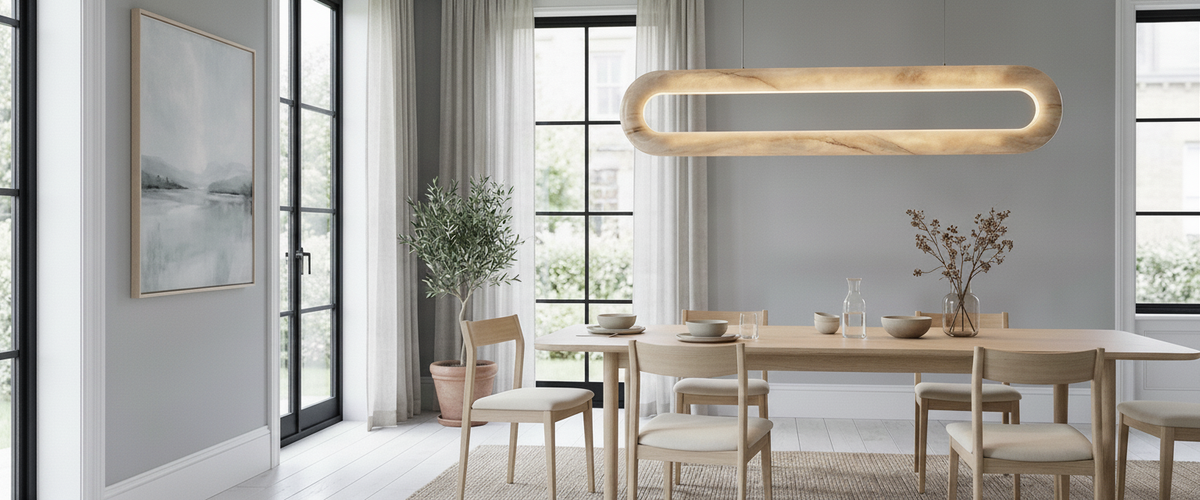

The stone decides the light before you ever choose a bulb. Two natural stone pendant lights can hang side by side, take the same lamp, and throw completely different colours into a room because one sheet of stone carries a cool blue-grey cast and the other a warm honey vein. Get that wrong and a beautiful fixture reads cold, murky, or oddly clinical over a dining table you spent months planning. Get it right and the piece does the quiet, diffused work that makes alabaster and natural stone worth the money.
Below is how we think about it in the studio when a client sends through their wall colour, worktop and ceiling height and asks which stone will actually flatter the space.

Key Takeaways
- Colour first, form second. The tone of the stone changes the light it transmits; a light blue natural stone cools a room, a warm grey softens it.
- Green stone is the trickiest. It can turn muddy under the wrong bulb, so bulb colour temperature matters more here than anywhere.
- Translucent versus opaque decides whether the whole shade glows or just the edges catch light.
- Read the veining against your wall colour before you buy, not after it is hung.
- Hanging height and surface care keep the light honest over years, not just on day one.

The Colour Test: What Light Blue Stone Throws Versus a Warm Grey
Start by naming the temperature you want the light to feel like, then match the stone to it. A lighting blue natural stone, or a pale grey with cool undertones, pushes a crisp, faintly silvery glow that suits bathrooms, north-facing rooms you want to keep fresh, and modern schemes with cool marble or painted joinery. It can feel bracing in a room that already leans cold.
A light grey natural stone with warmer undertones does the opposite. It rounds the light off, takes the edge out of a bright LED, and sits comfortably over a dining table where you want faces to look well. If you cannot decide, ask which the room needs more of: brightness or softness. Cooler pale stones read brighter; warmer greys read softer at the same lumen output.
The mistake we see most often is choosing a stone by its dry showroom colour and forgetting that a lit shade shifts warmer, because the light travels through the mineral and picks up its tone on the way. A slab that looks neutral flat on a bench can glow distinctly amber once a lamp sits behind it.

Green Stone and Its Habit of Turning Murky Under the Wrong Bulb
Green is the diva of the stone world. A light green natural stone can look fresh and mineral in daylight, then slide into something swampy the moment a low colour-temperature bulb sits behind it. The green pigment absorbs part of the warm spectrum, so a very warm 2200K lamp can drag the whole shade toward brown.
The fix is bulb discipline. For green natural stone pendant lights we usually recommend a cleaner warm white around 2700K to 3000K, with a high colour rendering index (CRI 90 or above) so the mineral tones stay true. Lighting bodies such as CIBSE publish guidance on colour rendering that is worth a glance if you want the technical grounding, but the practical rule is simple: test a green stone shade with the exact bulb you intend to install before you commit. If it goes murky, the bulb is too warm or the CRI is too low.
Translucent or Opaque: Which Stones Actually Transmit Light
Not every natural stone lets light through, and buyers are often surprised by which do. Alabaster and thin-cut onyx are genuinely translucent; light travels into the body of the material and the whole shade glows from within, veining and all. Many marbles and denser stones are effectively opaque in the thicknesses used for lighting, so the light escapes at the rim or through a cut opening while the face of the stone stays quiet.
This is the single biggest decision in choosing natural stone light fixtures. If you want a lantern effect where the shade becomes the light, you want a translucent stone like alabaster, and you can see the full alabaster range on our alabaster lighting page. If you want a sculptural silhouette that directs a pool of light down onto a table while the stone reads as a solid object, an opaque stone earns its place. Neither is better; they do different jobs.
One studio note: alabaster is naturally variable, so no two translucent shades transmit identically. We treat that as a feature, not a fault, but it does mean a matched pair of pendants will have gentle differences in glow. Buyers who want close uniformity should say so early so we can select from the same block where possible.
Reading Veining Tone Against Your Wall Colour
Veining is where a fixture either sits into a room or fights it. A cool grey vein against a warm clay-painted wall can look dirty; the same vein against a crisp white or pale blue-grey wall looks deliberate and sharp. Before buying, hold a sample or a good photograph of the stone against your actual wall colour in the light you live with, morning and evening.
Warm cream and honey veining flatters most timber, brass and warm neutral schemes. Grey and blue-grey veining suits cooler palettes and modern stone worktops. If your room is already busy, choose stone with quiet, fine veining so the pendant does not compete. Save the dramatic, high-contrast veining for a simple room that can carry a single strong piece.
Hanging Height and Table Width for a Single Stone Jewel
A translucent stone pendant is a jewel, so hang it like one. Over a dining table, the base of the shade usually wants to sit around 30 to 36 inches (about 76 to 91 cm) above the tabletop, so it lights the surface without blocking sightlines across the table. Raise it slightly for very large shades and lower it a touch for small ones.
Match the shade width to the table, not the room. A rough working guide is a shade roughly half to two thirds the width of the table below it. A single 12 inch (30 cm) stone pendant looks lost over an eight-foot table; a cluster of smaller pendants often reads better than one undersized piece. Where a compact fixture suits a narrower table or a bedside position, something like the Gemini Pendant Light 42.5cm in brass sits at a scale that flatters rather than overwhelms, while a broad island can carry the fuller Gemini Pendant Light 105cm as a single spanning line.
In kitchens over an island, spacing matters as much as height. Two or three matched stone pendants want even gaps and equal drop, measured from the finished ceiling, so the line reads calm rather than accidental.
Keeping the Surface Even So the Light Stays Honest
A stone shade glows evenly only while its surface stays even. Dust settles, fingerprints leave oils, and over years an uneven film can make the light look patchy. Natural stone is also porous and can etch, so treat it with more care than glass.
- Dust regularly with a dry, soft microfibre cloth. This alone keeps the glow honest.
- Skip acidic and abrasive cleaners. No vinegar, no lemon, no scouring pads, since acids etch calcite-based stones like alabaster and marble.
- For marks, use a barely damp cloth with a pH-neutral stone cleaner, then dry immediately.
- Handle by the metal, not the stone, when changing bulbs, so you are not leaving oils on a translucent shade.
Can You Lighten Natural Stone That Has Darkened?
Sometimes. A stone that has darkened often has trapped grime or a stain sitting in the pores rather than a permanent colour change. Gentle cleaning with a pH-neutral stone product lifts surface grime. For a deeper stain, a stone-specific poultice can draw it out, and light scratches on a stone counter or a stone shade can sometimes be polished back by a stone specialist. Aggressive DIY bleaching or sanding usually does more harm than good on a lighting piece, so ask before you experiment on a shade you cannot replace.
Mounting a Stone Fixture Safely
Stone shades add weight, and the fixing has to carry it. A translucent alabaster shade can be several pounds heavier than a glass equivalent of the same size, so the ceiling box and fixing must be rated for the load. For anything hard-wired, use a qualified electrician; do not treat mains work as a DIY task. In the UK, follow the wiring regulations and the guidance from Electrical Safety First on installing fixed light fittings. If you are mounting into stone or masonry rather than plasterboard, you need the correct anchors for that substrate, and an electrician or installer should confirm the fixing is rated for the full weight of the fixture.
How to Choose: A Quick Buyer's Framework
- Decide the mood: brighter and cooler points you to pale blue or cool grey stone; softer and warmer points you to warm grey or honey alabaster.
- Pick translucency: do you want the shade to glow, or to sit as a solid form casting light down? That narrows the stone type.
- Match veining to your wall, quiet veining for busy rooms, bold veining for simple ones.
- Choose the bulb early, especially for green stone, aiming for 2700K to 3000K and CRI 90 or higher.
- Size to the surface below, then set hanging height from the tabletop or island.
- Ask about pricing per piece. Cost depends on the stone, scale, complexity, engineering and finishing, so request a tailored quote rather than assuming a band.
Niori works only in alabaster and natural stone, which is why we push clients to test colour and bulb tone before they buy. Well-chosen natural stone pendant lights make the fixture the easy part; the stone is the decision that lives with you.