

There is one test that decides whether a natural stone lighting piece earns its place or quietly disappoints: hold the material to a lamp and see if the colour comes alive or the surface stays flat. Translucent stone drinks the light and hands it back as a warm, veined glow. Opaque stone blocks it and reads as a dark shape, however handsome the slab looked in daylight. Most buyers only learn this after the fixture is hung, which is a costly way to find out with any natural stone light.
At Niori we work almost entirely with alabaster and other light-friendly stone, so we spend a lot of time on this exact question. A stone shade is a filter, not a decoration, and the wrong stone gives you a natural stone light that looks expensive when it is off and sullen when it is on.

Key Takeaways Before You Buy
Translucency beats prettiness. A quiet, even stone that lets light through will always outperform a dramatic slab that blocks it.
Thickness controls mood. Thin sections glow bright and lively; thicker sections read deep and moody.
Colour behaves oddly when backlit. Light blue stone can cool a room while light green warms it, the opposite of what the swatch suggests.
Bulb temperature makes or breaks the veins. Warm white flatters mineral colour; cold white greys it out.
Care is ongoing. Dust, cooking film and hard-water spray dull a stone shade within a year if you ignore it.

Translucent or Opaque: The Test That Decides Everything
Alabaster is the classic translucent stone for a natural stone light, which is why it has been used for windows and lamps since antiquity. The Getty conservation resources describe alabaster as a soft, fine-grained gypsum stone valued precisely because it transmits light. Onyx behaves similarly, with more theatrical banding. Marble sits at the opaque end for most cuts, though very thin marble sections can glow faintly.
The practical takeaway: ask any supplier of a natural stone lighting fixture how the stone behaves when lit from behind, not just how it photographs. A slab that looks understated in the hand often reads far richer once a bulb sits behind it. A bold, heavily figured slab can turn muddy and grey. If you can, ask to see the stone illuminated. Our studio does this as standard, because the surprise runs both ways and buyers make better choices when they see the glow first.
Why Light Blue Stone Cools a Room and Light Green Warms It
Here is the counter-intuitive part. A light blue natural stone, transmitted through a warm bulb, reads as a soft, silvered coolness that calms a space; it steadies a warm room without making it feel clinical. A light green natural stone, by contrast, picks up the amber in a warm bulb and pushes it toward honey, so the light feels warmer than the raw swatch implies. Light grey natural stone lands in between, holding a neutral tone that suits almost any palette, which is why it is the safe choice for open-plan interiors where the light travels across several zones.
Colour under transmitted light is never the colour you see on a countertop. Backlighting changes how minerals read, so judge the stone lit, in the room it will live in, at the time of day you will actually use it.
How Thickness and Backing Turn a Slab Into a Lantern or a Lump
The same stone can be a lantern or a lump depending on how it is cut and mounted. A shade machined to a slim, even wall of roughly 5mm to 8mm (about 0.2 to 0.3 inches) glows brightly and shows every vein. Leave it at 15mm or more and the light struggles through, giving you a deep, moody wash that suits a hallway more than a dining table.
Backing matters just as much. A stone panel bonded to a solid, opaque base only lights along its exposed edge, which can look intentional or accidental depending on the design. A free-hanging stone bowl or drum, lit from within, glows across its whole surface. When you compare natural stone pendant lights, look at where the light source sits and how much stone it has to pass through. A wide, boldly figured piece such as the Stone CCT LED Pendant Light in Multicoloured Slate handles a strong internal LED very differently from a slender alabaster wall light where the stone is thin and the glow is gentle. Browse the full lighting collection with that lantern-versus-lump question in mind and the good pieces separate themselves quickly.
The Rooms Where Stone-Filtered Light Reads Rich, and Where It Dies Flat
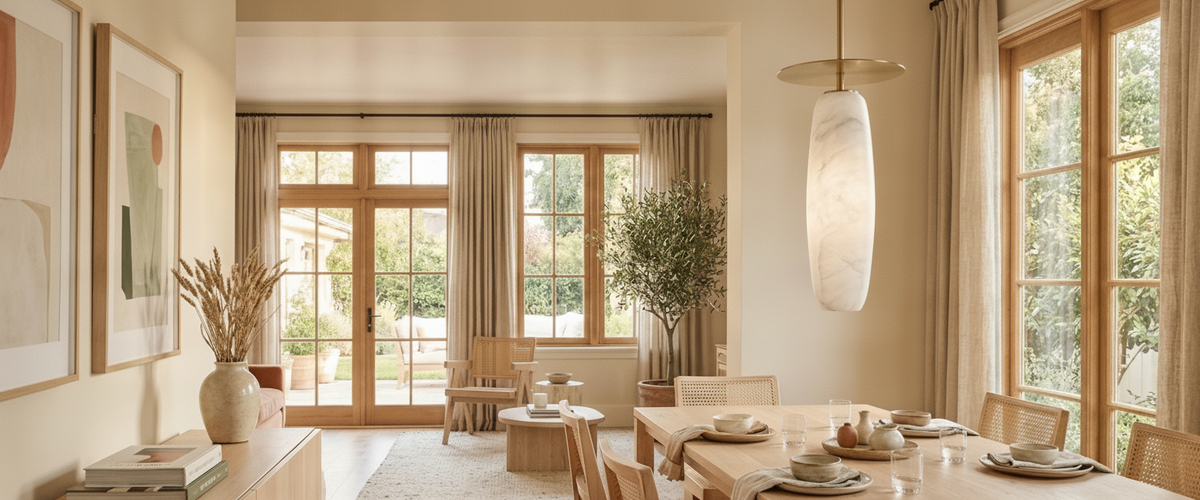
A natural stone light rewards rooms where you want atmosphere over task brightness. Over a dining table, a translucent linear fixture such as the Petra LED Linear Chandelier in brass and natural alabaster throws a warm pool that flatters both food and faces without ever glaring. In a bedroom, a pair of alabaster table lamps gives a low, even glow. In an entrance hall, a stone pendant makes a strong first impression the moment it is switched on.
It dies flat in rooms that demand crisp, cool, high-output light. A home office where you read fine print all day, a busy kitchen prep zone, a bathroom mirror used for detailed grooming; these want dedicated task lighting, with stone playing a supporting role for ambience. The mistake we see most often is a single stone pendant asked to light an entire open-plan kitchen. It cannot. Layer it: use your natural stone light for warmth and character, then add discreet task lighting where hands actually work. Our alabaster lighting pieces are built for that ambient layer first.
Bulb Temperature That Flatters Mineral Colour Instead of Muddying It
Get the bulb wrong and even the best natural stone light looks cheap. For alabaster, onyx and warm-toned stone, a colour temperature around 2700K to 3000K keeps the veining rich and the light golden. Push past 4000K into cold white and the stone greys, the warmth drains out, and the honey tones you paid for turn flat and lifeless.
Some of our natural stone light fixtures use CCT LED technology, meaning the colour temperature is adjustable across a range such as 3000K to 6000K. That flexibility is genuinely useful: warm for evening, cooler for daytime clarity. Match your bulb temperature to the stone as well as the room. For guidance on getting light levels and colour right across a home, the CIBSE lighting guides are a sound reference. Also pay attention to dimming; a stone shade that dims smoothly to a low, candle-like glow is worth far more in the evening than one that only sits at full brightness. Check the fixture and bulb are compatible with your dimmer before you buy.
The Dulling Habits That Quietly Grey Out a Stone Shade
Natural stone is porous, and that is the whole care story in a sentence. Over a year, three things dull a natural stone light: airborne dust settling on the surface, cooking film in kitchen-adjacent fixtures, and hard-water spray near bathrooms. None of them announce themselves. You simply notice, months later, that the glow has gone slightly grey and tired.
The fix is gentle and regular. Dust with a dry, soft microfibre cloth every week or two. For anything more stubborn, use a barely damp cloth with warm water, then dry immediately. Avoid vinegar, citrus, bleach and general household sprays; acids etch stone and harsh cleaners strip sealants. The Natural Stone Institute has clear guidance on why acidic cleaners damage calcite-based stone. Always switch a fixture off and let it cool for at least 15 minutes before cleaning.
A Simple Buying and Care Checklist
See the stone lit before you commit, not just in daylight.
Confirm the shade is thin enough to glow for the effect you want.
Choose stone colour by how it reads backlit, not by the raw swatch.
Pair warm stone with a 2700K to 3000K bulb and check dimmer compatibility.
Layer your natural stone light with separate task lighting in working rooms.
Dust regularly and keep acids and harsh sprays away from the stone.
Have a qualified electrician handle mounting and wiring for heavier fixtures.
A natural stone light is a long-term piece. Choose it for how it glows, place it where atmosphere matters more than raw output, and keep it clean, and your natural stone light will look as good in five years as it did on the day it was hung.