
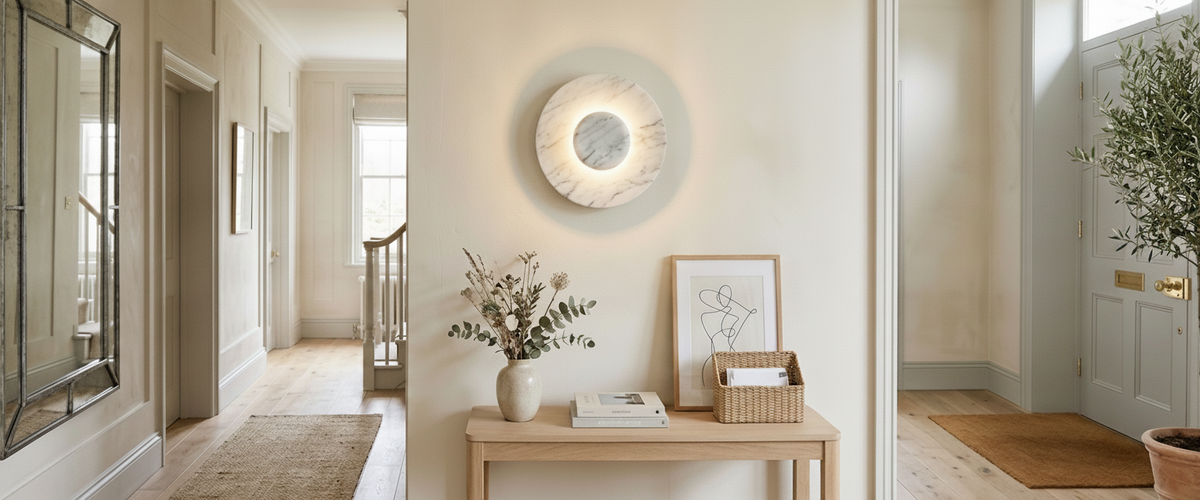

Hang a marble sconce wall lights four inches too high and the whole thing looks like an afterthought. Get it right and the stone reads as if it belongs, glowing softly at the exact height your eye expects. Placement is the part most buyers skip, and it is the part that separates a considered scheme from a fixture stuck on plasterboard at whatever height the electrician's chalk line landed. This guide walks through the heights, spacing and backdrops that make a marble sconce wall light sit properly.
Marble and alabaster both glow because they are slightly translucent. Light passes into the stone and softens before it reaches the room, which is why a marble sconce wall light rewards careful positioning far more than a hard downlight does. The veining, the warmth, the way the edge catches: all of it depends on where the sconce sits relative to your eye.
A pale marble sconce set near eye line, throwing a soft scallop of light onto a warm wall.

Key Takeaways
Eye line rules everything. Most marble sconces look best with the light source around 60 to 66 inches (152 to 168 cm) from the floor.
Height changes by room. Hallways sit higher, bedsides lower, bathrooms follow the mirror.
Marble dims the throw. The stone softens output, so plan for a pool of light of roughly 3 to 5 feet (about 1 to 1.5 m), not a room-filler.
Symmetry must be exact. Flanking a mirror or bed exposes any measurement error instantly.
Backdrop colour borrows the glow. Warm walls amplify the effect; cool greys can flatten it.

Where a Marble Sconce Wall Light Belongs Relative to Eye Line
The single most useful number to carry around is eye line. For a standing adult that sits somewhere between 60 and 66 inches (152 to 168 cm). Position the brightest part of the marble sconce wall light, usually the centre of the marble shade or diffuser, near that band and the fixture reads as intentional. Too high and you get glare bouncing off the ceiling while the wall below stays dark. Too low and it feels like task lighting that wandered off course.
There is a caveat that matters with stone. Because a marble wall lights glows through its body, the whole fixture becomes the light source, not just the bulb inside. That gives you a little more forgiveness than a bare-bulb fitting, but it also means a tall marble sconce wall light placed high will still throw its warmth above head height where nobody benefits. Anchor the glowing mass to eye line and let the fixture extend up or down from there.

Hallway, Bedside and Bathroom: Three Heights, Three Reasons
Each room asks a different question of a wall light, so the height shifts with the job.
Hallways and Corridors
Here you want rhythm and reassurance, not reading light. Mount each marble sconce wall light slightly above eye line, around 66 to 72 inches (168 to 183 cm) to the centre, and space them evenly along the run. A pair of pale marble sconces set six feet apart, each throwing a gentle scallop of light onto the wall, gives a corridor pace without glare. Where you want that scalloped wash and a touch of ornament rather than a plain diffuser, a cut-glass fitting such as the Aegean Aged Brass Wall Light sits in a similar decorative register to marble. The point of a corridor sconce is to lead the eye forward, so consistency of height matters more than any single fixture.
Bedside
Bedside sconces drop lower because you are lying down, not standing. Aim for the light source around 30 to 36 inches (76 to 91 cm) above the mattress, or 24 to 28 inches (61 to 71 cm) above the bedside surface if you read in bed. A marble bedside light gives a warm, low-glare glow that suits winding down far better than a hard spot. If you want to browse warm, diffusing wall pieces for a bedroom, the alabaster lighting collection is the natural place to start, since alabaster and marble behave similarly in the way they soften output.
Bathroom
Bathroom sconces follow the mirror, not the floor. Flanking a mirror, position each marble sconce wall light at roughly 60 to 66 inches (152 to 168 cm), level with or just above eye line, so light lands on the face rather than the top of the head. Marble in a bathroom needs a fitting rated for the zone it sits in, and any wet-area installation should be signed off by a qualified electrician against current wiring regulations. The Electrical Safety First guidance is a sensible reference before you commit to a position near water.
Matched sconces flanking a bed, measured from a single datum so heights read as a set.
How Far the Light Throws Before the Stone Dims It
Marble is beautiful precisely because it holds light back. That translucency means a marble wall sconce light will not fill a room the way a clear glass fitting does. Expect a soft pool of illumination roughly 3 to 5 feet (about 1 to 1.5 m) across, brightest near the fixture and fading gently outward.
Plan around that behaviour rather than fighting it. In a large space, treat marble sconces as layered accents and let a pendant or ceiling light carry the general brightness. In a snug hallway or a bedroom, the marble sconce wall light can do more of the work because the room is smaller and the falloff feels intimate rather than dim. Bulb choice helps here: a warm LED around 2700K keeps the stone's colour honest, and a dimmable circuit lets you dial the glow down without the light going cold. Denser, more heavily veined marble absorbs more, so a green or black marble wall light will read darker than a pale one at the same wattage.
Flanking a Mirror or a Bed: Symmetry That Has to Be Exact
Nothing exposes sloppy placement like a matched pair. When two examples of a marble sconce wall light flank a mirror or a bed, the eye reads them as a set, and even half an inch of difference in height or spacing shows.
Measure from a fixed datum, not from the ceiling, which is rarely level in older homes. Use the floor or the top of the mirror as your reference and mark both mounting points from the same line. For a bed, keep equal distance from the centre of the headboard; for a mirror, match the gap on each side and keep both light sources at the same height. A stone fixture makes this doubly important because the veining draws the eye, and asymmetry in the marble pattern combined with asymmetry in position turns a considered wall into a busy one. If you are choosing a pair, look for pieces cut so the veining runs in a similar direction, and hang them as mirror images where the stone allows.
Backdrop Colour and How It Borrows the Sconce's Glow
A marble sconce wall light does not light in isolation; the wall behind it becomes part of the fitting. Warm off-whites, soft plaster tones and deep clay colours all catch the sconce's glow and hand it back, so the light feels fuller. Cool blue-greys and stark brilliant whites tend to flatten the effect, reading the warm stone as slightly muddy by contrast.
Darker walls do something more dramatic. Against a charcoal or deep green backdrop, a pale marble sconce wall light reads like a lit object, the glow separating cleanly from the wall. A black marble wall light on a dark wall goes the opposite way, quiet and moody, with the veining catching most of the light. If you want the fixture to feel like a piece rather than a utility, choose your backdrop as deliberately as the sconce. The natural translucency of these materials is well documented by the Natural Stone Institute, and it is exactly that quality you are working with when you set stone against colour.
The Placement Slips That Make a Good Sconce Look Accidental
Most placement mistakes are small and completely avoidable. Watch for these.
Hanging to the ceiling, not the floor. Old ceilings slope. Reference the floor or a fixed feature and your heights stay honest.
Ignoring the switch and cable route. Decide the position of your marble sconce wall light before first fix wiring, not after the plaster is on.
Overlighting a small marble fitting. Push too much wattage through translucent stone and you lose the soft quality that made you buy it. Keep it warm and dimmable.
Forgetting the fixing weight. Marble and natural stone carry real mass. Confirm the wall can take the load and use fixings suited to the substrate.
Uneven pairs. Measure both mounting points from the same datum, every time.
Mismatched veining on a matched pair. Where the stone is figured, hang the pieces so the pattern reads as a set.
Placement is where a fixture earns its keep. Get the height, spacing and backdrop right and a marble wall light stops looking like hardware and starts looking like part of the architecture. If you want to compare shapes and stone tones before you settle on a position for your marble sconce wall light, the full lighting collection at Niori, an alabaster and natural-stone lighting brand, is a good place to see how different forms sit on a wall.