
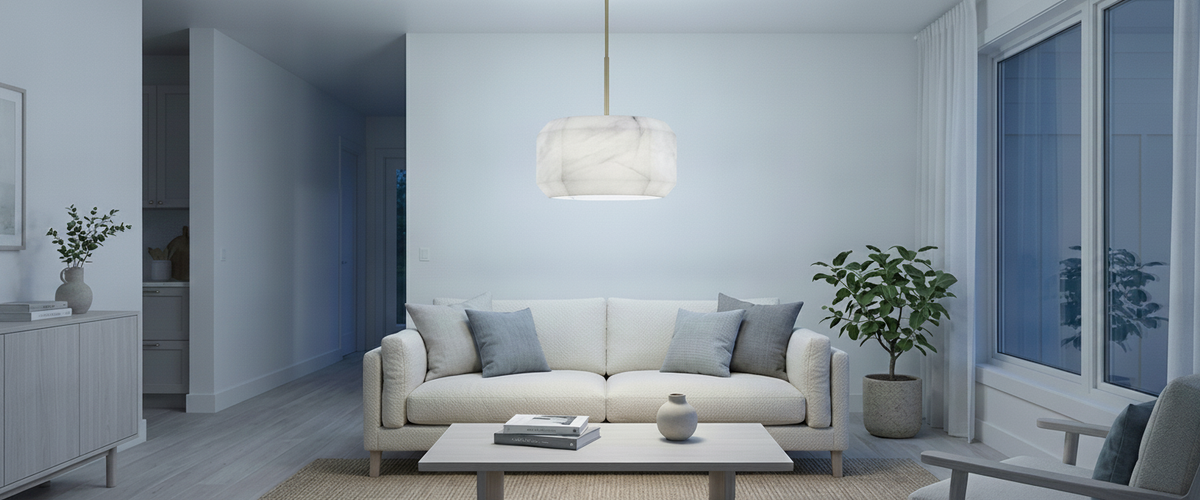

Switch on the single ceiling light above your sofa at eight in the evening and watch what happens. The room flattens. Faces go slightly grey, corners fall into shadow, and the whole space takes on the mood of a waiting room. This is the most common failure in living room lights, and it has nothing to do with the fixture being cheap or badly made. Good living room lighting is never one bulb doing everything; a lone downlight, however lovely, cannot do the work of a whole scheme on its own.
Good living room lighting is a set of layers that cooperate. Get the layers right and the room reads warm at midday and intimate after dark, without you ever thinking about the bulbs. Get it wrong and you will keep buying lamps that never quite fix the problem. That is the real test of living room lighting: does it hold up when the sun is gone?

Key Takeaways
One ceiling fixture on its own will always leave a living room flat after sunset. Plan three layers of living room lighting instead.
Ambient, task, and accent light should each be on separate switches or dimmers so you can change the room's mood without changing rooms.
Alabaster and natural stone give a soft, diffused glow that is kind to faces and easy to live with over long evenings.
Stick to 2700K bulbs across the whole room for a consistent warm tone, and dim rather than switch off to hold the atmosphere.
Budget depends on material, scale, and finishing, so request a tailored quote rather than guessing from a catalogue photo.

The Single-Pendant Trap
A single pendant or flush ceiling light throws most of its light straight down and outward from one point. Directly under it you get glare; a few feet away you get shadow. Around the edges of the room, where your bookshelves, artwork, and the backs of your seats live, you get very little at all. That is why a room lit by one fixture can feel both harsh and dim at the same time. It is the classic living room lighting mistake.
The fix is not a brighter bulb. A brighter bulb in the same spot just deepens the contrast between the pool of light below and the gloom around it. What the room needs is more sources, each doing a smaller job, spread across different heights. That is the whole idea behind layering, and it is the single most useful thing to understand about living room lights fixtures.
Building Three Layers That Talk to Each Other
Think of your living room lighting scheme in three parts. Ambient light fills the room and sets the baseline. Task light does specific work, like reading or lighting a games table. Accent light picks out the things you want noticed, such as a painting, a stone fireplace, or an alcove.
The trick is making them cooperate rather than compete. If your ambient layer is a bright central fixture and your task lamp sits right beneath it, they fight; you get a hot centre and dead edges. Push the task lamp to the reading chair in the corner, dim the ceiling fixture to a low wash, and add a couple of wall lights along the far wall, and suddenly the room has depth. Your eye moves across it instead of stalling in the middle.
Alabaster earns its place in living room lighting because of how it handles the ambient and accent layers. The stone is naturally translucent, so a shade or bowl carved from it glows rather than glares. Rather than a bright point you are asked not to look at, you get a soft, warm surface that reads as part of the room. To see how that quality plays out across pendants, wall lights, and lamps, the alabaster lighting collection is a useful place to start comparing forms.
Task Pools and Ambient Wash
Reading needs real light, but not the whole room lit like a kitchen. A table lamp or floor lamp beside the reading chair creates a task pool: a defined area of usable brightness that leaves the rest of the room in a softer register. This is where a stone table lamp does something a downlight simply cannot. Placed on a side table beside an armchair, it lights the page and the sitter's hands while its own body glows gently, filling the corner that ceiling light never reaches.
For the ambient wash, aim for even, low-level light around the room's perimeter. Wall lights are the quiet heroes of living room lighting here. A pair of alabaster fittings flanking a fireplace or spaced along a long wall lifts the edges of the room and stops it feeling boxed in. Because the light bounces off the wall and back into the space, it feels indirect and calm, which is exactly what you want as the baseline mood for an evening.
Living room ceiling lights still have a role, but their job changes. Rather than being the only source, a pendant or chandelier becomes the top note: on a dimmer, pulled back to roughly half brightness, adding gentle overall fill and a focal point overhead. In a room with high ceilings, a natural-stone chandelier can anchor the whole scheme without ever needing to be the workhorse.
Reading the Room Twice
Here is a habit worth borrowing from designers. Look at your living room twice: once at midday with the curtains open, and once after dark with only the artificial light on. The two versions are almost different rooms, and your living room lighting has to work in both.
At midday, daylight floods in and your fixtures barely register. The stone looks like a beautiful object, unlit. After dark, that same alabaster shade becomes the primary source of warmth, the daylight is gone, and every shadow you tolerated at noon now matters. We had a client in a west-facing sitting room who loved how their space felt at four in the afternoon and could not understand why it felt cold by nine. The answer was simple: they had lit for the daytime version and ignored the nighttime one. Adding two wall lights and a corner floor lamp solved it in an evening.
Plan your living room lighting for the after-dark room, because that is when you actually sit in it. If it works at night, the daytime version looks after itself.
Dimming and 2700K: One Honest Room All Day
Colour temperature is what keeps a room feeling consistent. For living room lighting, 2700K is the reliable choice: a warm white that flatters skin, wood, and natural stone without tipping into orange. Mixing colour temperatures across fixtures is a common own goal; one cool bulb among warm ones reads as a fault, like a single tooth that has been whitened. Keep every source in the room at the same warm 2700K and the layers blend instead of clashing.
Dimming is what turns those layers into moods. Put your ambient and accent layers on dimmers so you can drop the whole room to a low glow in the evening and bring it up for a lively gathering. Warm-dimming LEDs, which shift slightly warmer as you lower them, mimic the way older incandescent bulbs behaved and suit stone fixtures particularly well. If you are choosing LED sources, the guidance on bulb ratings and quality from ENERGY STAR is a practical reference for understanding lumen output and colour rendering before you buy.
As for wattage, the honest answer is to think in lumens rather than watts, since LED wattage tells you little. A comfortable ambient layer usually lands somewhere in the region of a soft, dimmable fill rather than a single high-output bulb, with brighter task lamps where you read. Prioritise a high colour rendering index (CRI 90 or above) so the veining in the alabaster and the tones in your room look true.
Layering Mistakes and Quick Fixes
Most flat rooms fail for one of a handful of reasons. Here is the short diagnostic for your living room lighting, with fixes you can act on:
Everything on one switch. If ambient, task, and accent all turn on together, you only ever have one mood. Split them onto separate circuits or add smart plugs and dimmers so each layer works alone.
No light below eye level. A room lit only from the ceiling feels institutional. Add a table lamp and a floor lamp to bring warmth down to where people sit.
Dead corners. The corner behind the sofa is where atmosphere goes to die. A slim stone floor lamp or a wall light fixes it instantly.
Overlit centre, dark edges. Dim the central fixture and push light outward with wall lights. The room will feel larger, not darker.
Mismatched colour temperature. Swap any cool bulbs for 2700K so the whole room speaks in one tone.
Choosing Fixtures Room by Room
When you are deciding what to actually buy for your living room lighting, work from the room outward. Measure your ceiling height first; a low ceiling wants flush or semi-flush ceiling fittings, while a double-height space can carry a substantial pendant or chandelier. Note where you sit and read, and put task lamps there. Identify the walls that need lifting and plan wall lights for them.
Scale matters more than people expect. A pendant that looks generous in a photograph can vanish over a large sofa, and a table lamp sized for a hallway looks lost on a wide living room console. When in doubt, go slightly larger; alabaster and stone carry visual weight well and hold their own in a room. To browse fixture types side by side before you commit, the full niori lighting range lets you compare pendants, wall lights, and lamps in the same material language.
Niori works in alabaster and natural stone precisely because these materials do the diffusing work for you. The stone softens the source, warms the tone, and turns a functional bulb into something worth looking at. Build the layers, keep the colour temperature honest, and put those layers on dimmers, and your living room lighting will finally look as good at nine at night as it does at noon.