
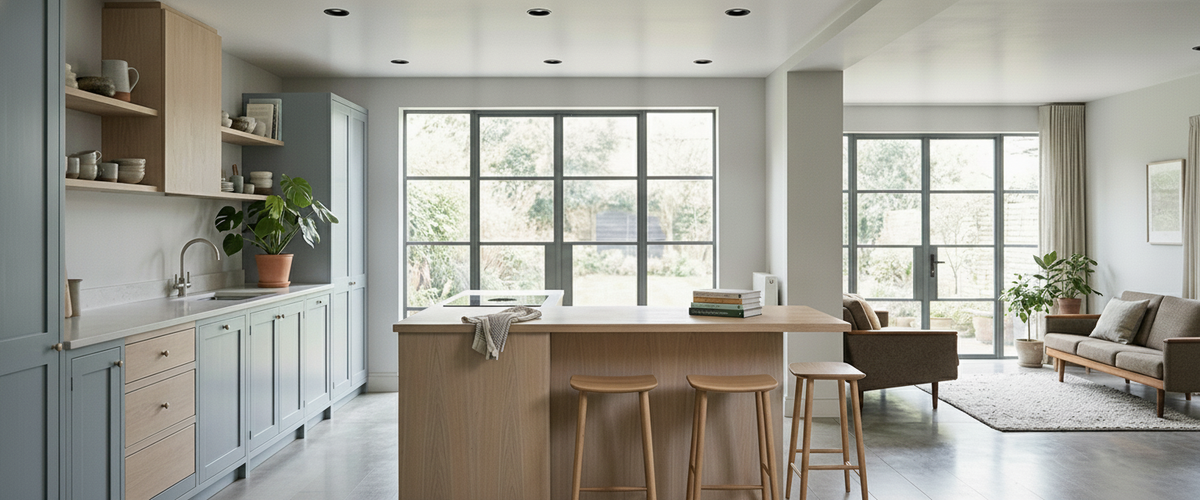

A ceiling peppered with evenly spaced LED downlights can do one of two things: light a room with quiet control, or strip every scrap of atmosphere out of it and leave you sitting in something that feels like a meeting room. The fitting itself is rarely the problem. The grid, the beam angle, the driver, and what else is doing the lighting work alongside it are where rooms go right or wrong. Getting an led downlights scheme to feel considered rather than clinical is mostly a planning job, and it pays to think it through before a single hole gets cut.
At Niori we sell alabaster and natural-stone lighting, so we spend a lot of time talking buyers down from a wall-to-wall led downlight grid and back toward something with shadow and warmth in it. Recessed light has a real role. It just should not be the whole story.
A planned led downlight grid keeps pools of light even and avoids dark patches.

Key Takeaways
A led downlight washes horizontal surfaces well (worktops, hallways, bathrooms) and drains mood from rooms meant for relaxing.
Space them off the walls and off each other to avoid scalloped streaks and dark patches.
Flicker almost always traces back to a dimmer and driver that do not get along, not a faulty bulb.
Pair recessed light with pendants, wall lights, and alabaster fixtures to put warmth and softness back.
Specify fire-rated fittings between floors and check ceiling depth and insulation before you buy.

The Wash They Deliver Well, and the Rooms They Drain
Downlights are at their best when they have a clear job: throwing light down onto a surface you actually use. Over a kitchen island, along a corridor, in a bathroom or utility room, an led recessed downlights gives clean, shadow-free task light that keeps the ceiling plane uncluttered. That is genuinely useful, and in a working space it reads as calm rather than cold. Where you want the colour temperature to flex between a cooler task light and a warmer evening tone, a CCT-selectable led downlight such as the Tiberi 21W LED Downlight gives you that range from one fixture rather than committing to a single fixed white.
The trouble starts when the same logic gets applied to a sitting room or bedroom. Light coming straight down lands on the tops of people's heads, hollows out faces, and leaves the vertical surfaces, walls, art, curtains, dark. A room lit only from above has nowhere for the eye to rest and no warmth at the edges. People describe it as feeling flat, and they are right. Mood lives in the mix of heights and the glow off vertical surfaces, which a recessed grid alone cannot supply.
So treat a led downlight as one layer, not the scheme. Reach for them where you need light on a counter or floor, and pull back where you want the room to feel soft. The collections across our full lighting range are built around that layered approach rather than a single ceiling solution.
Spacing and Beam Angle: Avoiding Scallops and Dark Patches
Two numbers decide whether a recessed scheme looks deliberate or accidental: how far the fittings sit from the wall, and how far they sit from each other. Place a fitting too close to a wall and you get a hard scallop, a bright arc that draws the eye to the join rather than the room. As a rough working rule, keep each LED downlight around 2 to 3 feet (roughly 0.6 to 0.9 m) off the wall, and space them at a distance close to half the ceiling height between centres. A standard 8-foot (2.4 m) ceiling wants them roughly 4 feet apart so the pools of light meet without overlapping into hot stripes.
A narrow beam punches a tight pool; a wider beam spreads a softer, even wash.
Beam angle changes everything about that pattern. A narrow beam (around 24 to 36 degrees) gives a tight, punchy pool, good for highlighting a worktop or a piece of art on a wall when the fitting is adjustable. A wider beam (60 degrees or more) spreads a softer, more even wash that suits general room lighting and hides spacing inconsistencies. For most living spaces a wider beam reads gentler; for task zones a tighter beam keeps the light where you want it. Where a grid feels too busy for a large flat ceiling, a single broad source like the Blingo 600x600 Recessed LED Panel covers the area with one even wash instead of a constellation of spots, which is often the calmer choice in an office or utility room. Mixing beam angles in one ceiling, without a plan, is how you end up with bright patches next to gloomy ones.
If you are retrofitting an existing ceiling, mark the proposed positions for each led downlight with low-tack tape before committing. Stand in the room at night with a torch held where each fitting will go. It sounds basic. It catches problems that a paper grid never shows.
Why Your LED Downlights Flicker, and the Driver and Dimmer Cures
If your LED downlights flicker, the bulb is usually the innocent party. The most common cause of that stutter is a mismatch between the dimmer switch and the driver. Many older dimmers were designed for the heavy electrical load of halogen lamps. A recessed led downlight draws a fraction of that, so the dimmer struggles to read the load correctly and the light stutters, especially at the lower end of the dial. Once you understand why led downlights flicker, the cure is usually straightforward.
The fixes, in order of likelihood:
Wrong dimmer type. Swap a legacy dimmer for a trailing-edge dimmer rated for downlights led bulbs. This single change cures most led downlight flickering.
Minimum load not met. Some dimmers need a minimum wattage to work smoothly. A few low-wattage fittings on a large old dimmer can sit below that threshold and flicker.
Poor-quality driver. The driver regulates current to the led recessed downlight. Cheap drivers cope badly with dimming. A well-made fitting with a quality driver behaves far better across the range.
Mixed fittings on one circuit. Combining different brands or wattages on a single dimmer can confuse it. Keep a dimmed circuit consistent.
Flicker is more than an annoyance. Visible and invisible flicker can cause eye strain and headaches, so it is worth resolving properly rather than living with it. Any work behind the switch or fitting should go to a qualified electrician; matching the lamp, driver, and dimmer as a set is the part you can specify carefully before they arrive.
Pairing Recessed Light With Pendants and Stone for Warmth Back
The most reliable way to keep a downlit room from feeling like a car park is to give it something to glow from. The led downlight handles the practical wash; a pendant, a pair of wall lights, or a table lamp handle the mood. This is where natural stone earns its place.
Alabaster is mildly translucent, so light passing through it scatters into a soft, warm glow rather than a hard point. Put an alabaster pendant over a dining table and dim the surrounding ceiling lights, and the room gains a centre of gravity and a warm tone that a led downlight alone never produces. The same logic applies to onyx and marble fixtures, where the veining catches and diffuses light in a way flat glass cannot. We regularly ship alabaster wall lights to clients who installed a full recessed grid in a new build, found the living room cold, and wanted to claw the atmosphere back without re-cutting the ceiling. The wall lights and a couple of lamps did exactly that.
A practical layering plan looks like this: an led downlight on a dimmer for task and general light, set low for evenings; an alabaster pendant or chandelier as the warm focal point; wall lights or lamps to lift the vertical surfaces and the corners. You can browse the stone pieces in our alabaster lighting collection to see the warmth they bring against a flat-lit ceiling. When the stone fixtures carry the evening mood, the spots can stay off or barely on, and the room finally reads as somewhere you want to sit.
Ceiling Depth, Insulation, and the Fire-Rated Fittings to Specify
Before you order anything, look up. The space above the ceiling decides what you can fit. A recessed led downlight needs clearance behind the plasterboard for the body of the fitting and its driver, often 4 inches (around 100 mm) or more depending on the model. In a room with a shallow void, a slim fitting or a surface-mounted alternative may be the only honest option.
Two non-negotiables for safety:
Fire-rated fittings between floors. Cutting holes in a ceiling that separates floors compromises its fire resistance. A fire-rated led downlight is designed to seal that gap and restore the ceiling's rating. UK guidance from Electrical Safety First is clear on the importance of correctly rated, correctly installed fittings.
Insulation clearance. Loft insulation packed against a non-IC-rated fitting traps heat and is a fire risk. Either use fittings rated for insulation contact or fit covers that hold the insulation clear.
Bathrooms add their own rule. Fittings near a bath or shower need an appropriate IP rating for the zone they sit in. None of this is the place to improvise, and a qualified electrician should sign off the installation. What you can do as the buyer is specify the right led downlight for the void, the fire rating, and the zone before the trades arrive, which saves a frustrating round of returns.
A Quick Buyer's Checklist
Decide the job: task wash, general light, or accent. That sets the beam angle.
Plan spacing on paper, then test positions with tape and a torch at night.
Buy the fitting, driver, and a trailing-edge LED dimmer as a matched set to avoid flicker.
Check the ceiling void depth and specify an led downlight that fits.
Use fire-rated fittings between floors and insulation-safe fittings in lofts.
Add a warm layer: an alabaster pendant, wall lights, or a stone lamp to give the room mood.
Done well, an LED downlight disappears into a good scheme. The led downlight does the quiet, useful work while the pieces with character, the stone pendant, the glowing wall light, carry the feeling of the room. That balance, recessed light for function and natural stone for warmth, is the whole point.