
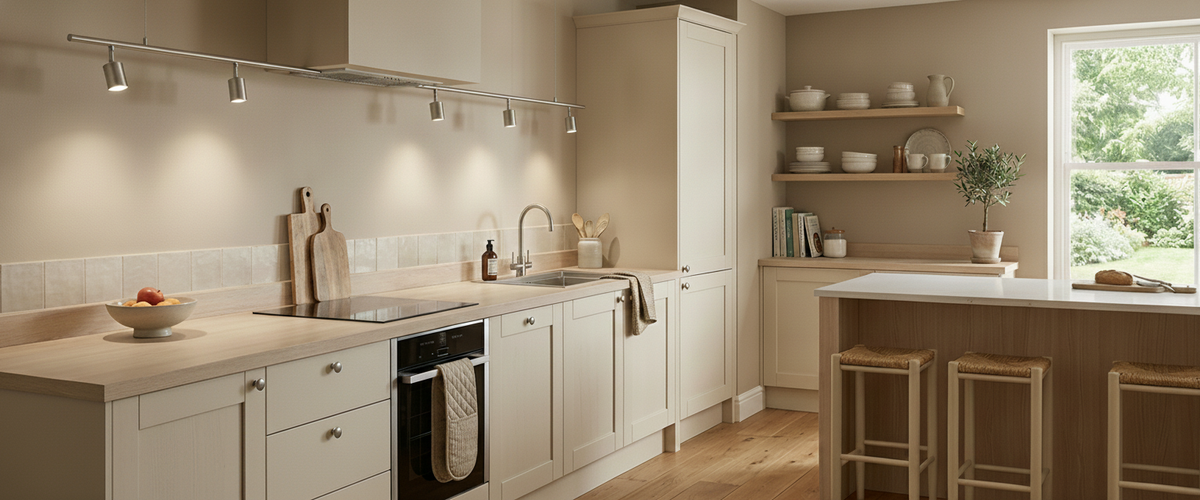

Stand at your worktop under a single ceiling pendant and reach for the chopping board. See that dark patch where your own body blocks the light? That is the real failure of most kitchen track lighting, and it is why so many people add more lumens when the problem was never brightness. Kitchen track lighting solves it by putting several aimable heads exactly where the work happens, so light arrives from in front of you instead of behind. Done well, track lighting for a kitchen is quietly precise. Done badly, you spend every evening slicing onions in your own silhouette.
At Niori we are known for alabaster and natural-stone lighting, the warm diffused pendants and wall lights that soften a room. Kitchen track lighting is the practical counterpart to those pieces: the task layer that does the hard graft while a stone pendant carries the atmosphere. Getting both right is what makes a kitchen feel finished rather than merely lit.

Key Takeaways for Kitchen Track Lighting
Kitchens fail on shadow, not lumens. Position beats raw brightness.
Map the track to your worktops, hob, and sink before anyone drills a hole.
Space heads so the light lands on the counter edge nearest you, not the wall behind.
Match beam angle to counter depth: tighter spots for narrow runs, wider floods for islands.
Choose warm, high-CRI output so food and finishes read true, not grey.
Always use a qualified electrician for the mains connection.

Why Kitchens Fail on Shadow, Not Lumens
A kitchen has more standing-and-working surfaces than almost any other room in the house. You prep at the counter, wash at the sink, cook at the hob, and you face the wall for most of it. Overhead light coming from directly above, or worse from behind, throws your own shadow onto the exact spot you need to see. Adding a brighter bulb only makes a sharper shadow.
A kitchen track lighting setup works because each head is independent and aimable, which is why track lighting beats a fixed pendant for prep. You can angle one at the sink, two along the main prep run, one at the hob, and suddenly the light reaches the surface at an angle that clears your hands and head. The catch is that this only works if the rail is positioned correctly relative to where you stand. Track fixed dead-centre in the ceiling, running parallel to nothing useful, is just an expensive way to light the floor.

Map the Track to Your Worktops, Hob, and Sink First
Before you commit to a single fixing point, walk the kitchen and mark where you actually work. In most galley and L-shaped kitchens the track wants to run above the front edge of the worktop, not down the middle of the ceiling. That offset, usually around a foot (30 cm) out from the wall units, is what lets the beam clear your shoulders and land on the counter surface. This is the single biggest factor in whether kitchen track lighting earns its keep.
For islands, the rail sits centred over the island but angled to wash the working face rather than the seating edge. Sinks under a window are the easiest win: a head aimed at the basin from slightly in front removes the classic silhouette you get when the only light is the window behind you at night.
Sketch it on paper. Mark the hob, the sink, the main prep zone, and the coffee or baking station if you have one. Those are your fixed targets. Everything else is fill. We have redrawn plenty of track lighting kitchen ideas for clients who fixed the rail symmetrically to suit the ceiling and then wondered why the cooking still happened in the dark. Symmetry is for the ceiling; function is for the counter, and good kitchen track lighting always follows the function.
Spacing Heads So You Don't Cook in Your Own Silhouette
Once the run is set, space the heads to the tasks, not to a tidy ruler. A common working rule is a head roughly every 2 to 3 feet (60 to 90 cm) along an active worktop, with extras concentrated over the hob and sink. Two heads on a hob from slightly different angles cancel each other's shadows better than one bright spot ever will.
Leave yourself spare capacity. One of the quiet advantages of track lights for a kitchen is that heads slide and clip on and off the rail, so you can add or move one after you have lived with the room for a fortnight. Where you want a discreet head that recedes against a dark ceiling, a fitting such as the GU10 Track Spotlight in black keeps the hardware quiet while you concentrate on aim. Buy a rail that takes more heads than your initial plan, then hold two in reserve. The people who regret their kitchen track lights are almost always the ones who filled every socket on day one and left no room to correct an aim.
Spot Versus Flood: Matching Beam Angle to Counter Depth
Beam angle is the setting most people ignore, and it decides whether your kitchen track lighting feels sharp or muddy. A narrow spot, around 15 to 24 degrees, throws a tight pool; it suits a deep island or a high ceiling where the light has distance to spread. A wider flood, 36 degrees and up, blankets a standard worktop run without leaving scalloped dark gaps between heads.
As a rough guide: standard-depth worktops under a normal ceiling want floods; tall ceilings, deep islands, and feature zones can take tighter spots for drama. Mixing the two on one kitchen lighting track lighting circuit is perfectly legitimate. Floods over the prep run, a spot or two picking out a shelf of glassware or a piece of art on the end wall. Where a run needs one integrated head that lets you set warmth on site rather than swapping bulbs, the LTL 38W LED Track Light with CCT Select gives you that flexibility across the main prep zone, and you can see how spot and flood fittings pair on a single circuit across our lighting collection.
Warm Output That Flatters Food and Finishes
Colour temperature and colour rendering matter more in a kitchen than almost anywhere. Aim for warm white in the 2700K to 3000K range for the main task light; go cooler than that and raw chicken, tomatoes, and timber worktops all take on a clinical grey cast nobody wants over dinner. Just as important is the CRI, the colour rendering index. A figure of 90 or above means colours read true, so a ripe avocado looks ripe and your oak counter keeps its warmth. The guidance on brightness and light appearance from ENERGY STAR is a useful primer if you want to understand the numbers behind lumens and warmth.
This is where kitchen track lighting and stone lighting complement each other. The rail delivers the accurate, warm task light; an alabaster pendant over the island or a stone wall light near the dining end supplies the glow. Alabaster diffuses light through the stone itself, so the veining reads as soft warmth rather than glare. If you want that softer layer over an island or breakfast bar, our alabaster lighting range shows how a natural-stone piece can sit alongside functional track without either fighting the other.
The Track Layouts We Redraw Most Often After a Botched Install
A few mistakes come up again and again, and they are all fixable before the drill comes out. Most bad kitchen track lighting fails on one of these five points.
Rail centred on the ceiling. Beautifully symmetrical, useless for prep. Move it out over the worktop edge.
Every head aimed straight down. Vertical beams maximise shadow. Tilt heads forward so light crosses in front of you.
One warm layer only. Track alone can feel flat. Pair it with a dimmable stone pendant for evenings.
No dimming. A kitchen that runs at full task brightness at 10pm is exhausting. Put the circuit on a dimmer rated for LED loads.
Filling every socket. Leave a couple of positions free to correct aim once you have cooked in the room.
A Quick Install and Safety Checklist
Confirm the rail's voltage and circuit type match your supply and connectors.
Plan feed position, connectors (T, X, or flexible), and any run length before ordering.
Mark head positions against your worktop map, not the ceiling grid.
Have a qualified electrician make the mains connection and test the circuit.
Set colour temperature (CCT-select heads let you fine-tune 2700K to 4000K on site).
Live with it for two weeks, then adjust aim and add reserve heads if needed.
Is Track Lighting Good for a Kitchen, and What About Budget?
Kitchen track lighting is one of the most forgiving systems you can put in precisely because it is adjustable after the fact. If your layout changes, your lighting can follow. Affordable options exist at the component level: a simple single-circuit white rail with GU10 spots covers most domestic runs, and CCT-select LED heads let you tune warmth without swapping fittings. What a system costs depends on rail length, the number and type of heads, connectors, and installation, so it is worth requesting a tailored quote rather than guessing from a headline figure.
Think of the rail as the workhorse and stone as the character. Get the kitchen track lighting layer right first, then let an alabaster pendant or wall light do the atmospheric work. That balance, precise task light where you chop and warm diffused light where you gather, is what separates a kitchen that merely works from one you actually want to stand in.