

A single pendant hung dead-centre is the fastest way to make a hall feel like a corridor. It flattens the space, throws one hard pool of light onto the floor, and leaves the far ends in shadow. Most of the hallway lighting ideas that actually work do the opposite: they carry your eye along the length of the space and give the walls something to do. That is where alabaster and natural stone earn their place, because the warm, diffused glow they cast reads as depth rather than a spotlight on the doormat.
A hallway is a space you pass through, never one you sit in, so the lighting has to work in glances rather than long looks. The best hallway lighting ideas start there. Get it right and the first impression of a house is generous and calm. Get it wrong and every guest walks into a tunnel.
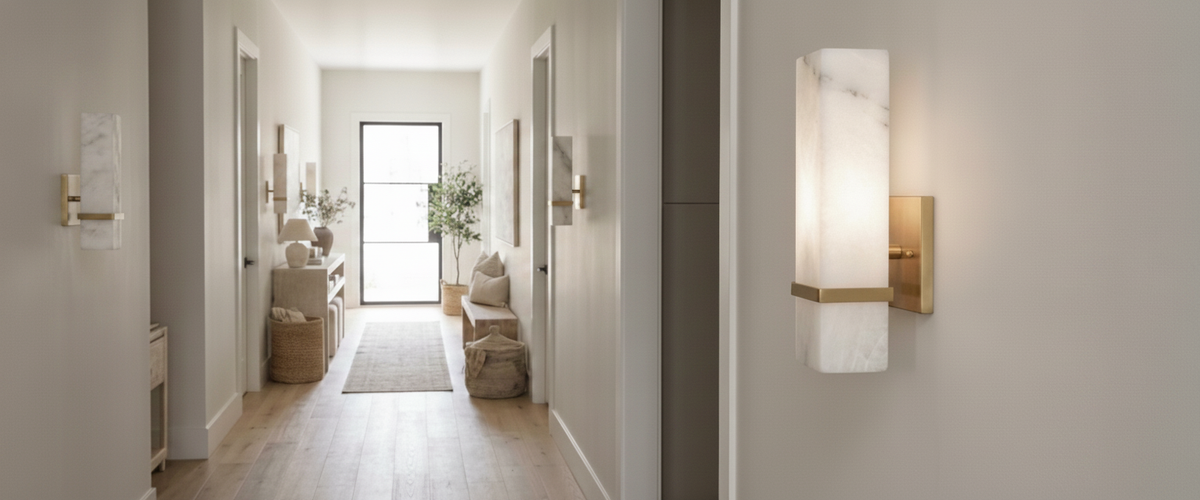
Paired alabaster sconces add depth to a slim hall.

Key Takeaways Before You Buy
Measure width and ceiling height first. A narrow hall under about 4 feet (1.2 m) wide rarely wants a large pendant.
Layer light at two heights. Wall lights at eye level plus a low overhead glow beats one bright fixture every time.
Warm stone reads as welcome. Alabaster and onyx diffuse light softly; cool downlights alone feel clinical at a front door.
Space sconces to lead the eye, not to sit in isolation halfway down the wall.
Fit a dimmer. A hall needs different levels at 8am and 11pm, and you never linger to adjust it.

Read the Width and Ceiling Height Before You Commit
Every good decision here starts with a tape measure, and the hallway lighting ideas that follow all depend on it. Width tells you whether a pendant will crowd the space or hang comfortably; ceiling height tells you whether you can drop a fixture at all. In a typical terraced or townhouse hall around 3 to 4 feet (0.9 to 1.2 m) wide, a bulky central light will graze shoulders and cast that single flattening pool. Reserve pendants for entrances with genuine volume: double-height stairwells, wide period halls, or an open-plan entry where the ceiling clears 9 feet (2.7 m) or more.
For lower ceilings, a flush or semi-flush ceiling light keeps the glow overhead without stealing headroom. An alabaster disc or shallow bowl works well here because the stone spreads the output evenly instead of firing a hotspot straight down. If you are weighing up hallway ceiling light ideas and the wider ceiling lights options for a standard hall, think in terms of soft washes rather than points of brightness.
Narrow Hallway Lighting Ideas That Add Depth
Narrow halls are where most people go wrong, and where a little planning pays off most. Among narrow hallway lighting ideas, the trick is to stop treating the ceiling as the only place light can come from. Wall lights at roughly eye level, mounted along the longer run, break the tunnel effect by giving the walls texture and rhythm. Alabaster wall lights are ideal because the stone glows rather than glares; you get a warm plane of light instead of a bright bulb in your peripheral vision.
Pair that with a low glow near the floor or on a console: a small alabaster table lamp on a slim hall table, or a discreet wall light lower down near a stair. This second, gentler layer gives the eye somewhere to travel and makes a slim space feel considered. Of all the hallway lighting ideas for a tight run, paired alabaster sconces along a narrow Victorian hall can make it read as part of the house rather than the gap between the front door and the kitchen. That is the goal. You can see the range of wall and ceiling options across our alabaster lighting collection if you want to compare fixture types side by side.
Warm Stone at Eye Level Versus Cool Downlights Overhead
Here is a quick first-impression test. Stand at your front door and picture two versions of the same hall. In one, recessed downlights fire cool white light straight down onto the floor. In the other, an alabaster wall light glows warm at eye level and a soft ceiling wash fills the space above. The second version is the one people describe as welcoming, and it is largely down to colour temperature and where the light sits. This is the sort of contrast that separates the hallway lighting ideas that work from the ones that photograph well and disappoint in person.
Warm stone at eye level reads as welcome at a threshold.
Warm light in the region of 2700K reads as domestic and calm, which is why it suits an entrance. Cooler light above 3500K can feel efficient but slightly institutional at a threshold. Natural stone warms and softens whatever bulb sits behind it, because the mineral structure scatters light as it passes through. The Natural Stone Institute has good background on how the translucency and veining of stones like alabaster and onyx vary from block to block, which is exactly why no two shades diffuse light quite the same way.
Downlights are not the enemy. They earn their keep as a background layer for cleaning or unloading shopping. The mistake is making them the only source. Among warm hallway lighting ideas, treat cool overhead light as functional and warm stone at eye level as the mood, and let the dimmer decide which dominates at any given hour.
Spacing Sconces So the Light Carries You Along
Sconce spacing is where a hall either flows or stalls, so it deserves a place in any list of hallway lighting ideas. Lights placed too far apart create dark gaps between bright zones, so the eye jumps rather than glides. As a working guide, space wall lights roughly 6 to 8 feet (1.8 to 2.4 m) apart along a run, mounted at about 5 to 5.5 feet (1.5 to 1.7 m) from the floor so the glow sits near eye level rather than above sightlines.
Symmetry helps in a formal hall; a staggered rhythm can suit a longer, more relaxed space. Keep the fixtures identical along a single run so the repetition itself does the leading. In practice, two or three well-spaced alabaster sconces will do more for a long hall than a dozen recessed spots, because each one gives the wall a soft anchor of light. Browse fixture families across the wider lighting range if you want to match sconces to a pendant or ceiling piece elsewhere in the entrance.
Hallway Light Fixture Ideas by Space
Tall entrance or stairwell
Volume invites a statement, and this is where the boldest hallway lighting ideas belong. A cascading alabaster pendant or a compact chandelier can fill vertical space without touching the walls. Hang it so the lowest point clears head height on the landing above, and let it read as sculpture in daylight and glow after dark.
Standard hall with a lower ceiling
Semi-flush alabaster ceiling lights keep the plane of light gentle and even. Add one or two wall lights near the door and further along to break up the run. These are the hallway lighting fixtures ideas that suit most family homes.
Narrow galley hall
Skip the pendant entirely. Rely on paired wall lights and a low console lamp. The absence of anything hanging from the centre is what stops the corridor feeling. When you are short on hallway light ideas for a tight space, this pared-back layering rarely fails.
Switching and Dimming a Space You Pass Through
A hall is used in short bursts at very different times, so the controls matter as much as the fixtures, and good hallway lighting ideas plan for both. A single on-off switch forces one brightness on you all day. A dimmer lets the same lights run bright for the morning rush and drop to a low glow last thing at night, which is far kinder for anyone crossing the hall in the dark.
Consider two-way switching if the hall connects to a stair, so you can control the light from both ends without doubling back. Where you want warm stone glowing gently after dark, put the wall lights and any ceiling wash on a dimmer and keep functional downlights on a separate circuit. Check that your chosen bulbs and driver are dimmable before you install, as not all LED fittings dim smoothly, and always have wiring done by a qualified electrician; guidance from Electrical Safety First is a sensible starting point on what to expect from a competent installation.
Care and First-Year Notes for Stone Fixtures
Alabaster and marble are soft, porous stones, so a hall fixture wants gentle handling. Dust with a dry or barely damp soft cloth; skip household sprays, which can mark or dull the surface over time. Because each piece is natural, expect variation in veining and translucency between fixtures, even within the same design. That variation is the point. It is what gives a stone hall light its warmth and stops it looking like moulded plastic.
A Quick Buyer's Checklist
Measure hall width and ceiling height before choosing pendant, ceiling or wall lights.
Layer light at two heights: eye-level wall lights plus a soft overhead or low glow.
Favour warm stone diffusion at the threshold; keep cool downlights as a background layer only.
Space sconces 6 to 8 feet (1.8 to 2.4 m) apart, mounted near eye level.
Fit a dimmer and confirm your bulbs and driver are dimmable.
Use two-way switching on halls linked to stairs.
Have all wiring carried out by a qualified electrician.
Handled this way, a hallway stops apologising for being a passageway and starts setting the tone for the whole house. The hallway lighting ideas that last are the ones built on measurement, layering, and warm stone at eye level. Niori works only in alabaster and natural stone precisely because that soft, layered glow is what a good entrance needs, and it is what a single cold pendant can never give you.