
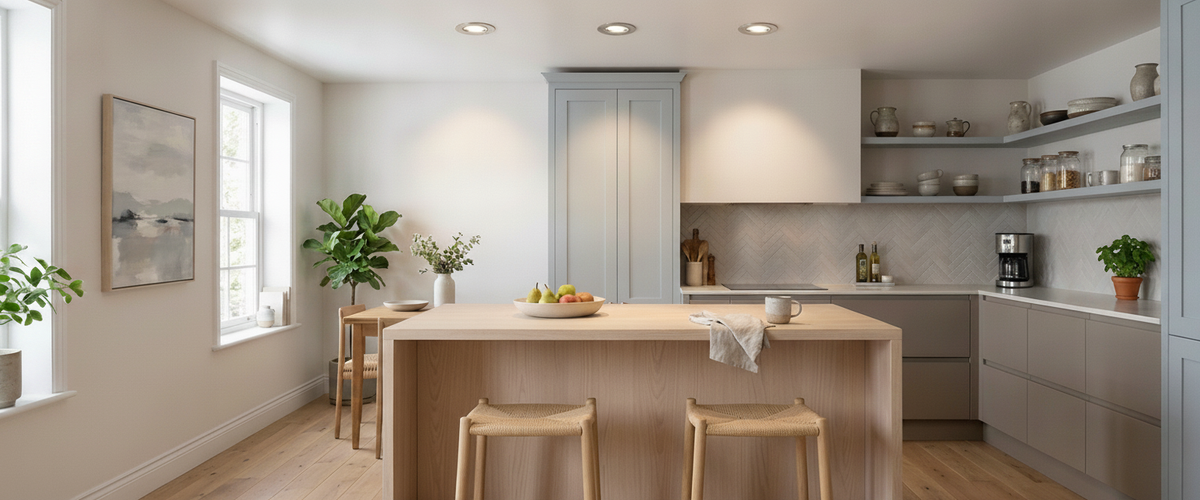

Walk into a newly finished kitchen and you can usually tell within a second whether the lighting was planned or panicked. The panicked version has one look: downlights led bulbs spaced like ceiling tiles, cool blue light flattening every surface, and skin that reads slightly grey under the beam. That flat, corporate feel comes from a handful of specific choices, and every one of them is fixable before the plasterer arrives.
Recessed spots are a tool, not a default. Used with restraint and paired with warmer light and softer fixtures, they disappear into the ceiling and do their job. Used as a grid, they announce themselves. This guide is for the buyer who wants the first outcome, and who wants their downlights led bulbs working with the room rather than against it.

Key Takeaways
Beam angle and placement matter more than the number of fittings; aim for pools of light, not a punishing grid.
Choose 2700K led bulbs with a high CRI (90 or above) to keep skin and timber warm.
Dimmable bulbs and dimmable systems are not the same thing; check compatibility before you buy.
Some rooms are better carried by a stone pendant or wall light than by recessed spots at all.
Fitting depth and IP ratings decide what fits where, and mains wiring is a job for a qualified electrician.

The Office-Ceiling Look, and the Bulb Choices That Cause It
Three habits create that showroom-for-photocopiers effect. First, cool colour temperature: 4000K and above reads clinical in a home. Second, evenly spaced fittings marching across the plaster with no relationship to what sits below. Third, cheap lamps with poor colour rendering that drain warmth out of wood, wool and skin.
The fix starts with the bulb. Most recessed fittings take a GU10 LED lamp, and the spec on the box tells you almost everything you need. When you compare downlights led bulbs on the shelf, look for the colour temperature in Kelvin, the CRI figure, the beam angle in degrees, and whether the bulb is genuinely dimmable. A room lit with warm, high-CRI led bulbs in the right spots feels considered before you touch anything else.

Beam Angle Over Spacing: Why Pools Beat a Punishing Grid
Beam angle is the width of the cone of light a bulb throws, and it does more to shape a room than spacing ever will. A narrow beam, roughly 24 to 38 degrees, gives you a defined pool that lands on a worktop, a table or an artwork. A wide beam, 60 degrees or more, washes a larger area with softer, flatter light and suits general fill.
The mistake buyers make is choosing one wide beam for the whole ceiling and spacing it out on a uniform grid. That gives you the airport-lounge wash. Instead, mix beam angles by task across your downlights led bulbs. Tighter beams over the island and the sink; a wider, gentler wash near seating; and gaps where you genuinely do not need light. Where the fitting uses an MR16 lamp and you want that broad, even fill rather than a hard spot, a wide-throw bulb such as the GU5.3 7W MR16 LED Spotlight Bulb 120 Degree is closer to the right design language for general wash. A ceiling with deliberate dark patches reads far more expensive than one lit corner to corner.
As a rough starting point, keep spots away from the very edge of the room so you are not scalloping the walls with harsh arcs, and think about what each fitting is actually lighting rather than how tidy the layout looks on paper. The best schemes look slightly irregular from below and completely intentional in use.
2700K and High CRI: Keeping Skin and Timber Warm Under the Beam
Colour temperature is where most home schemes go wrong. For living spaces, bedrooms and dining rooms, 2700K is the warm, candid glow that flatters people and materials. Kitchens can push to 3000K if you want a touch more crispness at the worktop, but rarely beyond. Anything cooler belongs in a garage or a surgery, which is why the color rating on your led bulbs is the first number to check.
Colour Rendering Index, or CRI, measures how faithfully a light source shows colour compared with daylight. A CRI of 90 or above keeps oak reading as oak and skin reading as healthy; drop to the low 80s and everything goes slightly muddy. The Lighting Research Center's work on colour rendering is a useful primer if you want to understand why two led bulbs of the same wattage can make a room feel completely different.
This is also where recessed spots and alabaster start to work together. Your downlights led bulbs handle task light; a warm, high-CRI stone fixture handles atmosphere. The 2700K glow through alabaster is soft and slightly golden because the stone diffuses and warms whatever passes through it, which is why we build so much of the alabaster lighting range around that colour temperature. Match your ceiling lamps to the pendant and the room reads as one scheme rather than two arguing systems.
Dimmable Bulbs Versus Dimmable Systems: The Compatibility Trap
Here is the trap that catches careful buyers. You can buy a dimmable lamp, wire it to a dimmable switch, and still get flicker, buzz or a narrow useless dimming range. The reason is that the bulb, its driver and the dimmer all have to be compatible with each other, not just individually labelled dimmable.
These led bulbs draw very little current, and many older dimmers were designed for the heavy load of halogen or incandescent bulbs. Below their minimum load, they misbehave. The result is a stutter at the bottom of the range, or a lamp that jumps from off to bright with nothing in between. The usual answer is a trailing-edge LED dimmer rated for low loads, paired with bulbs the dimmer manufacturer lists as tested.
Are all recessed lamps dimmable? No. Plenty are fixed-output only, and driving a non-dimmable bulb from a dimmer is a fast route to failure and flicker. Check the bulb spec, check the dimmer's compatibility list, and if you are running a large scheme of downlights led bulbs, ask the electrician to test one circuit before committing to the lot. It is far cheaper to change a dimmer once than to swap thirty led bulbs after the ceiling is closed.
When a Downlight Is Wrong and a Stone Pendant Carries the Room
Not every room wants recessed light. A led downlight excels at task and function; these fittings are poor at making a space feel warm and inhabited. Over a dining table, a single alabaster pendant does what a cluster of spots never will, throwing light down onto plates while glowing softly at eye level. In a bedroom, a pair of stone wall lights beside the bed beats four spots firing into your face when you lie back.
Where the fixture is a compact fitting with a small capsule socket rather than a full recessed spot, the choice of led bulbs is what keeps the glow soft; a low-wattage warm option such as the G4 Capsule LED Bulb 1.2W in Warm White gives the diffused pool that flatters a bedside stone lamp rather than the hard downward beam a ceiling spot produces.
One client had planned twelve ceiling spots across a sitting room. On our advice they cut it to four, used them purely to graze a stone fireplace and a bookcase, and let an onyx pendant and two alabaster table lamps do the living. The room went from meeting-room bright to genuinely restful, on fewer fittings and less wiring.
The principle is simple: use your downlights led bulbs for the jobs that need a beam, and let sculptural stone fixtures carry the mood. If you are weighing up where a pendant, chandelier, wall light or lamp earns its place, the full lighting collection is a useful way to see how the pieces work room by room before you lock in a ceiling full of spots.
Fitting Depth, IP Ratings and the Jobs Worth an Electrician
Before you buy a single fitting, check the space above the ceiling. Recessed spots need clearance for the fitting body and its driver, and shallow voids under a first floor or in a converted loft rule out deeper fixtures. Fire-rated versions, which maintain a floor's fire resistance where they pierce it, are commonly required and are worth specifying by default in ceilings between storeys.
IP ratings matter in wet areas. Bathrooms are divided into zones, and fittings over a shower or bath need a suitable rating, typically IP65, to keep moisture out. The UK guidance on bathroom zones and appropriate fittings is set out clearly by Electrical Safety First and is worth a read before you buy.
Mains wiring, fire-rated installation and bathroom zoning are not DIY territory. Use a qualified electrician for anything beyond swapping a like-for-like bulb. It protects the guarantee on your fittings and, more importantly, keeps the installation safe.
A Quick Buying Checklist
Colour temperature: 2700K for living and sleeping spaces, up to 3000K in kitchens.
CRI: 90 or above so materials and skin stay warm.
Beam angle: narrow for task pools, wide for gentle fill; mix by function.
Dimming: confirm the bulb, driver and dimmer are compatible, not just individually dimmable.
Fitting depth: measure the ceiling void before you choose a body for your led downlight fittings.
IP rating: IP65 over showers and baths; check the zone.
Fire rating: specify fire-rated fittings between storeys.
Balance: pair recessed spots with a stone pendant, wall lights or lamps so the room has warmth as well as function.
Get the spec on your downlights led bulbs right, place fewer fittings with more intent, and let alabaster and natural stone do the softening. That combination is the difference between a ceiling that looks like a plan and a room that feels like a home.