
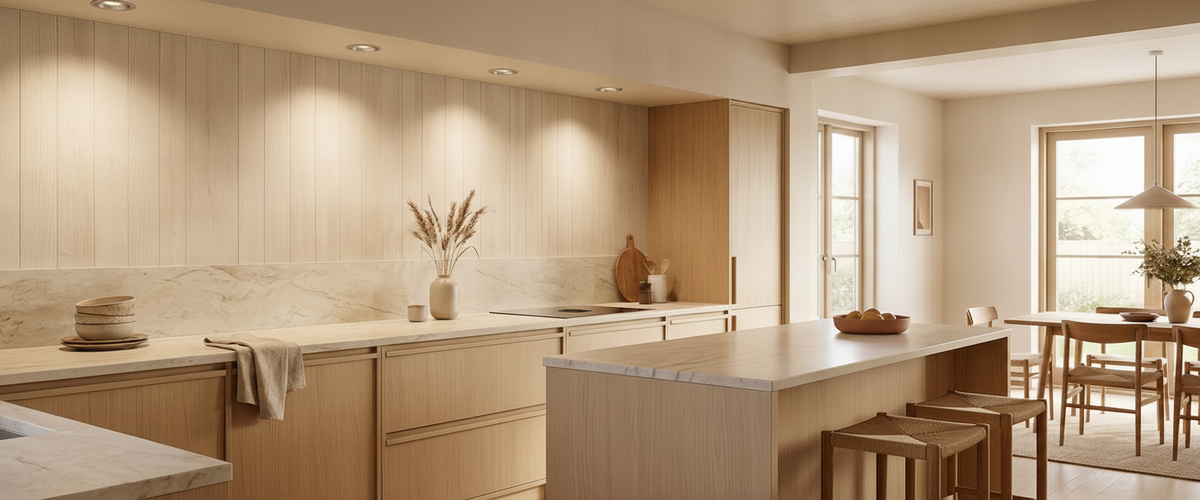

Walk into a new-build kitchen and count the little discs punched across the ceiling in a tidy grid. That is the giveaway. A single downlights is a useful tool, but a ceiling covered in identical ones spaced by rote produces the airport-terminal look: bright, flat, and strangely joyless. The light lands on the floor and skips everything you actually want to see. At Niori, where we spend most of our days on alabaster and natural-stone fixtures, the questions we get about recessed lighting almost always come down to the same thing. People do not hate downlights. They hate what happens when downlights are the whole plan.
Good recessed lighting is quiet, deliberate, and blended with other layers. Get the beam angle, spacing and colour temperature right, then let a pendant or a pair of alabaster wall lights carry the mood, and a room reads as considered rather than commercial.

Key Takeaways
- Spacing by feel, not by grid. Even spacing lights the floor; targeted placement lights walls, worktops and art.
- Beam angle matters more than wattage. Narrow beams for accent, wider beams for general wash.
- Warm and dimmable wins. Aim for around 2700K in living spaces and always dim.
- Recessed fittings are a layer, not the whole scheme. Pendants, wall lights and table lamps add the depth cans cannot.
- Under-cabinet light is a separate job. Keep it off the main ceiling circuit and hide the source.

The Airport-Ceiling Effect and Why Even Spacing Flattens a Room
When a grid of recessed spots is drawn purely for symmetry, every fixture does the same job: throw a cone straight down. The result is uniform brightness with no shadow, and shadow is what gives a room shape. Faces look tired, worktops glare, and the corners fall dark because nothing is aimed at the walls. It is the lighting equivalent of a room painted a single flat grey.
The fix starts with intention. Before you mark a single cut-out, decide what each light is for. Is it washing a wall, grazing a stone splashback, lighting a prep zone, or filling a walkway? A recessed downlight aimed at a wall a foot or so out from the skirting will bounce soft light back into the room and make the whole space feel taller. Where you want to angle the beam toward a wall or a feature rather than straight down, an adjustable fitting such as the Play Adjustable Recessed Downlight 7W 4000K earns its place, because you can tilt it instead of relying on position alone. That single change does more than adding four more cans to the middle of the ceiling ever will.

Beam Angle and Spacing That Light the Space, Not Just the Carpet
Beam angle is the number people skip and then regret. A narrow beam (roughly 24 degrees) concentrates light and works for accenting a picture, a plant, or a run of natural stone. A wide beam (around 60 degrees) spreads a gentle wash and suits general room fill. Mixing the two in one ceiling is normal and desirable; a scheme with only one beam angle is usually the flat one.
For spacing, a rough working rule is to take the ceiling height in feet, halve it, and use that figure as a starting distance in feet between fixtures. An 8-foot (2.4 m) ceiling suggests roughly 4 feet (1.2 m) between each downlight as a baseline, then you adjust for the task. Pull them closer over a worktop, spread them out in a lounge, and keep them off the exact centre lines that create that grid effect. The Chartered Institution of Building Services Engineers (CIBSE) publishes lighting guidance that professional designers use to set illuminance levels room by room, and it is a sensible sanity check if you want numbers behind your instinct.
The Rooms Where a Pendant Simply Outperforms Recessed Cans
Some spaces are not asking for spotlights at all. Over a dining table, a pendant does something a recessed fitting cannot: it draws people to a centre and creates a pool of warmth that says sit here. Try to light a dining table with ceiling cans and you get shadowed faces and a spotlit tablecloth. A single alabaster pendant, with its stone diffusing the source into a soft, even glow, is worth more than six recessed spots around it.
The same logic applies to entrance halls, stairwells, and any room with a focal point. Alabaster and onyx have a translucency that turns a hard bulb into gentle, honey-toned light, which is exactly what a recessed fitting cannot do because its whole job is to hide the source and point it down. If you are weighing where a feature fixture earns its place, browse the range at alabaster lighting and think in terms of one hero piece per key space, supported by discreet recessed light around it.
Layering Downlights With Wall and Table Light for Real Depth
Depth comes from lighting at different heights. Recessed fittings sit at ceiling level, so on their own they give you one plane of light. Add a pair of alabaster wall lights at roughly eye level and a table lamp lower down, and suddenly the room has three tiers of glow that catch the eye at different points. This is the trick behind interiors that feel expensive without looking bright.
A client fitting out a London townhouse sitting room came to us convinced they needed a dozen more ceiling lights. We halved the count, aimed the survivors at the chimney breast and a bookcase, then added stone wall lights either side of the fireplace and two table lamps. The room used less total wattage and read far warmer. If you want to see how feature and functional pieces sit together, the full lighting collection is a good place to picture the layers side by side.
Warm Dimmable Output Versus the Cold Clinical Wash
Colour temperature is where good rooms go wrong. Many stock fittings ship at 4000K, a crisp neutral white that suits an office or a clinical space and drains the warmth out of a living room. For lounges, bedrooms and dining rooms, aim for around 2700K. Kitchens can sit slightly higher, near 3000K, for a cleaner working light, but rarely need the cold end.
Dimming is non-negotiable in a home. Full-brightness ceiling spots are for finding a dropped earring, not for an evening. Choose downlights with LED bulbs or integrated LED modules rated as dimmable, and pair them with a compatible trailing-edge dimmer to avoid flicker and buzz. If you want app control and scene-setting, a smart system such as a philips hue downlights lets you shift brightness and warmth without a wall dimmer, which is genuinely useful in open-plan spaces where one circuit covers cooking, eating and relaxing. The advantage of a Philips Hue fitting is that it recreates several colour temperatures from a single unit, so you are not locked into one white forever. Whatever you choose, have the wiring done by a qualified electrician; recessed fittings involve mains work and often fire-rated housings.
Task and Under-Cabinet Placement Without Glare and Hot Spots
Kitchen lighting fails most often at the worktop. Ceiling spots sit behind you as you stand at the counter, so your own body casts a shadow onto the exact surface you are trying to light. That is why kitchen under cabinet downlights or LED strips matter: they put light where the hands are, with no shadow and no glare bouncing off a glossy splashback. Over a larger prep zone or island, a higher-output fitting such as the Play Adjustable Recessed Downlight 13W 4000K gives you enough working light while still letting you angle it away from a reflective surface.
Mount under-cabinet light toward the front edge of the wall units, not the back, so the beam falls on the worktop rather than the tiles. Use a diffused source or a recessed channel to kill hot spots; a bare LED reflected in a polished stone surface is harsh. Keep this on its own switch so you can run just the task light for a late-night glass of water without flooding the room. For pantries and display shelves, warm low-output light shows off natural stone and glassware far better than a single bright disc overhead.
Quick Downlight Planning Checklist
- Decide the job of each fixture before marking cut-outs.
- Mix beam angles: narrow for accent, wide for general fill.
- Aim some fittings at walls to add height and remove dark corners.
- Choose a warm (around 2700K) dimmable downlight for living spaces.
- Keep under-cabinet and task light on separate switching.
- Reserve the drama for a pendant or alabaster wall light, not the cans.
- Book a qualified electrician for the install and fire-rating.
A recessed downlight earns its place when it disappears into the background and lets the room, and a well-chosen feature light, do the talking. Plan the layout around what you want to see rather than a neat grid, keep the output warm and dimmable, and let alabaster and natural stone carry the character overhead.