
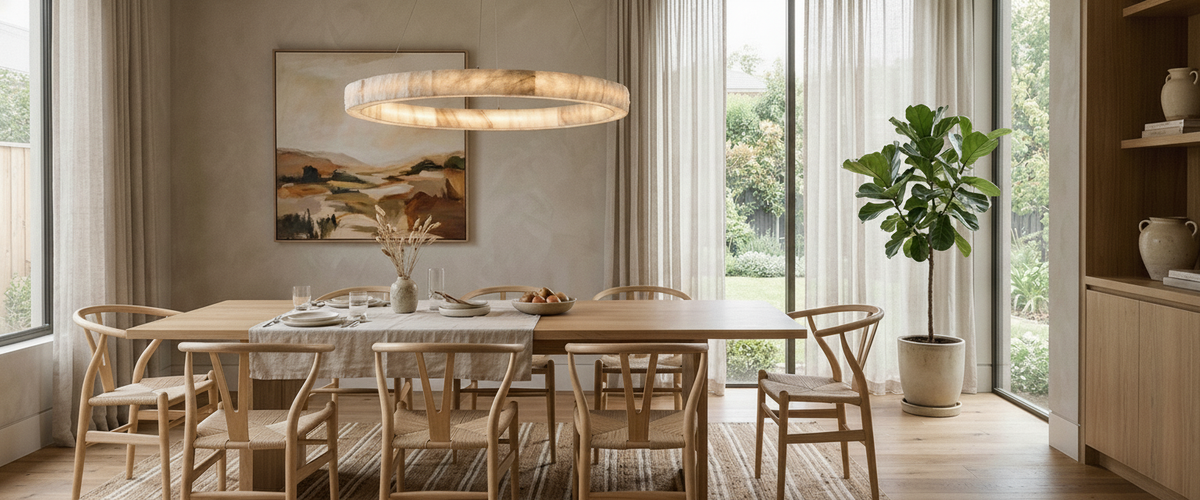

Dining room chandeliers with crystals do one thing better than almost any other fixture: they take a single filament and scatter it into a hundred bright points across a table. If you are choosing between sparkle and softer warmth, the short answer is this: crystal scatters light into sharp, theatrical reflections, while alabaster and natural stone diffuse it into an even, honeyed glow. Size the fixture to the tabletop, hang it 30 to 36 inches above the surface, and match its shape to the table. That is the whole decision in one breath, and the rest of this guide explains how to get each part right.

Key Takeaways Before You Buy
- Crystal scatters, stone softens. Cut crystal throws sharp reflections; alabaster and marble diffuse light into an even, warm glow.
- Size to the tabletop, not the room. Aim for a fixture roughly one half to two thirds the width of the table.
- Hang height matters more than most people think. Around 30 to 36 inches (76 to 91 cm) above the tabletop keeps light useful and sightlines clear.
- Shape follows the table. Linear over a long rectangular table; round or square over a square one.
- Dimming behaves differently by material. Crystal keeps some sparkle at low levels; stone holds a warm, steady wash.

What Crystal Scatters and What Stone Quietly Softens
Faceted crystal is built to refract. Each cut face bends and bounces light, so a crystal chandelier reads as movement and brilliance, especially against a dark ceiling or over a polished table. It is theatrical in the best sense. The trade-off is that raw crystal sparkle can feel cool and busy if the room has nothing to balance it.
Alabaster and natural stone work the opposite way. Instead of throwing light out in points, they let it pass through the material itself, so the fixture appears lit from within. Alabaster is naturally translucent; light travels through it and carries the stone's veining with it, which is why the glow reads as amber and honeyed rather than white. If you want a contrast to a crystal-heavy scheme, a stone pendant or chandelier gives you calm where crystal gives you drama. Our full range of alabaster lighting shows how that diffused warmth behaves across different fixture types.
One approach we recommend often: if a room already has a formal crystal chandelier you want to keep, do not remove it. Flank it with softer stone light nearby, so the crystal becomes a centrepiece rather than the only voice in the room. That balance is frequently the smartest brief.

Sizing to the Tabletop, Not the Square Footage of the Room
The most common sizing mistake is scaling a dining room chandeliers to the whole room and ending up with something that dwarfs the table. The table is the anchor, not the walls. A dependable rule: the fixture should measure roughly one half to two thirds the width of the tabletop.
So a table that is 40 inches (about 102 cm) wide suits a fixture around 20 to 26 inches (51 to 66 cm) across. A generous 48-inch (122 cm) round table can carry something closer to 30 inches (76 cm). Go wider than the table and guests knock elbows against a piece that overreaches; go too narrow and the fixture floats like an afterthought.
Length is a separate question for rectangular tables, which is exactly why linear chandeliers exist. Rather than one round burst of light, a linear chandelier for a dining room stretches the illumination along the table's axis, covering the full run of place settings. For a modern dining room chandelier over a six or eight seater, a linear form almost always reads better than a single round cluster; a compact five-light piece such as the Cosmic 5 Light Glass Crystal Linear Chandelier suits smaller runs, while a longer table calls for something scaled up like the Suria 8 Light LED Crystal Linear Chandelier.
Hang Height That Keeps Sparkle Out of Your Guests' Eyes
Ask how high above a dining room table a chandelier should sit and you will get a range, but the working answer is consistent. Hang the bottom of the fixture about 30 to 36 inches (76 to 91 cm) above the tabletop. That gives clear light on the food, keeps bare bulbs and bright crystal out of seated sightlines, and leaves the table surface visually open.
Two adjustments are worth making. If your ceilings are higher than the standard 8 feet (2.4 m), add roughly 3 inches (about 8 cm) of drop for every extra foot of ceiling height, so the fixture still relates to the table. And with a crystal chandelier specifically, err slightly higher rather than lower, because faceted crystal at eye level puts sharp reflections straight into your guests' faces mid-conversation. Stone is more forgiving here; its glow is soft enough to sit a touch lower without glare.
Always confirm the final mounting with a qualified electrician, particularly for heavier crystal or stone fixtures that need proper ceiling support. Weight is not a detail to guess at.
Linear Over a Long Table, Round Over a Square One
Shape is where a lot of otherwise good buys go wrong. Match the geometry of the fixture to the geometry of the table and the room reads as considered.
- Long rectangular table: a linear chandelier or a run of pendants distributes light evenly end to end. A single round fixture over a long table leaves the ends dim.
- Square or round table: a round or square chandelier centres cleanly and lights all seats equally.
- Very long farmhouse or banquet table: consider two matched fixtures spaced evenly rather than one enormous piece that overwhelms the ceiling.
Crystal linear designs handle this well because the facets keep the light lively across the whole length. Where a grand rectangular table can carry real presence, a densely dressed piece like the Wisteria 16 Light Crystal Linear Chandelier in French Gold holds the full span without looking sparse. If you prefer restraint, an alabaster linear pendant does the same job with a continuous warm wash instead of points of sparkle. You can compare both approaches across the wider niori lighting collection to see how form changes the feel of the same table.
Dimming Through the Courses: How Crystal and Stone Each Hold a Low Glow
Dinner is not one lighting scene. It is several. Bright and social for the first course, low and intimate by dessert. A dimmer is the single most valuable thing you can add to any dining room table chandeliers, and the two materials respond to it differently.
Crystal keeps a surprising amount of character at low levels because even a dim source still refracts across the facets, so you retain little glints of sparkle when everything else has dropped away. Alabaster and stone behave more like a hearth: as you dim, the whole piece settles into a steady amber glow that reads warmer the lower you go. Neither is better; they simply set different moods.
Use warm-toned LED bulbs in the 2700K range for dining, and check that both the bulbs and driver are marked dimmable. The Chartered Institution of Building Services Engineers offers useful guidance on lighting levels and comfort for occupied rooms, which is worth a look if you are lighting a larger scheme (cibse.org). For a full crystal fixture with many lamps, confirm the total load works with your chosen dimmer to avoid flicker.
Deciding Between Showpiece Sparkle and Understated Warmth
Here is the honest buyer's decision. Choose crystal when you want the fixture to be the event: formal dining, high ceilings, darker walls, a room that dresses up. Choose alabaster or natural stone when you want the light to serve the room rather than compete with it, and when warmth and texture matter more than glitter. Among the many chandeliers for dining room schemes we ship, this is the fork most clients pause at.
Some questions that make the choice clearer:
- Is this room mostly used at night, dressed and social, or day to day and relaxed?
- Does the existing palette already have shine (mirror, glass, metal), in which case stone may balance it better?
- Do you want the fixture to read differently when lit versus unlit? Stone glows from within when on and reads as a sculptural object when off; crystal always reads as ornament.
- How much cleaning are you willing to do? Faceted crystal collects dust across every facet; a smooth alabaster shade wipes clean quickly.
On care: dust crystal gently with a soft dry cloth and clean facets occasionally with a barely damp lint-free cloth, drops removed and dried if the piece is heavily soiled. Alabaster is porous and should never be soaked or cleaned with harsh chemicals; a dry or very slightly damp soft cloth is all it needs, as the Natural Stone Institute notes for calcite-based stones (naturalstoneinstitute.org). Treated well, both materials outlast the trends that surround them.
Whichever way you lean, Niori works across both languages: crystal for sparkle, alabaster and natural stone for a quieter, warmer glow. The best dining rooms often borrow from each. Start with the table, size and hang correctly, then decide whether you want your guests looking up at brilliance or sitting inside warmth.