
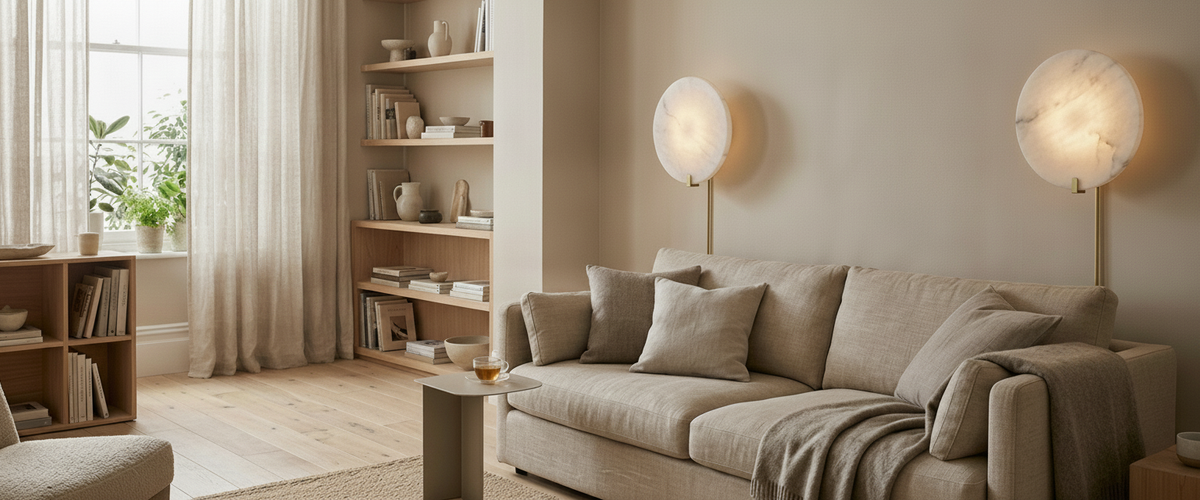

The same sconce that looks bold at the end of a hallway can look timid over a sofa, and the fixture rarely changes; the wall around it does. That gap is where most people go wrong with designer wall lights. Buyers spend weeks choosing a beautiful alabaster shade, then bolt it at whatever height the old fitting left behind, and wonder why the room feels slightly off. Placement is the quiet half of good wall light design, and it is the half we spend most of our time correcting on client projects.
This guide is about getting that half right. We work in alabaster and natural stone at Niori, so the advice leans toward materials that glow rather than glare, but the geometry holds for any sconce you love. Choose your designer wall lights for the wall they will actually sit on, not the one in the showroom photo.

Key Takeaways
Mounting height changes the entire mood; roughly 60 to 66 inches (152 to 168 cm) to centre is a safe default, but sightlines beat rules.
Beam direction (uplight, downlight, or wash) does more to reshape a wall than the fixture's shape.
Alabaster and onyx soften output, so they suit rooms where you sit close and linger.
Contrast between the light and its backdrop is what makes designer wall lights look deliberate.
Pair every wall light with a dimmer and a warm bulb around 2700K.

Why the Same Sconce Feels Bold in a Hallway and Shy in a Lounge
A hallway is a corridor of glances. You pass through it, and a wall light gets read quickly, in motion, against a tight width. Even a modest sconce carries weight there because it has nothing competing for attention. Drop that identical fixture into a wide lounge with a big sofa, a coffee table, and a run of shelving, and it shrinks. The room has more visual mass, so the light needs more presence or more repetition to hold its own.
Settle this before you buy: is the wall a passage or a place to sit? Passages reward a single confident piece. Rooms where people gather usually want a pair, or a fixture with real scale, because a lone small sconce reads as an afterthought. Our alabaster designer wall lights tend to do well in pairs precisely because symmetry gives them the presence a single unit lacks in a larger space. You can see the range of forms across our alabaster lighting collection and gauge which ones carry a wall on their own.

Mounting Height and Sightlines: The Numbers People Always Get Wrong
The default that serves most rooms is a centre height of about 60 to 66 inches (152 to 168 cm) from the finished floor. That puts the brightest part of the fixture near eye level for a standing adult, which suits hallways and general-purpose walls. It is a starting point, not a law, and it applies whether your designer wall lights are compact or oversized.
Two situations break the default. First, sconces flanking a bed or a sofa should sit lower, because your eye level when seated or lying down is far below standing height; aim the fixture to light the task (a book, a face) rather than the ceiling. Second, a light beside a mirror wants to sit at roughly face height, around 64 to 66 inches (163 to 168 cm), so it casts light across the face rather than down onto it and carving shadows under the eyes.
The number people get most wrong is spacing on a bathroom mirror. Two sconces set too close pinch the reflection; set them at least 28 to 36 inches (71 to 91 cm) apart so the light wraps the face evenly. And always check the sightline from where people actually stand. If a seated guest looks straight into a bare bulb, no height chart will save you. Alabaster earns its keep here because the stone diffuses the source, so even at eye level you get glow rather than glare.
Living Room, Bedroom, Bathroom, Stair: Where Each Wall Light Earns Its Keep
Each room asks a different question, and the answer shapes the fixture you choose. Good designer wall lights read the room before they read the wall.
Living room. Here designer wall lights is mood, not task. Mount a pair either side of a fireplace or a piece of art and let them wash the wall softly. Alabaster and onyx shine in this role because you sit close for long stretches, and a hard downlight would fatigue the eye. Keep them on a dimmer and treat them as the low, warm layer beneath your main pendant.
Bedroom. Swing-arm or fixed reading sconces beside the bed free up the nightstand and give each sleeper independent control. Position them so the light falls onto the page, not into the eyes of the person opposite. A stone shade keeps the late-night glow gentle enough not to jolt anyone awake, which is why alabaster designer wall lights suit a bedroom so well.
Bathroom. This is the one room where flattering, even light matters most, and it needs the right ingress protection rating for its zone. Vertical designer wall sconces lighting the mirror from each side beat a single fitting above it, and any fixture in a splash zone should be specified to the correct IP rating and installed by a qualified electrician. UK bathroom zones and the fittings suited to them are set out in official electrical safety guidance from Electrical Safety First.
Stairwell. Stagger the fixtures to follow the rise rather than lining them up at one height, so each pool of light lands where a foot will fall. A stairwell is also a place where a sculptural natural-stone piece gets seen from multiple angles, so choose a form that reads well in the round. Where the run carries outdoors onto steps or an entrance, a sealed fitting rated for the weather matters more than the form; something like the Outdoor Wall Light E27 IP44 15W Max in Black holds up in an exposed zone where an indoor sconce would fail.
Uplight, Downlight, or Wash: How Beam Direction Rewrites a Wall
Fixture shape gets the attention, but beam direction does the heavy lifting. The same wall behaves like three different surfaces depending on where the light goes, so the beam matters as much as the form when you pick designer wall lights.
Uplight throws a cone toward the ceiling and makes a room feel taller and calmer. It hides texture and lifts the eye, which is why it suits lounges and bedrooms where you want softness. Downlight pulls attention toward the floor and grazes anything below it, so it works over a console or beside a stair tread where you need to see. Wall wash spreads an even sheet of light across the surface and is the most flattering treatment for art, texture, or a beautiful plaster finish.
Good light design for a wall depends on rhythm: set the fixture a consistent distance out from the surface and keep the spacing between units regular, so the pools overlap into one continuous field rather than a row of hot spots. On an outdoor run where you want a taller, elongated wash, a longer body such as the Outdoor Wall Light E27 IP44 500mm in Brown stretches the glow further than a compact fitting can. Alabaster sconces do a version of this naturally: because the stone itself glows, a wall-mounted piece washes the surface around it with a soft halo before any beam even reaches the plaster. That built-in diffusion is the reason natural-stone fixtures forgive imperfect walls that a crisp downlight would expose.
Backdrop and Contrast That Make a Designer Piece Look Intentional
A beautiful fixture against the wrong backdrop looks like it wandered in by accident. It needs something to push against. A pale carved alabaster sconce disappears on a bright white wall and comes alive against a deep clay, forest, or charcoal paint. A veined stone piece wants a plainer ground so the pattern reads. Get the contrast right and the same lamp suddenly looks chosen, and designer wall lights start to look deliberate rather than default.
Texture behind the light matters too. Limewash, tadelakt, or a matte deep colour absorbs and returns the glow beautifully; high-gloss surfaces bounce it back as a distracting reflection. When we specify a wall light lamp design for a project, we treat the paint colour behind it as part of the fixture selection, not a separate decision. If you are still comparing forms and finishes, browse the broader lighting collection to see how different pieces read against light versus dark grounds.
Placement Mistakes We Keep Fixing in Client Projects
A few errors turn up again and again, and all of them are cheap to avoid before installation. Get past them and designer wall lights repay the effort.
Mounting to the old fitting's height. The previous owner's electrician chose that box, not a lighting designer. Reassess from scratch.
One lonely sconce on a wide wall. Pairs and symmetry almost always look more considered in a large room.
No dimmer. A fixed-output fixture has one mood. Put it on a compatible dimmer and it earns its place at every hour.
Cool bulbs behind warm stone. A 4000K bulb turns honeyed alabaster grey and lifeless. Stay around 2700K.
Ignoring the seated sightline. We once shipped a beautiful pair to a client who mounted them perfectly by the chart, then found every dinner guest stared into the source because the dining chairs sat lower than expected. Two inches down solved it. Always test from the chair.
Get the height, the backdrop, and the beam direction right, and a well-chosen sconce stops being a fitting on a wall and becomes the reason the room feels finished. That is the whole job of designer wall lights, and none of it happens by accident.