
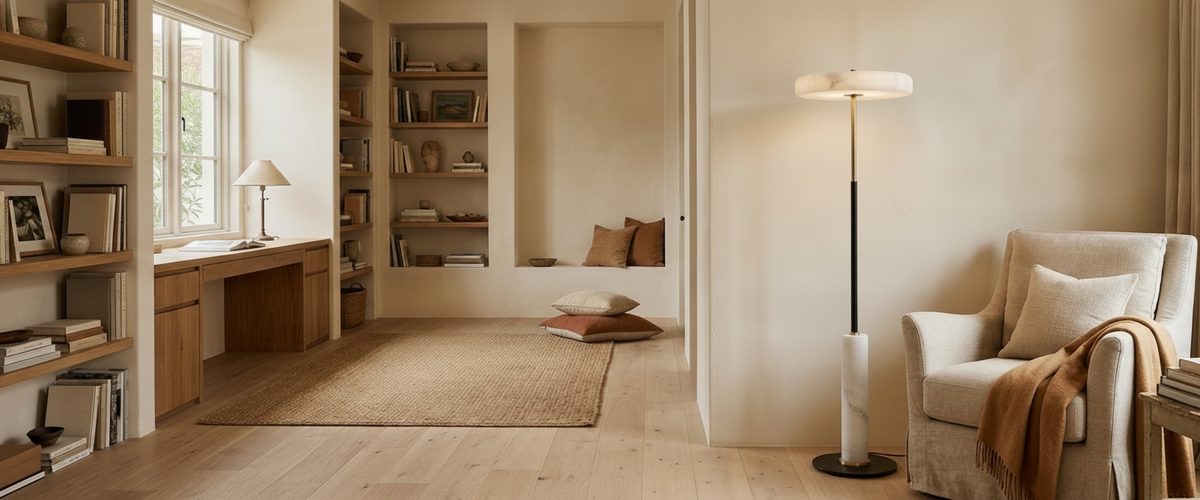

A floor lamp gives itself away the moment you touch it. The switch has a weight to it or it rattles. The stem meets the base with a clean shadow line or a wobble. Designer floor lamps earn their name in exactly these small moments, and once you know where to look, the decorative pretenders are easy to spot. This guide is for buyers and interior designers who want a lamp that reads well from across the room and still feels right up close.
At Niori we build in alabaster and natural stone, so we care about how a fixture handles light as much as how it looks switched off. That combination, the material and the glow, is where a lot of the money quietly goes on designer floor lamps.
A translucent stone shaft anchors a corner and lifts the whole room.

Key Takeaways
Quality lives in the joints. Look at how stem, base, and shade housing meet before you look at the silhouette.
Alabaster and stone diffuse light differently to glass. The glow is warmer and less uniform, with visible veining.
Proportion holds a corner. A strong lamp anchors the space; a weak one drifts.
Bulb and dimming matter as much as the fixture. Warm color temperature and a smooth dim make or break the effect.
Budget depends on material, scale, engineering, and finishing, so ask for a tailored quote rather than trusting a headline figure.

Where the Money Goes in Designer Floor Lamps
The difference between a designer standing lamp and a decorative one is rarely the shape. Both can look identical in a catalogue render. The difference is what you cannot photograph: the density of the base, the tolerance where parts meet, the quality of the wiring, and whether the material was chosen for how it behaves rather than how it costs. That is what separates true designer floor lamps from the copies.
Solid stone and metal cost more to machine, more to finish, and more to ship because they are heavy. A cast base that weighs enough to keep a tall lamp from tipping is not an accident; it is engineered. When you compare floor lamps designs side by side, the cheaper one usually saves weight, and weight is stability. We have shipped alabaster fixtures to clients who assumed the crate was mislabelled because a single piece arrived heavier than they expected. That heft is the point, and it is one reason designer floor lamps carry the price they do.
You can browse how these choices play out across our range on the alabaster lighting collection, where the material does most of the talking.

Stone, Metalwork, and Joinery Cues That Reveal Real Quality
Run your eye down a lamp the way a joiner would. Here is what tells the truth about designer floor lamps.
The Stone
Alabaster and onyx are translucent, so light passes through the material itself rather than only escaping around a shade. Each panel carries its own veining, which means no two pieces are ever identical. On a good one the veining reads as a feature, evenly lit and legible. On a poor one it looks muddy because the stone was cut thick to hide flaws. A tall alabaster shaft such as the Vellum LED Alabaster Column Floor Lamp shows how thickness and cut let the stone glow evenly rather than block the light. Marble, being denser, tends to appear in bases and collars rather than the light-emitting parts. The Natural Stone Institute has useful background on how these stones vary in translucency and hardness, which is worth reading before you commit to a material.
The Metalwork
Brass and bronze detailing should feel solid and warm, not hollow and cold. Look at the finish under a lamp: brushed brass hides fingerprints better than polished; polished chrome shows every mark but throws crisp highlights. Where a room needs warmth without the maintenance of a polished surface, a brushed-brass foot like the one on the Linea LED Alabaster Floor Lamp is closer to the right design language. Check the joints where the metal meets the stone. A tight, consistent seam suggests hand-finishing. A gap you could slide a card into suggests a rushed build, and it is exactly the tell that separates real designer floor lamps from lookalikes.
The seam where brass meets stone reveals whether a lamp was hand-finished or rushed.
The Joinery and Wiring
Lift the shade housing if you can. Cabling should be tidy and secured, not left to swing. A quality switch or dimmer feels deliberate. For any hard-wired or unusual fitting, always have a qualified electrician confirm the installation; guidance from Electrical Safety First is a sensible reference point for what safe practice looks like.
Proportion and Stance: How a Strong Design Holds a Corner
A floor lamp has a job most people forget: it fills vertical space. Get the proportion wrong and even a beautiful piece looks stranded. Most standing lamps sit somewhere around 1.5 to 1.8 meters (5 to 6 ft) tall, and that height wants a base broad enough to look planted. The best designer floor lamps get this balance right on the first look.
A column design, like an alabaster shaft rising from a brass foot, reads as architecture and suits a room with clean lines. A round or square diffuser on a slim stem reads softer and works next to a sofa where you want a pool of light rather than a monument. For a seating zone that needs a calm, contained glow rather than a vertical statement, a lower diffused head such as the Essence Round Floor Lamp sits more comfortably beside an armchair. This is where a floor lamp designer thinks about stance the way you would think about a chair: does it look like it belongs where it stands, or like it wandered in?
Corner placement is where designer floor lamps really pay off. A tall column in a dim corner does two things at once, adding light and giving the eye a vertical anchor so the room feels taller. In an open-plan space, use one to mark the edge of a seating zone without a wall.
Light Quality: Shade, Diffusion, and the Right Warm Bulb
This is where alabaster leaves glass behind. Opal glass gives an even, milky diffusion; it is clean and predictable. Alabaster glows unevenly on purpose, brighter where the stone is thinner, softer where it thickens, so the light has depth and movement. It looks lit from within because, effectively, it is. Good floor lamp designs treat that glow as the whole point.
To get that glow right, the bulb matters as much as the fixture:
Color temperature: stay warm, around 2700K, so the stone reads honey-toned rather than clinical.
Dimming: pair the lamp with a compatible dimmer. Alabaster is at its best at lower levels in the evening, where the veining comes forward.
LED integration: many standing lamps now use integrated LED modules rated for long life, which removes the fiddle of replacing bulbs behind a fixed shade. Check the module can be serviced if it ever fails.
Glare: a translucent stone shade softens the source, so you rarely get the hot spot a bare bulb throws.
A common buyer mistake is choosing a cool, bright bulb to "show off" the stone. It does the opposite; it flattens the color and kills the warmth that made you want alabaster in the first place. Even the best designer floor lamps cannot survive the wrong bulb.
Statement or Competition: Where a Designer Piece Belongs
One strong floor lamp beats two competing ones. The most common error we see in client rooms is doubling up on statement lighting until nothing wins. Decide what the lamp is for.
As a statement, place it where it has room: a reading corner in a large sitting room, the turn of a staircase, the empty flank of a fireplace. Give it space so the silhouette reads. This is where designer floor lamps earn their keep.
As working light, keep it modest and close to the task. Beside an armchair, a floor lamp with a directional or diffused head earns its keep every evening without shouting. It is worth noting that mass-market ranges like ballard designs floor lamps lean toward this quieter working role rather than sculpture.
In hospitality settings, a pair can work, but only when they are identical and framing something symmetrical, such as either side of a lobby console. Otherwise, let one lamp lead. If you want to see how these pieces sit within a wider scheme of pendants and wall lights, the full lighting collection shows how they relate.
Before You Commit: Questions Worth Asking on a Quote
Designer floor lamps bought online can be a real value if you know what you are paying for. Affordability is less about a low sticker and more about whether the build justifies the cost. Ask these before you buy:
Is the stone solid or a veneer? Solid alabaster glows differently and lasts differently.
What is the base weight and footprint? This tells you whether it will stand steady on a rug or a hard floor.
Is the LED integrated or replaceable, and what is its rated life?
What dimming systems is it compatible with?
How is it packed and shipped? Stone is heavy and brittle; crating matters for worldwide delivery.
What does the finishing add? Hand-brushed brass and hand-cut stone take time, and time is where cost sits.
If a seller cannot answer these clearly, that is your answer. A specialist in designer floor lamps should talk about material, engineering, and installation without flinching, and should quote for your exact piece rather than quoting a vague band. When you are comparing options, start from the material and the light, then work back to the shape. That is the order that keeps you from paying designer money for a decorative object.
Niori builds around alabaster and natural stone precisely because the material carries the design. Get the stone, the stance, and the bulb right, and the best designer floor lamps do the rest.